Who Should Take Care of the Children?
Capitalism is creating a crisis of care by treating childcare as a private burden instead of a collective responsibility. Parents and educators are trapped in a system demanding ever more labor while undermining the institutions sustaining social reproduction.
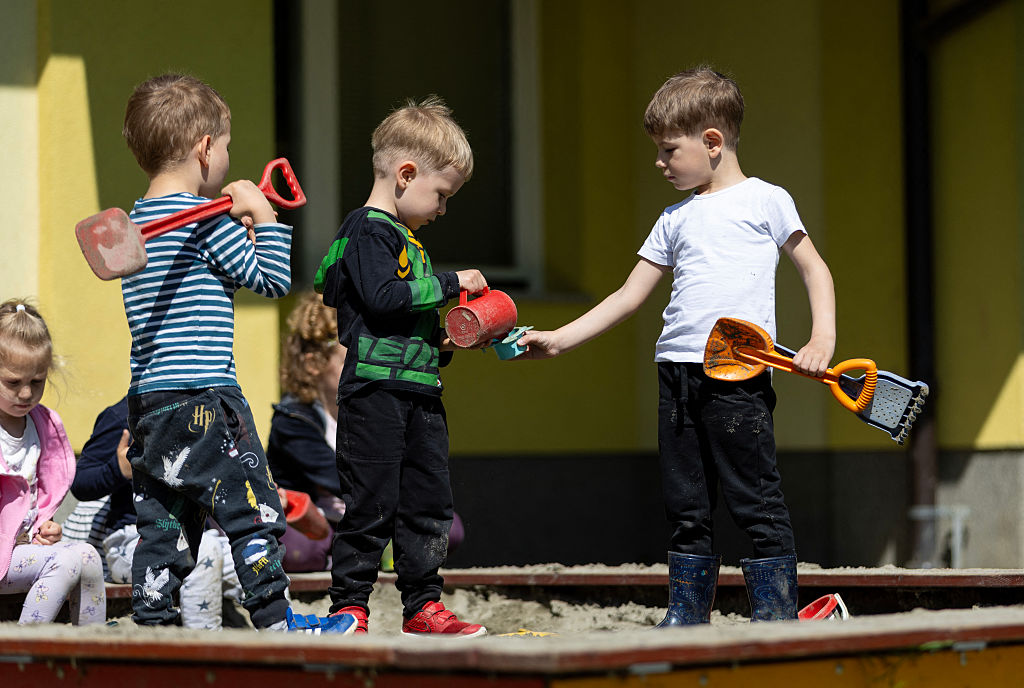
The conflict around childcare in Sweden has increasingly been framed horizontally: as a conflict between parents and preschool staff. (Damir Sencar / AFP via Getty Images)
In Sweden, few institutions are as ideologically celebrated as preschool. For decades, Swedish childcare has been held up as proof that gender equality and a strong welfare state can coexist with high labor-force participation. Universal childcare, one of the many progressive family reforms that were introduced during the social democratic Prime Minister Olof Palme, enabled women’s mass entry into the paid workforce while simultaneously promising children professional care and early education regardless of class background.
Preschool was not supposed to be mere storage for children while parents worked. It was to be pedagogical, developmental, and emancipatory for children. The transformation was linguistic as much as institutional. “Daycare” became “preschool.” Staff became educators. National curricula were introduced. Childcare was reframed as a social right and an educational project rather than a private family responsibility.
The expansion of Swedish childcare rested on a broader social democratic promise: care work would no longer fall entirely on individual families, and women would be less economically dependent within the household. Children’s upbringing would no longer hinge entirely on the unequal resources available to their parents. The system was made materially accessible through heavily subsidized fees and universal provision.
Having your children in preschool should not, according to these policies, be a luxury. Sweden’s “maximum fee” system imposes a national cap on preschool and after-school childcare fees, limiting how much municipalities can charge households based on income and number of children. Because the system is heavily tax-subsidized, parents pay only a fraction of the actual cost of care.
From Care to Social Discipline
While preschool attendance has never been legally mandatory in Sweden, enrollment rates are very high. Approximately 86 percent of children in Sweden between the ages of one and five, and up to 90 percent of those between three and five, attend preschool. Abstaining from preschool has increasingly come to appear socially deviant, associated with “maladjusted” communities. Sweden’s right-wing bloc has recently proposed compulsory preschool from the age of three, framing it as a necessary instrument for the socialization of children — especially those drawn from populations considered insufficiently assimilated into the Swedish way of life. Here preschool is seen as central for the integration of children in non-Swedish speaking communities.
The proposal met plenty of critique from the opposition but also from educators themselves. They argued that, given the current state of Sweden’s preschools, children risk harm and that the home — up to a certain age — is a much better place for children. Under present conditions, they are partly right. The institutions carrying the promise of equal and liberatory care have been systematically hollowed out. Over the last decades, Sweden’s welfare state has undergone the same pressures visible across much of the West: austerity, privatization, managerialism, and chronic understaffing. Preschool workers describe impossible workloads, growing group sizes, and a constant inability to provide the care and educational environment they are officially tasked with delivering.
This contradiction was made visible by movements like Förskoleupproret (“the preschool uprising”), in which care workers protested deteriorating conditions and warned that Swedish childcare could no longer live up to its own ideals. Their struggle reveals a broader crisis across Swedish welfare institutions — schools, hospitals, and elder care — where workers increasingly find themselves defending not only their own labor conditions but the very possibility of public provision.
In the touching documentary School Under Siege, Nils Petter Löfstedt chronicles women and men working at preschools, nursing homes, and home care services. While they speak of exhaustion and burnout, what seems to be most painful for them is when they are not able to give the care and attention that they want to give.
Parents vs. Preschool Workers
Importantly, these struggles are most often directed upward at the state and municipalities responsible for the deterioration of welfare infrastructure. But in recent years, the conflict around childcare has increasingly been reframed horizontally: as a conflict between parents and preschool staff. Preschool workers criticize parents for leaving children in care for long days despite being off work, for prioritizing careers, self-care, leisure, or personal time over time with their children.
Having worked at several preschools during my university studies, I remember staff rolling their eyes at parents who dropped off their children early in the morning and picked them up just before closing time. Viral social media posts mock parents who go shopping child-free before pickup or use preschool while on parental leave with younger siblings.
Many parents, meanwhile, describe an impossible situation. In many municipalities, unemployed parents or parents on parental leave are only entitled to fifteen hours of childcare per week rather than full-time access. Despite all the rhetoric about preschool as a pedagogical, developmental, emancipatory place for children, it becomes something closer to a privilege, available primarily for families with stable employment and no younger siblings at home.
At the same time, the ideal of “good parenting” increasingly demands extensive emotional presence, early pickups, reduced working hours, and near-total devotion to one’s children. Families are expected to combine full-time employment with intensive parenting norms. Not surprisingly, this hits mothers particularly hard.
The result is a deeply moralized conflict in which both sides feel abandoned. Parents feel accused of selfishness, while trying to survive the demands of wage labor and modern parenting simultaneously. Preschool workers feel forced to compensate for political disinvestment while being asked to provide emotionally intensive care under impossible conditions. As parents and preschool workers are brought into conflict with one another, the structural question itself disappears.
A Failed Promise
The question of who should take care of children is ultimately inseparable from another question: How is social reproduction organized under capitalism? As feminist Marxists such as Emma Dowling have argued, the capitalist order is producing a care crisis — hitting both employed care workers and unemployed care givers — by decreasing the public provision for care, forcing us all to work harder, both at work and at home. Neither parents nor preschool workers created the conditions producing the crisis. Parents are working within labor markets structured around long hours, economic insecurity, and dual-income necessity. Preschool workers are laboring within welfare institutions subjected to decades of cuts and efficiency reforms.
Yet instead of producing collective demands for shorter working hours, expanded welfare funding, and genuinely socialized care infrastructure, the conflict tends to be displaced into moral judgments about individual choices. “Why have children if you do not want to care for them yourself?” “Don’t you understand that your child needs you?” “Why become a preschool teacher if you resent parents needing childcare?” The tragedy is that most parents and preschool workers objectively share interests. Both suffer from the contradiction between intensified labor demands and the erosion of collective reproductive infrastructure. Both are asked to absorb socially necessary labor privately: either through unpaid parenting or through increasingly impossible care work.
The original promise of Swedish childcare was not that parents would abdicate responsibility for their children; it was that care itself would become a collective social responsibility. That promise has not failed because too many parents are selfish or because preschool workers no longer care. It has failed because the institutions required to sustain collective reproduction have been systematically undermined, while work itself continues to consume ever more of everyday life.
The debate should not be about whether parents care enough about their children. Nor should it be narrowly confined to how longer preschool hours enable parents to combine full-time work with raising children. Instead, we should ask why capitalist society remains so unwilling to organize itself around the needs of care at all — and how this failure affects us collectively, not as antagonists but as people bound by shared conditions.