The Pro-Israel Lobby Is Trying to Fly Under the Radar

Amid widespread public disapproval of Israel’s destruction across the Middle East, pro-Israel donors aligned with AIPAC appear to be resorting to new fundraising vehicles to covertly channel money to favored Democratic candidates.
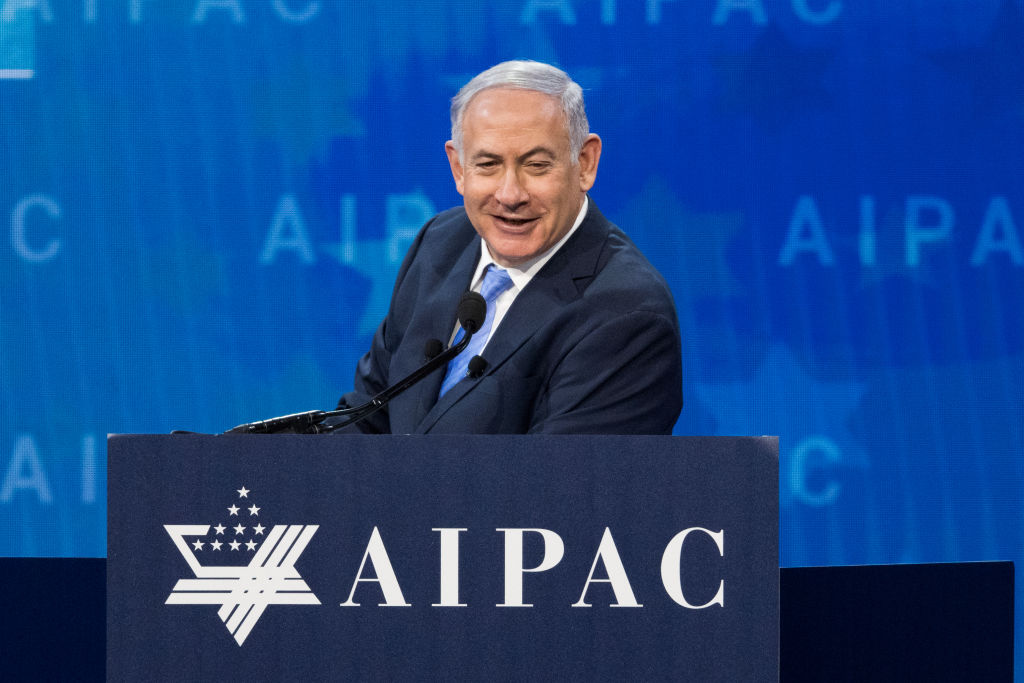
Benjamin Netanyahu stands at a podium that reads "AIPAC."

Along with new committes like the Better Blue Fund, longtime AIPAC donors have used other spending vehicles to hide recent spending on behalf of favored candidates. (Michael Brochstein / SOPA Images / LightRocket via Getty Images)


Amid widespread public disapproval of Israel’s mounting destruction across the Middle East, pro-Israel donors aligned with the American Israel Public Affairs Committee (AIPAC) appear to be resorting to new, innocuous-sounding fundraising vehicles to covertly channel money to favored candidates in high-stakes Democratic primaries.

That now includes the Better Blue Fund, a newly formed umbrella group that’s using weakened campaign finance rules to act as a “one-stop shop” for contributions from some of the pro-Israel lobby’s largest longtime donors, albeit with no mention of having a pro-Israel agenda. In less than two months, the fund has amassed more than $250,000 as it backs Democratic candidates already under fire from progressive challengers for supporting military aid to Israel or receiving endorsements from pro-Israel groups.

That list includes former Rep. Ben McAdams in Utah, House incumbents Adriano Espaillat and Dan Goldman in New York, and Rep. Wesley Bell in Missouri, who are all facing contested primary races where their support for pro-Israel policies has come under scrutiny.

The Better Blue Fund was formed in March as a joint fundraising committee, meaning it allows multiple candidates to band together to raise larger sums than they could individually under campaign finance rules. As the courts and regulators have chipped away at aggregate spending limits, joint fundraising committees have become increasingly popular vehicles for candidates to receive massive sums from high-value donors who may have an interest in their policies.

Along with McAdams, Espaillat, Goldman, and Bell, the Better Blue Fund is currently fundraising for four other Democratic congressional candidates: Rep. Rob Menendez (NJ), Rep. Grace Meng (NY), Rep. Steve Cohen (TN), and Jeremy Moss, a Democratic challenger for Michigan’s Eleventh District. All of the committee’s favored candidates are currently endorsed by pro-Israel groups or have been in the past.

A New Funding Strategy

AIPAC and its affiliates have frequently dropped millions of dollars into contested elections and proudly taken credit for knocking their perceived adversaries out of office — including the recent ousting of Rep. Thomas Massie (R-KY). But as voter sympathies shift away from supporting Israel, some of the operations’ donors now appear to be opting for a more low-profile approach by funneling money to outside entities with anodyne-sounding titles.

For example, in the 2020 Utah election cycle, McAdams was publicly endorsed by the Democratic Majority for Israel, a group dedicated to forging a close alliance between Democrats and Israel, and received a $5,000 donation from the group’s PAC in his failed reelection bid.

But this year, Democratic Majority for Israel hasn’t provided McAdams any direct financial support or public endorsement, while the Better Blue Fund is backing his campaign. That may be a tactical decision: McAdams has faced a barrage of attacks in the crowded race, including from progressive candidate Nate Blouin, for his past stances supporting unrestricted US military assistance to Israel.

As a congressman, McAdams voted in lockstep with pro-Israel groups on military funding, condemned boycotts of Israel, and attended congressional delegation trips to the country.

But at a recent debate, he decried, “the atrocities [Benjamin] Netanyahu has committed in Gaza [against] the Palestinian people,” though he suggested the conflict was not ongoing: “That has ended at this point.”

Familiar Donors

The Better Blue Fund has so far raised nearly $300,000 from a roster of pro-Israel donors. That includes $28,000 from financier Jonathan Jacobson, who in 2024 gave $2.5 million to AIPAC’s super PAC, United Democracy Project, making him the second-largest individual contributor to the group that election cycle. It also includes $24,500 from Rob Stavis, a partner at the venture capital firm Bessemer Venture Partners, who contributed $50,000 to Democratic Majority for Israel in 2024.

So far, Better Blue Fund’s largest single contribution is $31,500 from Eric Mindich, an investor who contributed $250,000 to Democratic Majority for Israel last cycle.

While the Better Blue Fund will eventually be distributing its war chest to the eight Democrats participating in the fundraising committee, the group has not yet reported any disbursements to candidates this quarter. When the fund does so, the donations will appear in candidates’ filings as Better Blue Fund contributions, obscuring the donors behind the spending and their affiliations with pro-Israel groups.

Along with the Better Blue Fund, longtime AIPAC donors have reportedly used other spending vehicles to hide recent spending on behalf of favored candidates.

In the Democratic primary race for Michigan’s Senate seat, a new PAC called the Center for Democratic Priorities, which had no prior campaign history, recently spent $5.3 million on ads boosting Congresswoman Haley Stevens, not long after AIPAC had championed her to donors in a fundraising email. The Center for Democratic Priorities’ registration documents revealed the organization shared the same treasurer as other pro-Israel groups and employed the same strategy firm used by these groups to place the ad buy.