We Rarely See Films as Fresh as I Love Boosters

Boots Riley’s remarkably easy confidence and visual flair in I Love Boosters is a tonic in an era of boring CGI slop. He’s one of the most compelling filmmakers working today.
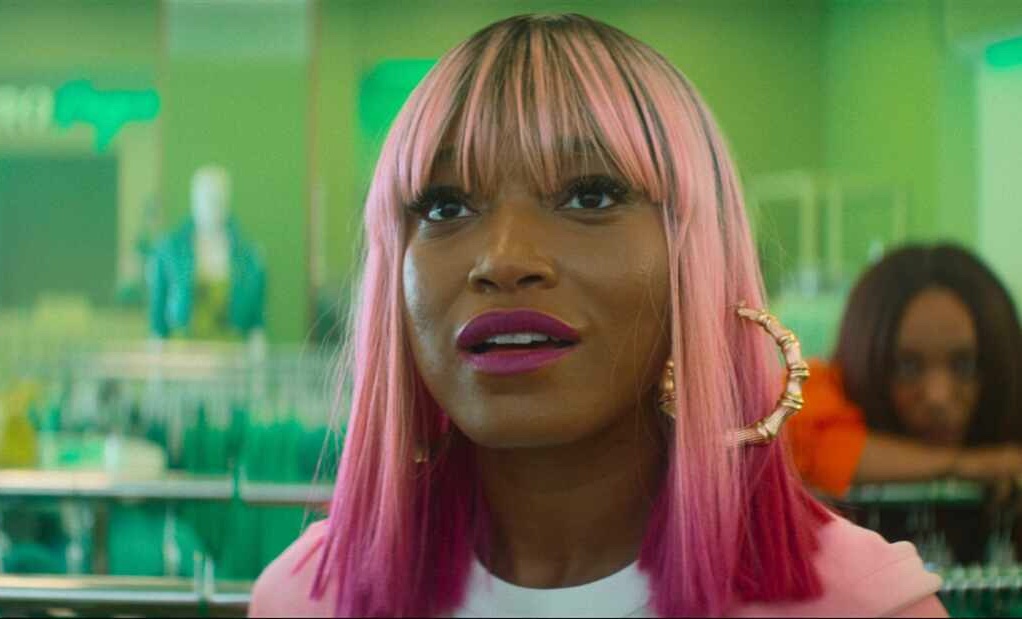
Close up still on actress Keke Palmer as Corvette with pink hair.

Keke Palmer as Corvette in I Love Boosters. (Neon)


Jacobin readers hardly need to be told that the new Boots Riley movie I Love Boosters is a must-see. It’s been eight years since the sleeper hit Sorry to Bother You, during which time Riley was busy with his Amazon Prime series, I’m a Virgo. In that time, he seems to have taken a great leap forward as a director. And I say that having loved Sorry to Bother You.

I Love Boosters starts so brilliantly, with a color scheme so vivid it’s stunning, especially in this era of drab visuals and muddy lighting. The mesmerizing initial images are vibrant with life. The camera is following Keke Palmer as she walks into a club that’s all lit up in dynamic shades of green, yellow, orange, and she seems to be grooving on the color as much as on the music.

Palmer is gorgeous, compelling, compulsively watchable on camera, emotionally gripping in dramatic scenes and inspired in comedy. She only needs the right roles to make her a top star. She’s one of the executive producers on I Love Boosters, clearly gunning for those roles, and this film is quite a showcase. She must have thirty costume, hair, and makeup changes, and she looks arresting in all of them.

Here she’s playing Corvette, a canny “booster” — a shoplifter of high-end designer clothes who makes a living turning around and selling the stolen goods at a big discount to people who can’t afford them — so she changes her look constantly in order to avoid detection. She’s only at the club in the first scene in order to pick up a stylish man who’ll be sure to want some of the great merchandise she has in stock once she lures him to her Oakland squat over a derelict Kentucky Fried Chicken franchise.

In interviews, Riley talks about Bay Area boosters with great affection and insider knowledge, having relied on them in his earlier days as a rapper with his group the Coup, when looking stylish on little money required a lot of help. The Coup released a 2006 song tribute called “I Love Boosters” with the lyric, “If it wasn’t for the hard work of a booster, most couldn’t go to the clubs that we’re used to.”

Along with her friends Sade (Naomi Ackie) and Mariah (Taylour Paige), who together call themselves the Velvet Gang, Corvette has developed surefire shoplifting routines that include stuffing one’s own clothes with expensive duds and escaping stores looking as puffed out as the Michelin Man while paid shills create a distraction. That is, two black men hired for the purpose start an in-store fight while a white woman customer, also paid off, gets hysterical over being a witness to such violence that in no way threatens her. The hysteria of the white woman, which is bound to get all the attention of the concerned store clerks, is key.

Corvette is herself an inventive clothing designer, particularly obsessed with the color turquoise. She’s also obsessed with Christie Smith (Demi Moore), a top fashion designer so innovative and cutting edge, her workspace is in a gravity-defying ultramodern building that tilts dramatically at the top floors, putting the Leaning Tower of Pisa to shame. Smith’s fabulous office with a floor slanted at a steep forty-five-degree angle is almost impossible to navigate for anyone but Smith.

Corvette sneaks in by hiding inside the coffee cart that’s delivered to Smith each morning, so the genius at work can create her own preferred coffee concoction. A surreal slapstick comedy scene ensues in which the young employee bringing in the coffee cart nearly slides downhill to the opposite wall, her ratty sneakers skidding all the way. After she manages to leave, Corvette sneaks out of the cart’s storage cupboard to take a peek around and then escape before Smith returns from the other room. Carrying her spike heels, Corvette tries to run uphill out the door but can’t get any traction, creating a leg-blurring Looney Tunes–style visual effect in her desperate, futile sprint.

Riley claims to use only practical effects, no computer-generated imagery, in his films when achieving such marvelously surreal comic moments, which is even harder to believe watching I Love Boosters than it was when watching Sorry to Bother You. It’s one of the many admirable commitments Riley honors that make his films unique and important. His casual lived-in communism is even more central to his projects. But like his cheerfully outrageous practical effects, it’s part of his fundamentally riotous view of the world.

But back to the scene. Corvette gets caught by Smith, of course, and has to make up an excuse for being in her office. She claims to be the manager of the coffee cart company, there to make sure all is satisfactory. This prompts Smith to give her an arrogant impromptu tutorial about the nature of good management, leading to the axiom that good management should be invisible. Smith’s rhetoric is wearyingly familiar in our era that’s so top-heavy with management figures from billionaire tech entrepreneurs to corporate execs to paid consultants, all spouting their specious pedantry about how to succeed in business as if they were gurus with much to teach the world.

Smith is even compelled to correct Corvette on the color of the self-designed turquoise dress she’s wearing: “Actually, it’s aquamarine.”

As Smith, Moore is oddly effective. She’s got the blank eyes, curated image, and soulless delivery of the vaguely messianic charlatan. After this encounter, Corvette discovers that Smith has actually stolen her own design for a full bodysuit in resplendent colors that’s supposedly going to be sold out of Metro Designers stores for $10,000 a pop. And Smith, in turn, realizes that the gang of shoplifters that keeps hitting her stores is led by that coffee cart “manager” in the turquoise dress — that is, aquamarine. Smith sets out to capture and punish the Velvet Gang just as the gang determines to steal Smith’s entire inventory and break her.

Demi Moore playing Christie Smith in I Love Boosters.
Demi Moore as Christie Smith in I Love Boosters. (Neon)

Corvette and her friends get jobs at one of Smith’s Metro Designers stores in the Bay Area, the one in which every bit of clothing worn must be in a screaming shade of yellow. “If they want another color,” Smith says coldly, “they should go to another store,” where everything would be jungle green, say, or cloying pinkish-red. It’s Smith’s obnoxious belief that customers should all feel honored to become part of the “living art” designed by a famous artist, such as herself.

Will Poulter plays the hilariously uptight manager of the yellow store, wearing a lemon-yellow suit and a memorable pair of big, square, yellow glasses to complement his Day-Glo yellow hair. Corvette and her friends are rebuked for wearing Smith’s designs in yellow from last year, which they already owned. Every employee is forced to pay for brand-new clothes to wear while working that are from the new Smith line in yellow — the money comes out of their paychecks.

The first paychecks of some of the employees are so small that one of them, Violeta (Eiza González), becomes the ringleader in a unionizing drive, trying to persuade her fellow clerks to strike for better pay and working conditions. Their breaks are so short, for example, that starting blocks used for track events are set up in the store, aimed at the exit, to allow clerks a faster running start on the thirty seconds they’re allowed.

But Corvette’s not interested in joining forces with her fellow employees. She’s fixated on getting revenge on Smith, her secret idol turned betrayer. It’s only in the process of carrying out her revenge that she discovers what Boots Riley protagonists always discover: the shocking, all-encompassing extent of systemic worker exploitation going on in the capitalist world.

If Riley had stuck closer to a more human-scale version of this scenario, developing the complications already latent in the plot — with some of his signature surreal flourishes, of course — the second half of the movie might’ve been as great as the first. It’s still good, but after a certain point, the narrative begins to unspool in looser, crazier patterns. The plot gets unwieldy as the number of characters multiplies, so there’s no time left to really develop what’s already been established — say, taking the Sade and Mariah characters beyond one-note characteristics. It comes as a vague shock when there’s a contrived confrontation between Corvette and Sade late in the film, because the friendship itself never achieves much emotional resonance.

Most obviously expendable is the secondary character of a very handsome, stylish, mysteriously hypnotic man known in the credits as Pinky Ring Guy (LaKeith Stanfield). He’s drawn to Corvette, who feels his magnetism. But he turns out to be a demon, picking up women and destroying them by “sucking their souls out of their pussies.” What the hell he’s doing in this film is never clear, and in the end, he’s unceremoniously shunted out of it again, never having gained any power to compel Corvette to do anything.

According to Boots Riley, the Pinky Ring Guy was a character he came up with long ago but waited to find a narrative use for:

I had the idea early on of Pinky Ring Guy, and I told LaKeith he was going to play him. But I didn’t know if he was going to be a lead character or even what project he was going to be in. Should I bring him into I’m a Virgo? What would that do to the world? I realized that by putting him in Boosters, it let us know a little bit more about what Corvette was searching for.

This approach to developing characters seems to be part of Riley’s “jankiness,” his pride in “showing the seams,” which is generally something I prize. It’s a great, defiant legacy of leftist filmmaking. Third Cinema films, for example, were explicitly made in opposition to typical Hollywood high-tech slickness, smooth “invisible” editing, and glossy professionalism that obscures the labor involved in making movies as well as the ideological coercion that’s part of the commercial film experience. Riley’s films have a happy, loose, organically evolving and politically forthright set of qualities that’s a wonderful corrective to what we see at the multiplex.

But in I Love Boosters, it struck me that things get a little too loose later in the film. The Pinky Ring Guy is a character that seems thrown in carelessly, distracting but at the same time inert, apparently there mostly for an elaborate sex gag.

The most interesting aspect of the character is simply watching Stanfield work. He’s another gifted and gorgeous star-waiting-to-happen and has been for many years now. He gets a lot of different film and television roles, but only certain directors seem to be able to showcase Stanfield’s charisma, and Riley is number one at it. Right after Jordan Peele featured him in Get Out, Riley brought Stanfield to widespread attention with the lead role in Sorry to Bother You.

Also loosely basted into the movie is Don Cheadle in a small role as Dr Jack, a fake minister-type running “Friends Being Friendly” gatherings that purport to be community-building efforts. But the meetings are all centered on Dr Jack’s obvious pyramid scheme — so obvious that an illustration of a pyramid gets passed out to attendees, with spots in the bottom row for them to fill in their names.

One man and one woman face each other in a still from I Love Boosters.
Still from I Love Boosters. (Neon)

Plus there’s a whole storyline set in a factory in China where badly exploited workers make Smith’s Metro Designers fashions. This introduces a set of late-breaking characters led by Poppy Liu as Jianhu, who works at the factory alongside her brother and mother. Her mother’s been stricken with cancer from making sand-blasted Christie Smith denim jeans.

In some way or other that I’ve now forgotten in the welter of plotlines, Jianhu gets ahold of a top-secret device that will prove to be of great use in bringing down Smith’s empire. It not only teleports materials from place to place, making it easy to expropriate an entire store full of clothing in seconds, it also has other functions. One button activates the “situational accelerator” that heightens the contradictions inherent in anything it’s aimed at, and another “deconstruction” button reduces anything to its basic elements.

This sci-fi dingus takes a great deal of time to explain, even after the political organizer Violeta lays out the concept of “dialectical materialism” to everyone, which should serve as a framework for understanding the machine’s functions. One of Riley’s strengths is in avoiding making his political films dry and didactic, but he makes a big exception here. “Violeta is being didactic because that’s her character,” he says.

And there’s more plot, but it gets spoilery, so I’ll leave you to find out for yourselves. I’ll just mention that the movie winds up being a bit tiring as the desperate endeavors of the Velvet Gang plus the Chinese factory workers combine in an extended but surprisingly lackluster chase scene on their way to disrupting Smith’s fashion show and transforming reality with the high-tech doohickey. The way characters can leap instantaneously between China and America, diving through the consciousness-raising teleporter, serves the purpose of illustrating the plight of workers around the world and the need to unite against the same capitalist oppression causing all their suffering. But it seems as if didacticism starts driving the film to a somewhat deadening degree. Is Violeta directing the end of the movie?

Still, there’s so much that’s thrilling in I Love Boosters, it seems a shame to harp on what seems to me to be its weaker portion. We rarely see anything this fresh at the movie theater. Just to see a film representing a directly opposed point of view from the typical ideologically poisoned media generated in the United States, offered up with Boots Riley’s remarkably easy confidence and visual flair, is a wild and wonderful experience that nobody sentient should miss. Everybody should see it at least twice.