How the UAE Built an Empire of Kleptocrats
From Libya to Yemen and Palestine to Sudan, the United Arab Emirates has built a regional network of militias, autocrats, and oligarchs that perpetuate violence for power and profit.
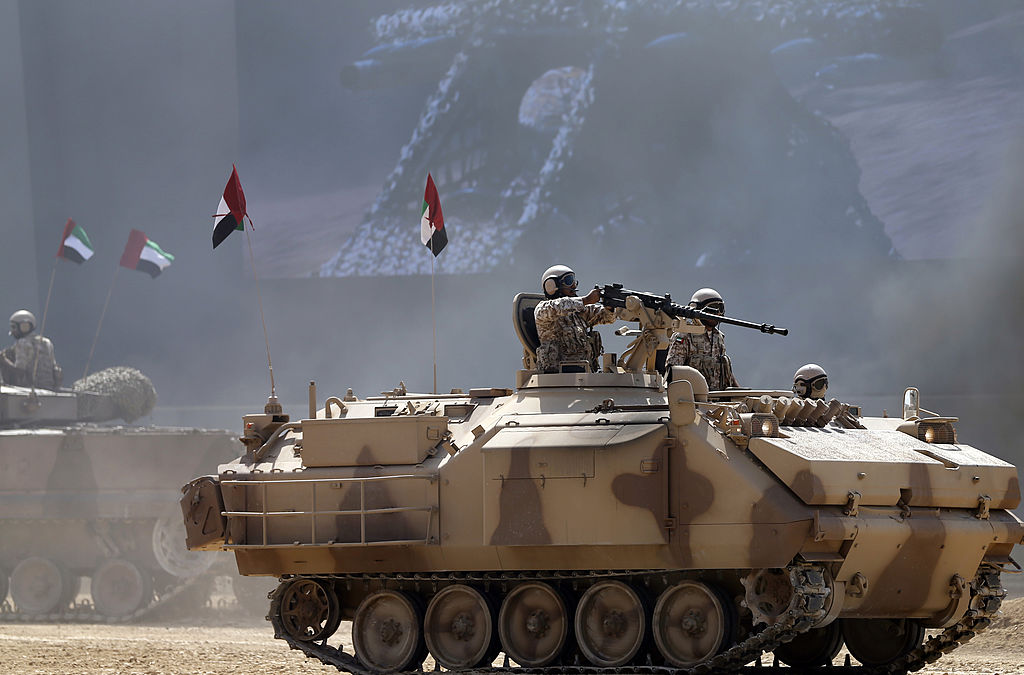
Emirati armed forces take part in a military show at the opening of the International Defence Exhibition and Conference (IDEX) in Abu Dhabi on February 17, 2013. (Karim Sahib / AFP via Getty Images)
On October 25, 2025, El Fasher, the capital of Sudan’s North Darfur, became the site of one of the most intense episodes of mass killing since the Rwandan genocide. A genocidal militia blocked off neighborhoods and went house to house executing people. The United Nations Human Rights Office documented at least 6,000 killings in the first three days, with countless others still missing, uncounted, or hiding in this murdered city.
The Rapid Support Forces (RSF) had already committed countless atrocities, including the slaughter of ten to fifteen thousand people in the city of El Geneina in 2023. A world swept up by the Save Darfur movement in the 2000s sat on its hands for two years as the same killers besieged the communities that escaped them twenty years earlier.
How could one of the grisliest episodes of the Darfur genocide pass through headlines with limited outcry, let alone action? Many things had changed since Save Darfur: the West soured on humanitarian intervention, the UN faced a dire liquidity crisis, and journalists and celebrities stopped diving headfirst into “African conflicts.” Yet perhaps most tangibly, the génocidaires had an unusually audacious patron: the United Arab Emirates (UAE).
Many governments contributed to Sudan’s catastrophe. However, the UAE went above and beyond to run a covert airbridge delivering advanced weaponry to the RSF, airlifting wounded RSF fighters to Emirati hospitals, and facilitating RSF smuggling operations on Emirati soil. Emirati officials weathered public and private pleas to rein in RSF atrocities while telling concerned governments to stay out of it. The UAE flagrantly broke an international arms embargo on Darfur while sitting on the UN Security Council, responsible for overseeing the embargo.
The UAE’s airbridge to genocide mobilized a complex transnational network and weaponized the Emirati elite’s significant international leverage. In the process, it shed light on the UAE’s “sub-imperial” hold on its neighbors. Across Africa and the Middle East, the UAE has committed its wealth and weapons to disastrous military adventures, merciless conflict economies, and repressive political systems. Its rulers are some of the most zealous overseers of our neo-imperial disorder. With a companion piece charting the Emirati elite’s rise to power, this article explores how they wield this power to devastating effect.
Power to the Princes
On December 17, 2010, twenty-six-year-old street vendor Mohamed Bouazizi self-immolated to protest the petty tyranny of Tunisian officialdom. His singular act catalyzed a wave of popular uprisings against the old order of patronage networks and police states. The Middle East’s rulers fell one after another. Watching from palaces and private jets, the Emirati monarchy prepared to throw its full arsenal into the fight against the people.
Much like America’s sprawling Cold War crusade against “socialism,” and later its boundless “war on terrorism,” Abu Dhabi’s hatred of political Islam put virtually every popular movement in its crosshairs. The ensuing struggle shaped the high-tech repression, shameless oligarchy, and neo-imperial competition still ravaging the world.
The first step was to kill hope. Protesters next door could directly inspire and conspire with dissidents at home. Regimes in Tunisia and Egypt folded faster than the reaction could respond, but the situation in Bahrain, the closest to home, could still be salvaged. After King Hamad bin Isa Al Khalifa’s police killed five protesters in mid-February 2011, socioeconomic protests became sharply political. As a fellow Gulf monarchy and a link in the chain of capitalist militarism (Bahrain hosts the headquarters of the US Navy’s Fifth Fleet), Bahrain could not be allowed to fall.
On March 14, one thousand Saudi National Guardsmen and five hundred Emirati military police deployed to Bahrain at King Hamad’s invitation. The Peninsula Shield Force gave cover for a state of national emergency and a vicious attack on Bahraini society. A regime that had just come close to an agreement with the protesters now hunted down everyone from opposition negotiators to doctors who treated injured protesters.
In the fifteen years since, King Hamad’s police state has saved itself with torture, lawfare, and sham trials while being rewarded with American and British arms sales. Though Saudi Arabia, Kuwait, and Oman also experienced protests, no Gulf monarchy would come close to making real concessions, let alone collapsing, as Bahrain did in 2011.
Carry a Big Stick
Having secured the home front, the next step was to shape the day after. As a “nexus state,” the UAE’s prosperity is deeply intertwined with other countries’ domestic struggles. Emirati capital needs raw materials, eager investors, and dependable supply chains — food, water, electricity, and labor — to sustain an economy operating well beyond domestic means. To this end, Abu Dhabi prefers to make deals with autocrats unrestrained by the messiness of democratic oversight. The UAE now deployed its wealth and war machine to build a network of these extractive elites.
Though Egyptian dictator Hosni Mubarak’s thirty-year rule was over, the Muslim Brotherhood, born in Egypt, posed a transnational political-ideological threat to secular autocracy. Before and after the Brotherhood’s Mohamed Morsi won a democratic election in 2012, the UAE and Saudi Arabia worked to bring the old police state back to power. Leaked diplomatic cables, voice recordings, and US intelligence indicate that the UAE covertly funded the Tamarod protest group against Morsi while diplomatically working to undermine his government.
Soon enough, on July 3, 2013, General Abdel Fattah el-Sisi overthrew Morsi in the name of the protesters. He then slaughtered over a thousand Brotherhood supporters in Cairo’s Rabaa al-Adawiya Square and instituted a reign of terror that may have produced the largest number of political prisoners in the world. The UAE became the leading investor in el-Sisi’s faltering economy, propping up his regime with $3 billion immediately after the coup, $20 billion in the following years, and a $35 billion development project in 2024.
With Egypt as a launchpad, the UAE then subjected Libya to a different kind of destructive intervention. The monarchies may have been glad to see a popular uprising against the “Islamic socialist” Muammar Gaddafi, but only as an opportunity to install their own strongman. The UAE contributed its skilled air force to the 2011 NATO intervention that overthrew Gaddafi in contravention of its UN mandate. The UAE, Egypt, Russia, and France then rallied behind former CIA asset Khalifa Haftar as he set up a military dictatorship in the oil-rich east and battled Islamist groups and the internationally recognized government in Tripoli.
From the al-Khadim airbase east of Benghazi, Emirati personnel covertly conducted air strikes against Haftar’s enemies — and quite a few civilians — and broke a UN arms embargo to deliver supplies to Haftar. The UAE consolidated Haftar’s regime by funding local development projects, facilitating mass corruption through Emirati companies, and buying off the UN’s chief negotiator with a $600,000 salary at the Emirates Diplomatic Academy.
During Haftar’s bloody attempt to capture Tripoli in 2019, the UAE ramped up air strikes and supply runs and even funded Sudanese and Russian mercenaries to join the failed offensive. This sophisticated mix of covert intervention and lavish investment matured in Libya and now defines Emirati empire-building. The price was Libya’s systematic plunder and de facto partition.
Money Is Blind
With the Arab Spring in tatters, the final step was to carve out a new order. For all its audacity, the UAE is just another player in the global capitalist order that rewards extraction, militarization, and political dependency. The UAE’s textbook imperial rivalry with Saudi Arabia and bitter ideological clash with Qatar, Türkiye, and Iran has fractured the region.
Each rising power has shaped its imperial identity and network by backing local allies and tearing countries apart before eventually reaching a fractured status quo. America, Europe, Israel, Russia, and China alternately join in or wag their finger based on context. For all their disagreements, these squabbling oligarchies have jointly created zones of perpetual insecurity where only profiteers and mercenaries thrive.
Dominating the Red Sea’s Bab-el-Mandeb choke point (like the Gulf’s Strait of Hormuz), Yemen is the monarchies’ most immediate imperial frontier. In March 2015, Saudi Arabia rallied the Gulf states in a doomed attempt to defeat the Iran-backed Islamist Houthis. With British and American support, the coalition initiated a full blockade that plunged Yemen into famine while thousands of air strikes systematically destroyed Yemeni society and killed or wounded almost 20,000 civilians.
Under cover of this catastrophe, the UAE began seizing key southern ports and energy infrastructure for itself. In 2017, it created the secessionist Southern Transitional Council (STC) to guard its interests in a proxy conflict with the Saudi-backed government. Though Saudi air strikes effectively destroyed the STC in early 2026, for a decade this Emirati fiefdom ran on repressive militias, professional assassins, UAE-trained mercenaries, and a covert torture network complete with US military interrogators.
Control of Yemen’s southern coast accelerated Emirati encroachment into Africa, where it has followed the Cold War playbook of fueling conflict and extracting resources. The UAE spent years building a chain of military-logistical hubs in Yemen, Djibouti, Eritrea, Puntland, and Somaliland to control the vital Red Sea corridor. These facilities anchor the UAE as it trains and equips embattled governments from Somalia to the Sahel and Mozambique to Congo. Most famously, when Tigrayan rebels marched on Ethiopia’s capital in 2021, the UAE rushed drones through Djibouti that turned the tide for the government.
In return, indebted elites offer sweeping military and economic concessions enabling further intervention and extraction. In 2023, the UAE and Ethiopia signed seventeen deals benefitting virtually every Emirati state corporation. The UAE is now the fourth-largest source of capital in Africa and the premier destination for Nigerian, Angolan, and South Sudanese kleptocrats laundering money and evading prosecution. Few Africans will ever benefit from the minerals siphoned off to Dubai, the “City of Gold,” or the weapons bought from Abu Dhabi, the region’s new gunrunner. The two pillars of Emirati power in Africa, plunder and militarization, betray its polished image as a benevolent investor and security partner in this “last frontier of capitalism.”
Genocide: Imperialism’s Final Stage
Finally, imperial dreams ended in genocide. The Israel Defense Forces (IDF) and Sudan’s RSF bear ultimate responsibility for the Gaza and Darfur genocides. However, the UAE is a prime case study in how capitalist expansion inevitably places its overseers on the side of the executioners.
In 2020, the UAE and Bahrain upended Middle Eastern politics. By signing Donald Trump’s Abraham Accords, two Arab monarchies broke the seal on recognizing Israel without even acknowledging Palestinians. A decade of repression enabled the monarchs to take this leap without worrying about domestic outrage. They knew normalization would buy them goodwill with Israel’s Western patrons and better access to the cutting-edge tools of violence Israel tests on Palestinians.
Washington soon announced a $23.3 billion deal with the UAE for F-35A fighter jets and MQ-9B Reaper drones (now stalled), while the UAE became one of Israel’s closest Middle Eastern allies. They conducted joint naval exercises, invested in each other’s arms industries, built Abu Dhabi’s air defense and mass surveillance systems, and established a “Crystal Ball” intelligence-sharing platform.
The UAE then stood with Israel throughout the Gaza genocide. In 2025, the UAE allowed thirty-four Israeli companies to participate in its flagship International Defence Exhibition and Conference (IDEX) and secretly signed a $2.3 billion deal with Israel’s Elbit Systems for an unidentified, state-of-the-art defense system. It shipped crude oil to Israel through the Sumed pipeline and offered to manage logistics and police training for Gaza’s reconstruction. The UAE lobbied Trump to reject the Arab League’s unanimous postwar plan for Gaza in favor of the neocolonial Board of Peace, which seeks to impose Tony Blair as Gaza’s viceroy and Jared Kushner as its landlord.
Most importantly, the UAE has repeatedly offered to bankroll “planned communities” in Gaza where genocide survivors can only access aid and services by submitting to biometric data collection and security vetting. This concept (and the inevitable contractor bonanza) has guided both Joe Biden’s and Trump’s plans for aid and reconstruction. It is the crux of the American Israeli assault on international law, humanitarian principles, and Palestinian self-determination. While other donors balked, the promise of Emirati money has enabled the United States and Israel to forge ahead with a techno-colonial experiment that is unlikely to stop at Gaza.
Finally, the UAE’s deep investment in Sudan led to an even more prominent role in the Darfur genocide. The food insecure Gulf has bought up vast agricultural lands in Sudan’s Nile breadbasket and profited from Sudan’s prime Red Sea coastline, dominance of the gum arabic market, and lucrative mineral smuggling routes. In the wake of the Arab Spring, the UAE shored up Omar al-Bashir’s thirty-year dictatorship with upward of $7.6 billion. In return, al-Bashir facilitated Emirati interests in Sudan and sent thousands of mercenaries to fight in Libya and Yemen. However, when Sudanese civil society rose up in 2019, the UAE backed vicious spymaster Salah Gosh in a coup against al-Bashir.
Abu Dhabi’s Genocidal Gamble
The UAE and Saudi Arabia also financed the old regime’s violent crackdown on Sudan’s democratic revolution. Though Saudi Arabia and most states rallied behind the Sudanese Armed Forces (SAF), the UAE crafted its own allied fiefdom under the RSF’s Mohamed “Hemedti” Hamdan Dagalo. Hemedti rose to prominence as a mass murderer in Darfur in the 2000s, subsequently building an empire of gold and graft in the post-genocide wasteland. When the RSF and SAF took up arms against civil society and each other in April 2023, the UAE quickly mobilized the imperial network it spent years cultivating.
For three years, RSF and SAF have hunted down activists and starved and displaced millions. Traveling along a chain of docks and runways — Puntland’s Bosaso port, Uganda’s Entebbe International Airport, Chad’s Amdjarass base — Emirati guns, cash, and personnel have fueled the carnage. Hemedti has benefited from arms hidden in aid convoys, Colombian mercenaries sneaking over from Libya, a secret Ethiopian training camp, a diplomatic tour of Kenya, Rwanda, and South Africa in an Emirati plane, and a stash of real estate and smuggling facilities in the UAE itself.
From the RSF’s Geneina massacre in June 2023 to El Fasher in October 2025, Abu Dhabi has consciously staked its regional empire on nothing more than a genocidal looting machine. This twisted calculus betrays the ultimate bankruptcy of Emirati imperialism. For all the resources mustered and lives destroyed, Yemen’s STC dissolved itself, Haftar failed to capture Tripoli, and the RSF was ejected from Khartoum. Abu Dhabi ingratiated itself with an American Israeli alliance that knowingly crashed its economy by attacking Iran. The UAE has profited from short-term plunder thinking it was creating long-term allies. This death spiral has nothing to offer the region.