The Ongoing Persecution of China’s Uyghurs
The Chinese government isn’t letting up on its repression of Uyghurs. It’s setting a dangerous example of how to use “anti-terrorism” to justify authoritarian practices.
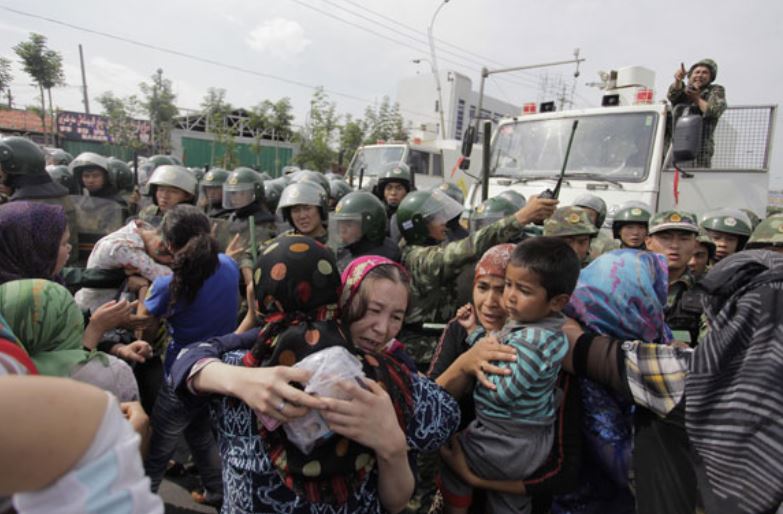
Police at a protest by Uyghurs in China’s Xinjiang region in 2016. Wikimedia Commons
In February, Mohammed bin Salman, Saudi Arabia’s crown prince, declared on Chinese state television, “China has the right to carry out antiterrorism and de-extremization work for its national security.” He was following the clumsy script that China has used repeatedly to cover up its violations of the human rights of the Uyghur people in Xinjiang province.
The alibi is common to authoritarian states who create “states of exception” and “emergency resolutions” to bypass the rule of law, substituting its own self-appointed notion of “right” to violate human rights doctrine conventions. In the case of the Uyghur, an entire people has been categorized as “terrorist,” and China has developed a massive and programmatic response to such “extremism” — concentration camps that extract labor at the same time as they suppress any thoughts, beliefs, cultural values, language, even food, that evinces Muslim identity.
Besides bin Salman, other leaders regarded as strong advocates for Muslims have also signed on to what might be called the “Uyghur Exception.” In 2017, Pakistan’s current prime minister, Imran Khan, while still in the political opposition party, condemned the “hypocrisy” of the international community in failing to protect the rights of Rohingya Muslims in Myanmar; Khan also has criticized human rights violations against Muslim Kashmiris.