War With Iran Would Be a Murderous Disaster
The case against Iran in 2019 looks a lot like the case against Iraq in 2002. Going to war would be a bloody, murderous disaster.
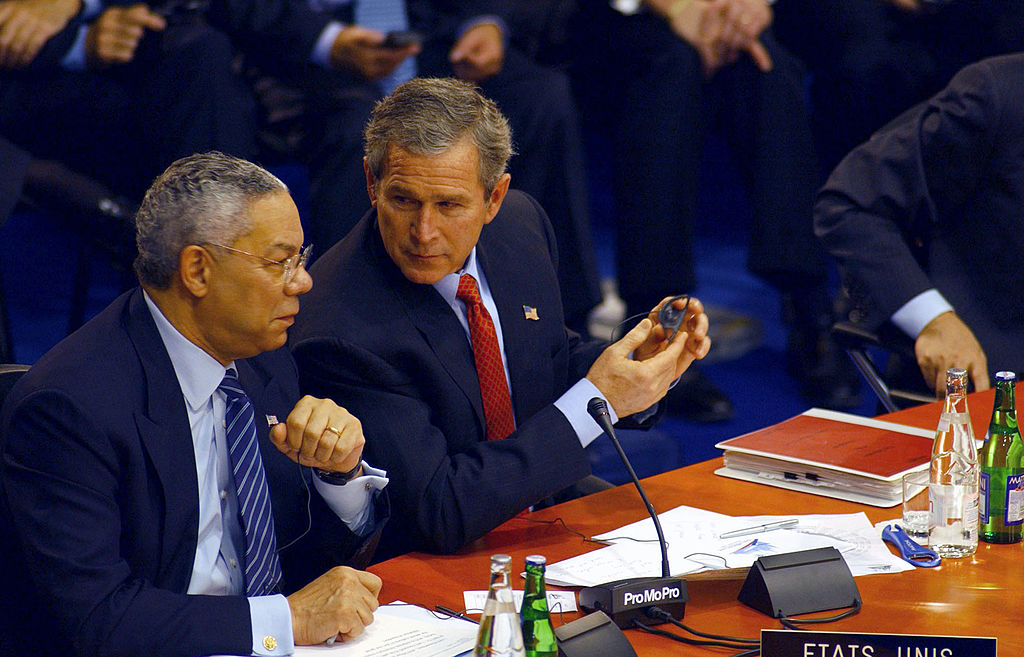
George W. Bush and Colin Powell attend the NATO summit, November 21, 2002 in Prague, Czech Republic. NATO / Getty
The drums for war against Iraq began beating in 2002 to the cadence of “credible” intelligence reports. These reports had been solicited by George W. Bush’s administration in support of two essential objectives: tying al-Qaeda to the Iraqi government, and proving that Saddam Hussein was resuscitating the nuclear program he had promised to kill off. Rumors and questionable intelligence that supported these conclusions trickled into Bush administration statements and speeches, and then into the media. As it turned out, neither conclusion was true, but the public wouldn’t understand that until it was far too late.
Vice President Dick Cheney himself trotted out the later-discredited story of 9/11 hijacker Mohamed Atta meeting with an Iraqi diplomat in Prague during a December 2001 Meet the Press appearance. The claim became a staple of war hawks in the Weekly Standard, New York Times, Washington Post, and elsewhere over the following year (Cheney would continue asserting the disproven allegation as fact well after it was formally debunked by then-CIA chief George Tenet in a letter to Congress).
These digestible little fibs, in time, gave way to bigger ones. By September 2002, reporters Michael Gordon and Judith Miller wrote a front-page Times news report, without citing a single named Bush administration official, asserting that the Iraqi government had “stepped up its quest for nuclear weapons and has embarked on a worldwide hunt for materials to make an atomic bomb.” Six months later, American troops would occupy Baghdad.