Should We Care About Inequality?
Since Occupy Wall Street, “inequality” has emerged as a central theme of progressive politics. Is that a good thing?
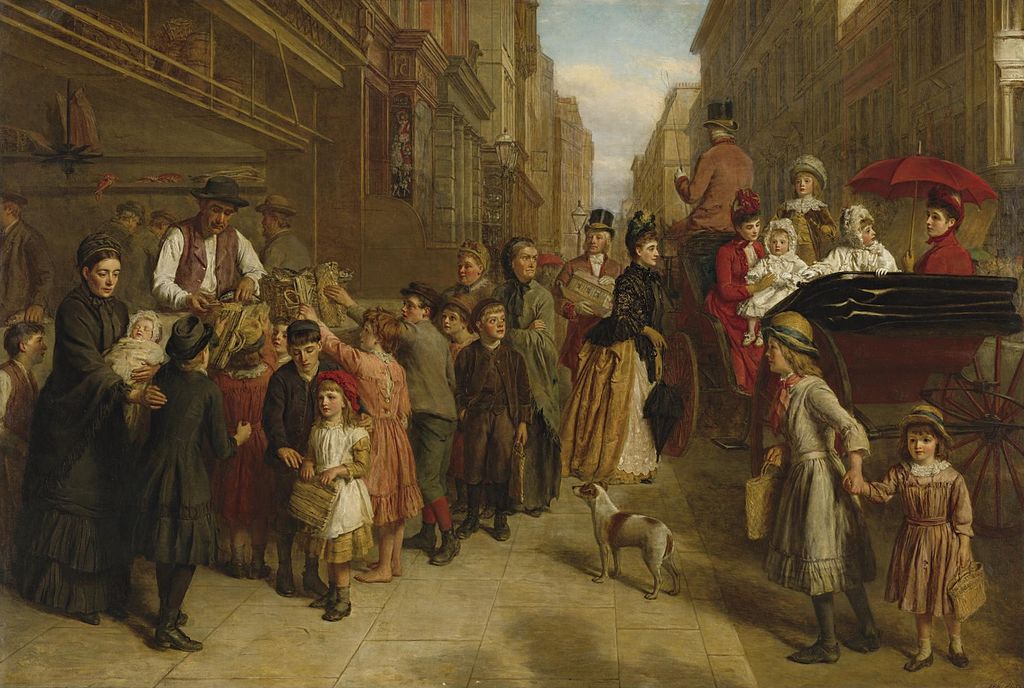
Poverty and Wealth byWilliam Powell Frith, 1888.Sotheby’s New York / Wikimedia
Following the sensational success of Thomas Piketty’s Capital in the Twenty-First Century, with no less than 2.5 million copies of the book sold worldwide, inequality is now widely perceived, to quote Bernie Sanders, as “the great moral issue of our time.” Clearly the shift is part of a wider transformation of American and European politics in the wake the 2008 crash that has turned the “1%” into an object of increasing attention. Marx’s Capital is now a bestseller in the “free enterprise” section of the Kindle store, Jacobin is considered a respectable place to be published, and socialism no longer looks like a failed rock band trying to climb on stage when the “party” is already over. On the contrary, if we are to believe Gloria Steinem, a Bernie Sanders rally is now the “place to be,” even “for the girls.”
On closer scrutiny, however, it’s not entirely clear how well our current interest in inequality (especially income inequality) rhymes with Marx’s own theory, or the ideas that dominated social-policy debates in decades following the Second World War. In fact, one could even argue that our current focus on income and wealth inequality, while crucial to any progressive agenda, also misses some of the most important aspects of the nineteenth-century critique of capitalism. At that time, “income inequality” was an elusive and at best ancillary term. In fact, the “monetization” of inequality is actually a relatively recent way of seeing the world — and, aside from its obvious strengths, it is also a way of seeing that, as the historian Pedro Ramos Pinto noted, has considerably “narrowed” the way we think about social justice.
The Lost Word in Capital
There may be no better way to gauge this difference than simply by looking at one of socialism’s classics itself: Capital. As surprising as it may seem, the term “inequality” per se was never a crucial category for Marx — or for nineteenth-century socialists, for that matter. Interestingly, the word itself, depending on the translation, appears fewer than five times in Marx’s voluminous masterpiece.