The Communist Party vs. China’s Labor Laws
President Xi Jinping’s support of a recent crackdown on workers’ attempts to organize a union is part of a broader centralization of power and repression of basic rights.
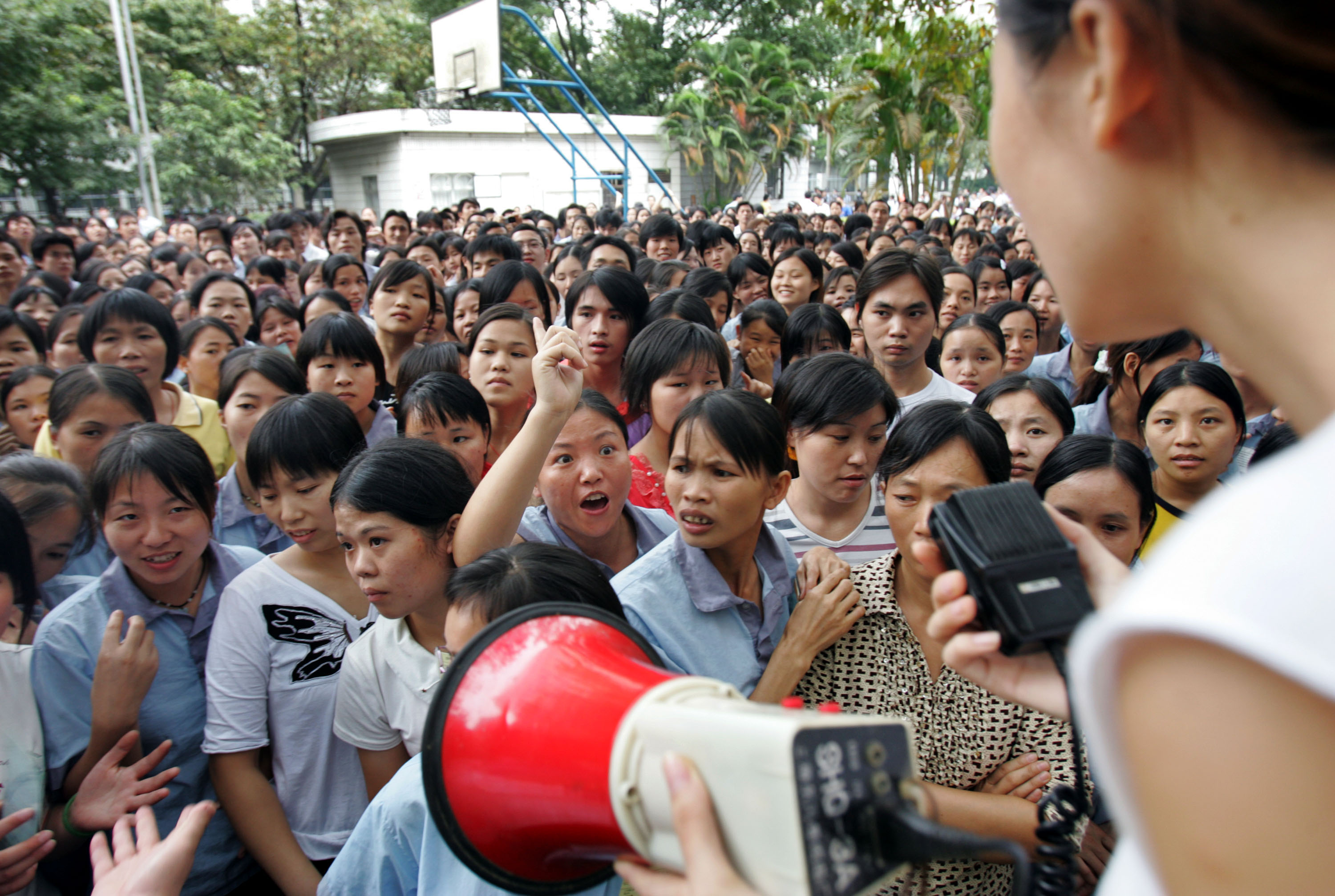
Workers demonstrate outside the factory of Hua Yang Printing Holdings Co Ltd on October 30, 2007 in Shenzhen of Guangdong Province, China.China Photos / Getty
Chinese president Xi Jinping presents himself as a man of the people, attuned to the needs and aspirations of those who have been left behind by China’s economic miracle. In last year’s landmark 19th Party Congress, he identified the “principal contradiction” in Chinese society as that between “unbalanced and inadequate development and the people’s ever-growing needs for a better life.” As Xi has centralized ever greater power in his hands and abolished presidential term limits, the implicit bargain has been that he would use this enhanced authority to break the power of entrenched interest groups for the benefit of the common people.
But recent developments in Guangdong province suggest that there may be another, deeper contradiction: that between Xi’s increasingly dictatorial rule and his desire to better the lives of poor people.
Beginning in May, a group of workers from Shenzhen Jasic Technology Co., Ltd (Jasic) responded to the company’s various efforts to cheat them out of their due compensation by establishing an enterprise-level trade union, a right guaranteed to them by Chinese law. But rather than finding support from above, workers and their allies have encountered official scorn, retaliatory firings, violent repression, police detention, and spurious legal charges.