The Forgotten Socialists of Tiananmen Square
What the world remembers about the 1989 Tiananmen Square protests were the students. But above all, it was a mass workers’ uprising for socialist democracy.
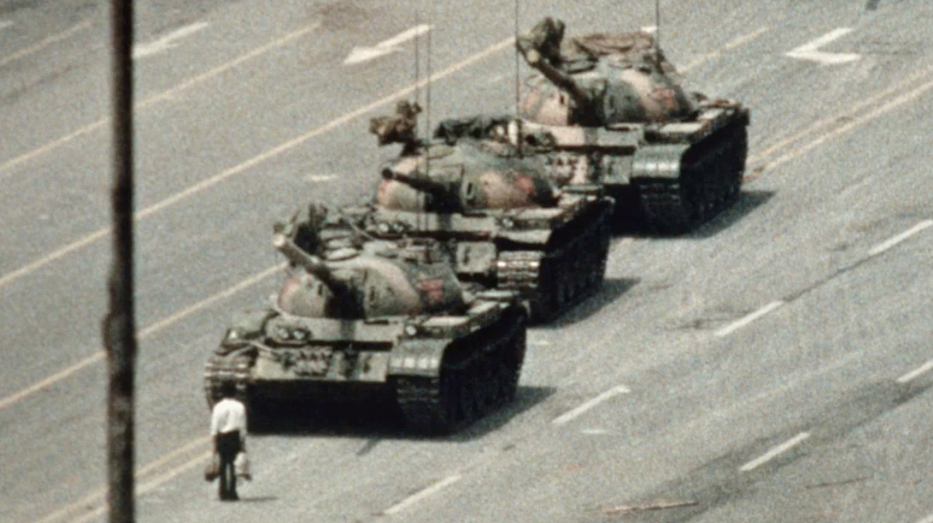
A Beijing demonstrator blocks the path of a tank convoy along the Avenue of Eternal Peace near Tiananmen Square, June 5, 1989.Bettmann / Getty
Public discourse on the 1989 Tiananmen Democracy Movement has been dominated by two narratives. The most prevalent interprets the movement in the framework of “democracy vs. authoritarianism.” The “democracy” in this narrative almost always refers to liberal democracy. In this telling, intellectuals and college students deeply influenced by Western liberalism hoped to push the Chinese Communist Party (CCP) to accelerate political liberalization, which had been rolled out only intermittently during the 1980s. The goal of the movement was to keep democratization advancing apace with marketization.
The second narrative, much less influential than the first but nonetheless widely circulated among segments of the Chinese and international left, interprets the movement in the framework of “socialism vs. capitalism.” In this narrative, China’s marketization reforms in the 1980s produced severe inflation and rising inequality, which hurt the livelihoods of urban populations and gravely intensified discontent. Therefore, the 1989 Tiananmen Democracy Movement was in fact an anti-market, anticapitalist movement triggered by material grievances.
Both of these narratives are flawed. In the “democracy vs. authoritarianism” narrative, the protagonists were always intellectuals and students. Almost completely ignored were workers and ordinary residents of Beijing, who played a significant role in the movement. In fact, measured by both the estimated death tolls during the final massacre on the evening of June 3 and early morning of June 4 and the intensity of repression thereafter, workers paid a much higher price than students and intellectuals, in a way similar to the 1980 Gwangju Uprising in South Korea. Yet in the liberal narrative, workers are largely absent.