George Wallace’s ’68
For every American won over to radicalism in 1968, there was another captured by George Wallace’s right-wing populism.
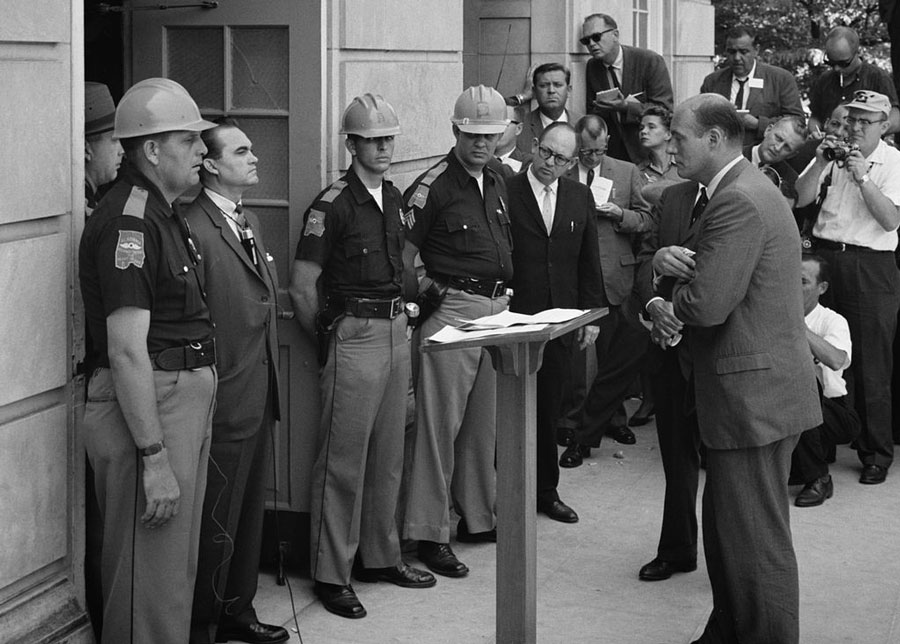
Attempting to block integration at the University of Alabama, Governor George Wallace stands defiantly at the door while being confronted by Deputy U.S. Attorney General Nicholas Katzenbach. Warren K. Leffler, U.S. News & World Report Magazine / Library of Congress
Despite our nostalgia, the “Sixties” was a polarized time rather than a radical one. Nowhere was this clearer than in the 1968 presidential election. Richard Nixon won narrowly by portraying himself as a moderate between welfare-state Democrat Hubert Humphrey on his left and segregationist former Alabama governor George Wallace on his right. Wallace got 9.9 million votes and came close to influencing the outcome.
Since the 1940s, Wallace had demonstrated considerable flexibility on economic policies and to some extent on issues relating to race. Alabama had a tradition of electing segregationists who nonetheless favored the New Deal-Fair Deal welfare state; in 1968 Senators John Sparkman and Lister Hill fit into this category. As a young legislator after World War II, Wallace allied with Governor “Big Jim” Folsom who tried to evade racial politics while improving public services and attacking Alabama’s economic elite colloquially known as the “Big Mules.”
Folsom’s acquiescence in court-ordered integration prompted Wallace to break ranks. Even so, Wallace lost the 1958 Democratic gubernatorial primary because he seemed insufficiently racist. He vowed never to be “out-segged” or “out-niggered” again. Wallace won the governorship four years later as a staunch segregationist.