A Line in the Sand
Bernie Sanders’ Workplace Democracy Act promises a fundamental shift of power toward working people.
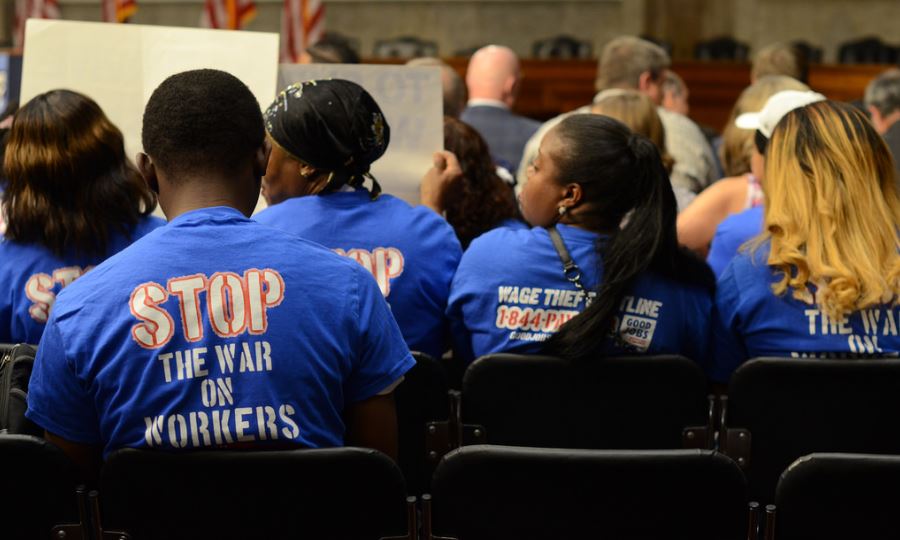
The introduction of the Workplace Democracy Act on May 9, 2018 in Washington, DC. AFGE / Flickr
This month, American unemployment dropped to its lowest rate in seventeen years — but wages haven’t caught up. It’s not difficult to divine the meaning of this disparity. Productivity has soared since the seventies, as has the wealth of the top 1 percent, while the income of average workers has stalled out. That means that despite producing more surplus value than ever, American workers are taking home a smaller share of the proceeds. The trend is not driven simply by abstract economic forces but by politics, as the capitalist class successfully pushes for policies that disempower workers and redistribute wealth to the top.
It’s no coincidence that this trend in wage stagnation has occurred over the same period that neoliberal government and corporate policies have frontally attacked unions. Unions are agents of collective bargaining, a way for individually weak workers to exert power together that they wouldn’t have on their own, and they’re effective: on average union employees’ paychecks (or market wages) are 27 percent higher than nonunion employees, and they get better benefits (or social wages) too. The bipartisan neoliberal attack on unions, which began in earnest in the 1970s, has been enormously effective in undermining the power of the United States labor movement. As a result, the percentage of US workers who currently belong to a union is about 10 percent, down from its peak of nearly 28 percent in 1970.
Again this problem is fundamentally political, stemming from the balance of power in our society and not from a natural or inevitable economic process. The solution, too, has to be political — and it’s in that spirit that Bernie Sanders has introduced a new bill called the Workplace Democracy Act, which aims to clear obstacles to the labor movement’s growth, and ultimately increase collective worker control over the economy. The chances of such a bill passing in a GOP-controlled legislature (or even in a Democrat-controlled legislature; a weaker bill was opposed by moderate Democrats during the Obama administration) are basically nil, but Sanders’s bill is a strong political move anyway. It signals an uncompromising commitment to unions and invites other politicians to support an ambitious vision of a revitalized movement for worker power — or oppose that vision at their own risk.