A Childlike Devotion Runs Through Godzilla Minus Zero
It’s heartwarming the way Takeshi Yamazaki has been able to channel his childhood commitment to that ultimate destructive monster, Godzilla, into Godzilla Minus Zero.
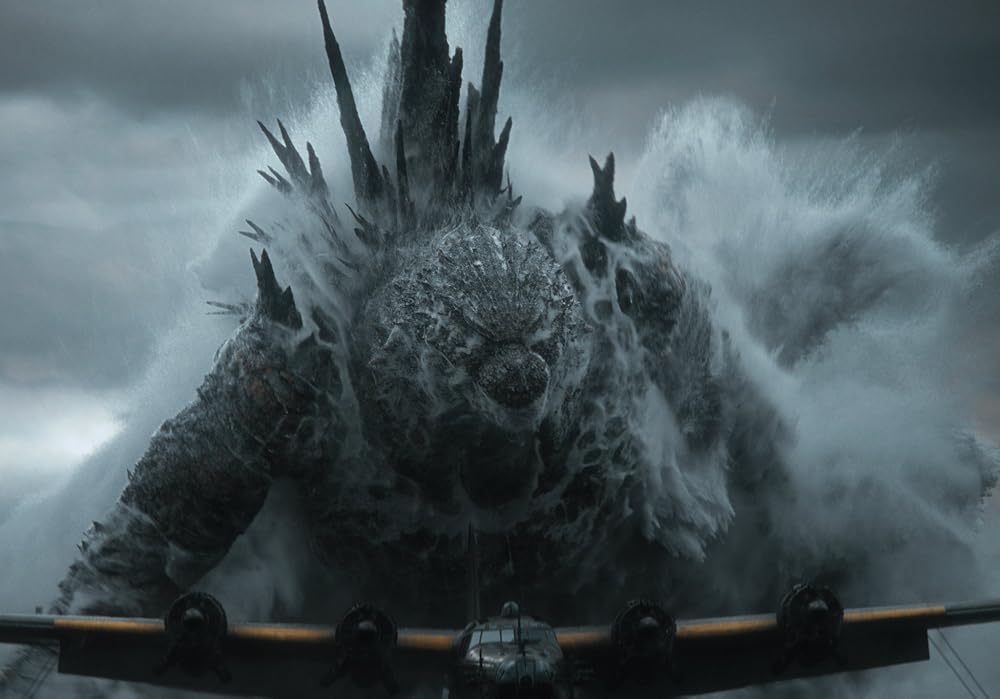
Set in 1949, Godzilla Minus Zero is a somber film entirely preoccupied with the relentless calamities besetting Japan — from the US nuclear bombs dropped on Hiroshima and Nagasaki to the past destruction wrought by Godzilla. (Toho Studios / Robot Communications)
There’s a familiar but always thrilling moment in Godzilla Minus Zero when Godzilla is fighting the newer, faster, entirely more visually glamorous monster King Ghidorah — an immense three-headed, golden-ray-shooting dragon that seems set on destroying the human race — and Godzilla is losing. In fact, it seems Godzilla is beaten and dying.
But then Godzilla goes deep and dredges up the last of his prehistoric mojo and comes back to win the brutal kaiju battle. Godzilla the destroyer from the sea becomes Godzilla the hero and savior of the Japanese protagonists watching in wide-eyed terror. All the viewer’s childhood love of Godzilla, who lumbers around on big, squat feet like a crude, clumsy dinosaur based on some devoted but impractical kid’s drawing, surges to the fore.
Writer-director-CGI effects master Takeshi Yamazaki seems highly motivated by such lingering childhood feelings. He cautions us in interviews, in a caringly paternal sort of way, to remember that though Godzilla fights King Ghidorah, it’s not because he sides with human beings: “He can’t become humanity’s friend.”
Oh, we know. But many small children aren’t entirely on the side of humans either. Personally, I was all for the animals as a kid and relentlessly pretended to be an animal for years before the US educational system crushed it out of me. And most little children are united, at least for a few years, in a love of dinosaurs that borders on obsession. Though I’ve known a few kids who loved and identified with cars and trucks and industrial vehicles more than adult people.
Yamazaki seems to understand all that. He says he opted to revive King Ghidorah and have him wreak havoc on Yamazaki’s own hometown of Matsumoto in the first scene of destruction in Godzilla Minus Zero, then fight the climactic epic battle with Godzilla because, fifty-five years ago, he was a seven-year-old kid in Matsumoto eagerly awaiting a revival screening of the Godzilla movie sequel Ghidorah, the Three-Headed Monster from 1964. The promotional flyer specifically promised, “King Ghidorah attacks Matsumoto!”
But he was terribly disappointed when “the monster finally appeared [and] all he did was clip the roof tiles of the city’s castle before flying off.”
Yamazaki said, “I was so frustrated, so heartbroken. . . . I held a grudge for years.”
But ultimately, it’s heartwarming the way Yamazaki has been able to channel his childhood commitment and frustration into making the gorgeous and emotionally compelling Godzilla Minus One, released in 2023 and Godzilla Minus Zero, currently playing in theaters. It goes a long way toward explaining the immense critical and popular appeal of both.
Yamazaki was stunned by the global success of the first film, which he claimed he never expected to get such a warm reception beyond Japan. Its embrace by mass audiences in the United States was especially surprising, since we’re notorious for refusing to see “foreign films” requiring us to read subtitles. But a grand exception is made in the case of Yamazaki’s Godzilla films.
And Yamazaki isn’t conciliating American feelings either. Given the subject matter, it wouldn’t make any sense.
In Godzilla Minus Zero, the characters representing the US military brass in post–World War II Japan are all sinister, arrogant conquerors clearly up to no good, always plotting ways to harness additional power and further subjugate the Japanese. Even the lowly GIs stationed in Tokyo are portrayed as a disturbing alien presence — jittery, full of directionless aggressivity, vaguely looking for trouble. One American soldier chews gum with a manic ferocity.
The satirical portrayal of this platoon looks a lot like British filmmakers Michael Powell and Emeric Pressburger’s 1946 take on American GIs in A Matter of Life and Death, and Powell and Pressburger were being conciliatory to the United States in a “hands-across-the-pond” manner. Their GI Joes, killed near the end of World War II, arrive in heaven all hopped up on a similarly strange, angsty energy and immediately scramble over to a suddenly revealed vending machine stocked with Coca-Cola.
Set in 1949, Godzilla Minus Zero has no humor of that kind. It’s a somber film entirely preoccupied with the relentless calamities besetting Japan: World War II, the US nuclear bombs dropped on Hiroshima and Nagasaki, living in postwar poverty and wreckage, the Godzilla attacks in Godzilla Minus One, and the King Ghidorah attacks in Godzilla Minus Zero. The character of Kanji Murakami (Min Tanaka), the elderly biologist who found the charred bodies of his family in the aftermath of the bombing of Hiroshima, miraculously comes through all the mayhem, exclaiming bitterly, “And again, I survive!”
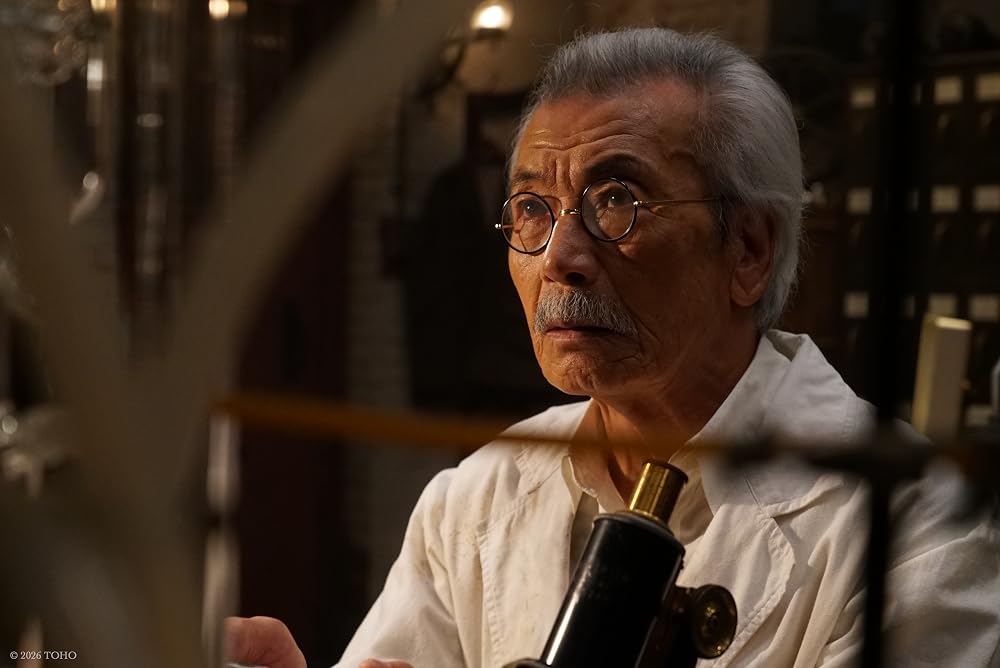
He joins forces to face the King Ghidorah threat with Kenji Noda (Hidetaka Yoshioka), director of the government’s Large-Scale Disaster Response Bureau, who has to put together the reluctant team that will fight this new monster. Former kamikaze pilot Kōichi Shikishima (Ryunosuke Kamiki), who flew the mission that apparently destroyed Godzilla in the previous film, is hoping — in vain — to avoid having to go up against King Ghidorah. Kōichi has married Noriko Ōishi (Minami Hamabe), a survivor of a previous Godzilla attacks, and together they’ve adopted war orphan Akiko (Sae Nagatani). The investment in their new family gives them a great stake in escaping any further life-threatening calamities.
Director Yamazaki particularly wanted a woman represented among the experts on the disaster team, so he created the character of Makoto Aoyama (Masami Nagasawa), a meteorologist with a useful theory about King Ghidorah’s attraction to lightning storms.
Godzilla Minus Zero has that typical sequel effect of moving away from a streamlined narrative toward a complicated one involving more monsters, more characters, more plotlines, more everything. There are promising story developments that aren’t fully explored and are presumably there as starter plotlines for sequels, such as the way living “Godzilla cells” are affecting humans, with a handful of scientific subjects who’ve survived contact with Godzilla but are now manifesting mutations. Noriko wears an eyepatch to cover her one reptilian yellow eye, and she also has Godzilla scales and spikes beginning to grow on one shoulder-blade, hidden by her clothing.
Still, the film maintains that basic rhythm also remembered from childhood when watching old Godzilla films: big action scenes full of exciting destruction and terror interspersed with far duller but somehow reassuring meeting scenes when characters representing science, government, the military, and the model family unit regroup to try Plan B, Plan C, and so on. Yamazaki hasn’t come to challenge the genre conventions but to fulfill them and render them more beautiful.
He makes vast CGI action sequences as sensational as it’s possible to make them, and it seems churlish to complain that, though generally magnificent, it’s still so much goddamn wearying CGI. It’s a generational viewership problem, really. I don’t think young people miss the sense of imprinting off of physical reality that once defined the film medium.
But the figure of Godzilla has such lasting, surefire appeal, it’s hard to quell the basic moviegoer longing to see him again. As Yamazaki put it about his own lifelong obsession,
As a kid, it was just: monster, cool, scary, amazing. Making these films now, I understand how much anxiety Japanese audiences were carrying when the first film came out in 1954, and how the monster’s shape matched that fear exactly. . . . Godzilla was never just a cool monster that wrecks things; he’s always carried the weight of the nuclear question, of war. The more I make these films, the more I feel that weight, and I think it’s exactly why people are still drawn to him.
Godzilla brings his fear-shaped silhouette into contemporary times as we’re “drifting toward conflict” on a global scale, in Yamazaki’s view. He meant the sequel to be weightier and more complex: “It’s entertainment, but I wanted it to leave something heavy behind, too.”
Yamazaki’s ability to unite fond nostalgia for Godzilla movies past, reaching back to childhood, with intensified modern angst forged in twentieth-century horrors that only grow over time, creates a riveting emotional combination. The third sequel is guaranteed, but it’s easy to imagine Yamazaki’s Godzilla movies maintaining their global appeal for as long as we’ve got a habitable globe to stand on.