The End of Oak Street Is Nostalgia Eating Itself

The new sci-fi film The End of Oak Street is about a 1982 suburban cul-de-sac taken over by dinosaurs. It’s Steven Spielberg nostalgia recycled into something barely alive.
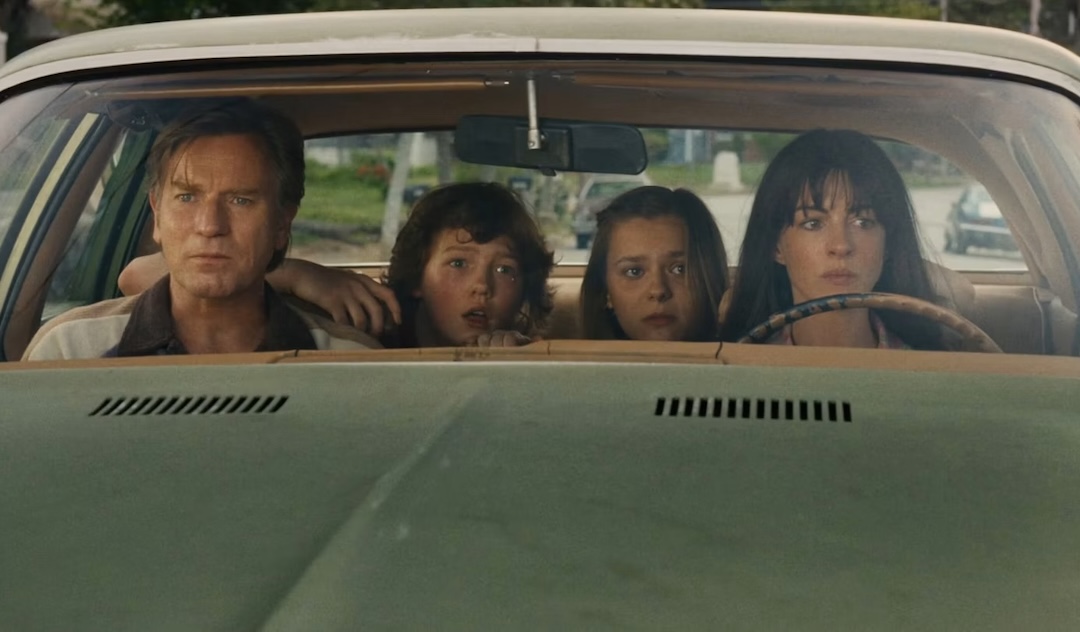
A screenshot of the main characters in the film "The End of Oak Street."

Stranger Things pulled off the rebooted-1980s trick for a while. The End of Oak Street makes it clear it’s now over. (Warner Bros. Pictures)


The most powerful impact created by The End of Oak Street, a lame nostalgia piece evoking Amblin Entertainment from four decades back, is that this sort of thing really must cease. For a while, Stranger Things managed to pull off a rebooted 1980s Americana entertainment crossed with horror, but now that that’s over at last, it’d be great if we’d all agree to just move on.

The classic era of Amblin Entertainment was itself nostalgic for a 1950s Neverland USA. The End of Oak Street is set in 1982, the year of both Steven Spielberg’s E.T. the Extra-Terrestrial and his haunted house film, Poltergeist, and it’s also centered on a white middle-class suburban family experiencing an extraordinary, otherworldly event. The End of Oak Street crosses that scenario with Spielberg’s Jurassic Park (1993), arriving at a plot about an entire suburban neighborhood transported via wormhole to the prehistoric jungle where dinosaurs tromp the earth and feed on everything smaller than they are, which is everything.

As in Spielberg’s 1980s films, The End of Oak Street remains absurdly invested in the prosaic woes of a representative nuclear family, no matter what world-shaking events occur. The Spielberg-ish nuclear family is always “troubled” — Mom and Dad are either divorced or on the verge of divorce, and the kids are anxious about that plus their own suburban concerns. Whatever the big event is that will disrupt their lives, dealing with it allows the family to resolve their own personal troubles, and in the end, voilà, everything is all fixed up again, and the representative white middle-class American family is restored to a restabilized world.

Just the Pleasantville-like opening shots of The End of Oak Street, featuring idealized middle-class white Americans having a block party on a sunny, pastel-colored day, made me want to bolt out of the theater. They’re actually affluent Americans living in big houses with vast lawns and all the trimmings, but you know they’re supposed to be seen as “middle class,” and the block party gathering is lightly sprinkled with people of color for the sake of plausible deniability.

Written and directed by David Robert Mitchell (Under the Silver Lake, It Follows), The End of Oak Street deals with the major and minor travails of the Platt family. They look like they’re living the American dream, but actually their relationships are charged with latent discord. Husband/father Greg (Ewan McGregor) has lost his job and isn’t telling his family why he’s suddenly so eager to deliver pizzas for cash every evening. Wife/mother Denise (Anne Hathaway) spends way too much time in her basement office writing a “novel,” which is actually a lightly disguised autobiography about her unhappy marriage and her desire to flee to New York City to start afresh.

Teenage daughter Audrey (Maisy Stella) longs to be an astronomer but says her parents can’t afford to send her to a good school, and younger brother Brian (Christian Convery) roams the neighborhood with his bow-and-arrow set and has an unrequited crush on a local girl who will wind up more interested in Audrey. The family dog, Starbuck, creates all sorts of problems for their irascible neighbor Mel (P. J. Byrne) — barking incessantly all night, for one thing, and running loose in Mel’s yard where he digs. The Platts’ answer to this is to keep Starbuck on a leash when he’s outside but also to leave Starbuck out all night every night, living alone in his doghouse. So naturally, Starbuck continues to bark all night and chews through his leash and runs away just as the likelihood of his being devoured by a dinosaur hits a sudden, unexpected peak.

Because suddenly the Platts are in the Mesozoic Era, and their fleeing neighbors are getting eaten by giant reptiles, and the only thing that matters is avoiding becoming dinosaur chow. The single advantage to such a scenario is that it no longer matters that Greg isn’t being honest about why he’s been delivering pizzas or that Denise feels unfulfilled in their marriage or that Starbuck annoys Mel the neighbor — now it’s all a desperate matter of survival.

You’d think that, but actually, no. While dodging gigantic chomping apex predators, Greg and Denise are still bickering about their old problems and generally sweating the small stuff. You can take the characters out of white suburbia, but you can’t take the white suburbia out of the characters.

If you’re thinking that this is a wild parody of Spielbergian nostalgia movies about these kinds of people and situations, forget it — I had the same hope that faded almost at once. It’s not a funny movie. It’s not an insightful, critically observant movie. It’s barely a movie at all. Anne Hathaway and Ewan McGregor, who can usually be counted on to bring some pizzazz to their roles, phone in a couple of dull performances. The most interesting thing about them in this film is where they’re at as far as plastic surgery and other face-tightening procedures. Their faces are both so smooth now, so free of crow’s feet, puckers, laugh lines, and other pleasing marks of age and experience, that store mannequins look more lifelike and display greater animation.

Mitchell directs with a lack of visual flair that’s remarkable considering, you know, dinosaurs and all. Presumably this is supposed to be a goofy summer movie blockbuster, gory and mindlessly amusing, but it was dumped into release in the dog days of August for a reason, and it’s doing mediocre business. In general, critics like it far better than audiences, but why anyone likes it is beyond me.

It’s a depressing, zombie-like film, up and moving when it should be long since dead in its grave. May The End of Oak Street be the end of film nostalgia for Steven Spielberg’s film nostalgia.