The Scandal of Flávio Bolsonaro’s Escape Won’t Fade Away
Shortly after losing the Brazilian presidential election, Flávio Bolsonaro fled the country with help from a Trump operative and a former Mossad agent. The newly elected US Congress needs to investigate Washington’s role in this shady exfiltration job.
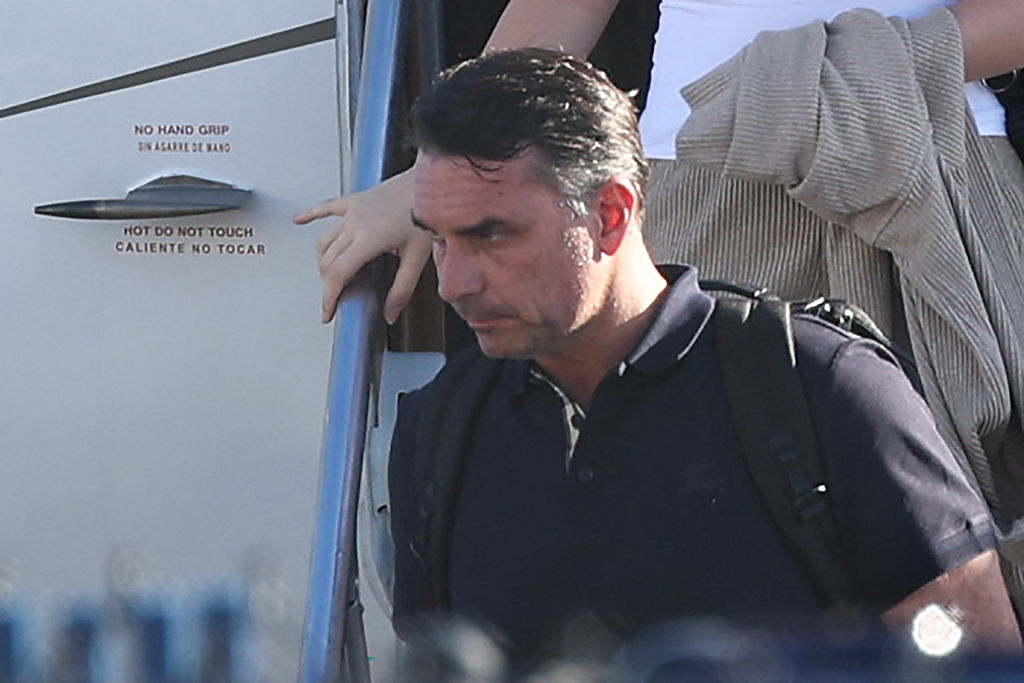
By fleeing Brazilian justice, Flávio Bolsonaro has secured protection, at least for now, from having to answer for his alleged crimes. His flight also makes it harder for Brazilian investigators to prove the precise nature of his ties to Washington. (Ricardo Arduengo / AFP via Getty Images)
To exfiltrate means “to smuggle [an intelligence agent, soldier, etc.] out of an area under enemy control.” The term belongs to military jargon, rather than to political commentary. Nevertheless, the Brazilian media has been using it to describe the sudden removal of former presidential candidate Flávio Bolsonaro from Brazil’s territory a couple of days after he lost the second round of this year’s presidential elections.
José Roberto de Toledo, a veteran journalist, was probably the first to use the word “exfiltration” in relation to Flávio Bolsonaro, in his influential weekly podcast. The circumstances of Bolsonaro’s escape seem to come directly out of a spy film. Smuggled in the middle of the night across the border with the active participation of a former Mossad agent and US government officials, he reappeared in Florida and pledged to take the details of his escape to his grave.
An exfiltration is not an act of political sympathy. It is an extremely risky operation to preserve an asset from being captured by the enemy. On the one hand, the exfiltrated asset enjoys safety when he finally reaches his destination; on the other, the exfiltration makes all masks fall, and the fugitive’s true allegiances become transparent.
For that reason, if Flávio Bolsonaro was indeed exfiltrated to the United States, this episode should figure side by side with the kidnapping of Venezuelan President Nicolás Maduro as a blatant example of US neo-imperialism in Latin America. The political and legal responsibilities for this case cannot be brushed under the carpet of history and will certainly come back to haunt Brazil-US relations for decades to come.
A Very Suspicious Escape
The details of Flávio Bolsonaro’s escape from Brazil are not entirely known. So far, The New York Times has reported that Jason Miller, a White House operative, arranged the luxury private jet that Bolsonaro and his family used (at the cost of almost one million reais, paid for by an American corporate account).
The party crossed the border with Argentina through means that are not yet entirely clear, most likely by land, on the night of Tuesday, October 27, near Foz do Iguaçu. Brazil’s top Sunday night TV news show, Fantástico, revealed that a former Israeli intelligence operative accompanied the fleeing Bolsonaro family. From the Argentinian border location of Puerto Iguazú, the disgraced former presidential candidate took a private jet to the United States, stopping in Ecuador for refueling and avoiding Brazilian airspace.
Arriving in the US, Flávio Bolsonaro landed at the infamous Miami–Opa Locka Executive Airport, used six decades earlier to prepare for the US-supported Bay of Pigs invasion of Cuba, one of the worst historical examples of direct US imperial aggression in Latin America. Upon arrival, despite presenting his canceled diplomatic passport, Bolsonaro received “parole status” and was escorted by a motorcade to an undisclosed location.
Who Takes Responsibility?
Donald Trump’s secretary of state, Marco Rubio, was quick to deflect responsibility. “We didn’t facilitate anything,”claimed Rubio in a press conference on the sidelines of a G20 meeting a few days after the fact. He knew that confessing the exfiltration would mean exposing the State Department to serious internal and international reckoning.
Flávio Bolsonaro himself told The New York Times he would take the details of his fleeing “to the grave.” In an open letterreleased after his arrival in the United States, he compared himself to figures like José Martí and Charles de Gaulle and denounced the election result. He also thanked Argentine President Javier Milei “for his courage, sense of justice, and legality” and expressed his gratitude to Trump “and the wonderful American people” for hosting him.
By fleeing Brazilian justice, Flávio Bolsonaro has secured protection, at least for now, from having to answer for his alleged crimes in two different investigations. More important, as long as he is safe in the United States, it becomes more difficult for Brazilian investigators to prove the precise nature of his ties to Washington.
He is not the first person to have claimed US protection in suspicious circumstances. His younger brother Eduardo has been agitating from Texas for the Trump administration to impose sanctions against his own country, while the former head of the Brazilian intelligence agency under Jair Bolsonaro is also on US soil, having dodged immigration enforcement under very mysterious circumstances.
However, Trump and Rubio cannot shield Flávio Bolsonaro from justice and history indefinitely. It took decades for Washington’s involvement in military coups across Latin America in the 1960s and 1970s to be proven with overwhelming evidence. A comprehensive apology is yet to materialize.
Hopefully, we will not need to wait that long this time. A newly elected Democratic-controlled Congress should hold US officials accountable for any interference in the Brazilian democratic process. It should clarify whether US taxpayers’ money was used to facilitate Bolsonaro’s escape from justice and whether he promised his eventual US handlers any specific information or advantages, beyond his public pledges to give the US preferred access to Brazilian rare earths.
In due course, Flávio Bolsonaro must be extradited, and cables and intelligence documents pertaining to this case should be declassified, so that the Brazilian and American people can finally learn what really happened on the night of October 27.