Brazil’s Far-Right Trajectory Is a Warning for Us All
To understand the global appeal of the far right, look to Brazil, where Bolsonarismo has capitalized on social disintegration to cement brute exploitation as the dominant social logic.
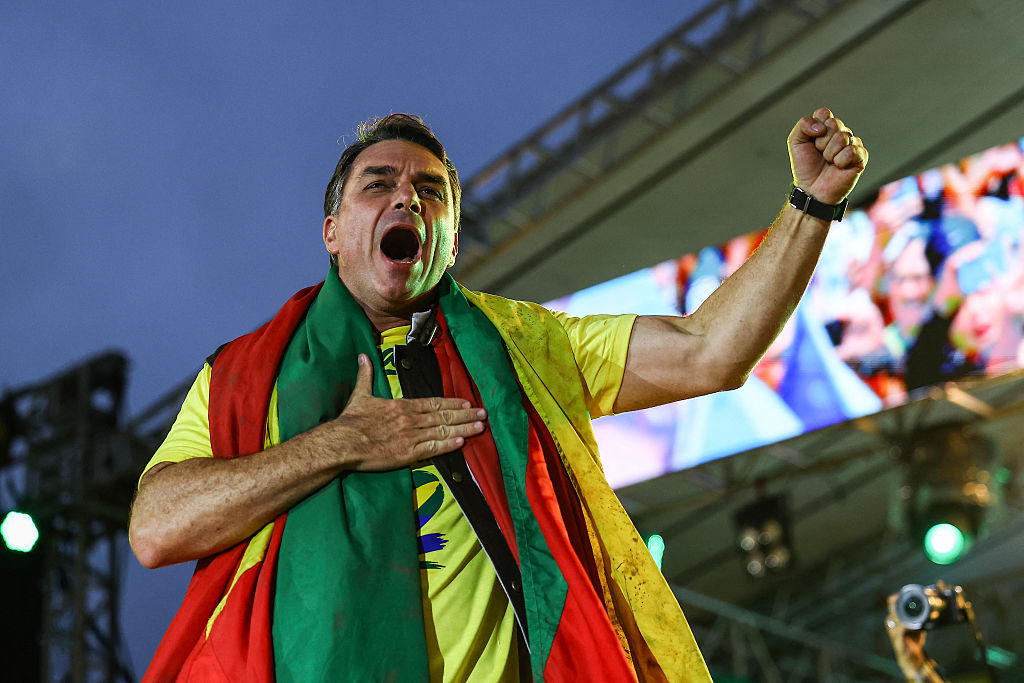
The idea that countries of the capitalist periphery would, in the inevitable march of economic progress, come to resemble the US and Europe has been turned on its head. Instead, are we witnessing the “Brazilianization” of the world? (Silvio Avila / AFP via Getty Images)
Attempts to make generalizations from what happens in the United States and Europe to the rest of the planet do not, as a rule, meet with much surprise; these are, after all, generally assumed to be the most advanced edges of world history, where processes that will eventually spread to other regions first take hold. Most of the literature on the lethal danger surrounding democracies that has flourished in the last decade implicitly assumes these central countries as the normative standard from which others — and increasingly themselves — can be measured as deviations. Starting from a place like Brazil, on the other hand, does not enjoy the same air of self-evidence and seems to require some explaining. Countries on the periphery are supposed to be somehow quirky and unique, partaking in what is universal only through the ways in which they have caught up with their developed counterparts, and otherwise assumed to be locked in a particularity that prevents them from offering anything generalizable. The irony, in this case, is that a tradition within Brazilian social thought has for some time elaborated an argument not only as to why that is not true but that those may, in fact, be precisely the places from where to start.
After the defeat of historical fascism in World War II, the division of the world into two competing geopolitical blocs pushed both sides to work on their sales pitch to those countries that had hitherto lain in the margins of the global market. Whereas the Soviet bloc offered the international comradeship of the exploited and the imminence of world revolution, its capitalist rivals held up the promise that, if they stayed the free-market course, all nations could one day attain the same level of material well-being that the richest countries enjoyed. This prospect was at the center of the different approaches that became collectively known from the 1950s onward as “modernization theory.”
Almost immediately, a loose group of thinkers from Latin America and Africa began to build a critique of it. Development was not a race, they argued, in which each country had their own lane to run down and could reach the finishing line regardless of when they began, but rather more like chess, the position of each piece conditioning the moves available to all others. This gave the first countries to set out on the capitalist road a first-mover advantage: While their own early takeoff had been made possible by colonialism and slavery (and the access to cheap labor and nature that these afforded), the integration of former colonies into the global market had been based on unequal exchange from the start, subordinating whatever development they could have to the needs and interests of development taking place elsewhere. The fact that one could speak of a center and a periphery within capitalism was, therefore, no mere factual, transient contingency. Not only had the constitution of the subordinate pole been the exact same process through which the dominant one established itself, but the fact that the former could only grow within terms dictated by the growth of the latter meant that, even as the periphery progressed, the very relation of dependency reproduced itself. This entailed that the development of the periphery could only ever be “dependent,” “limited,” or “underdeveloped.”