Culture Vultures Want a Piece of Democratic Socialism

Prediction-market company Kalshi staged a fake viral video during the Knicks’ championship run in order to associate its brand with Zohran Mamdani’s democratic socialism. As the Left’s cultural reach grows, expect more attempts by capital to commodify it.
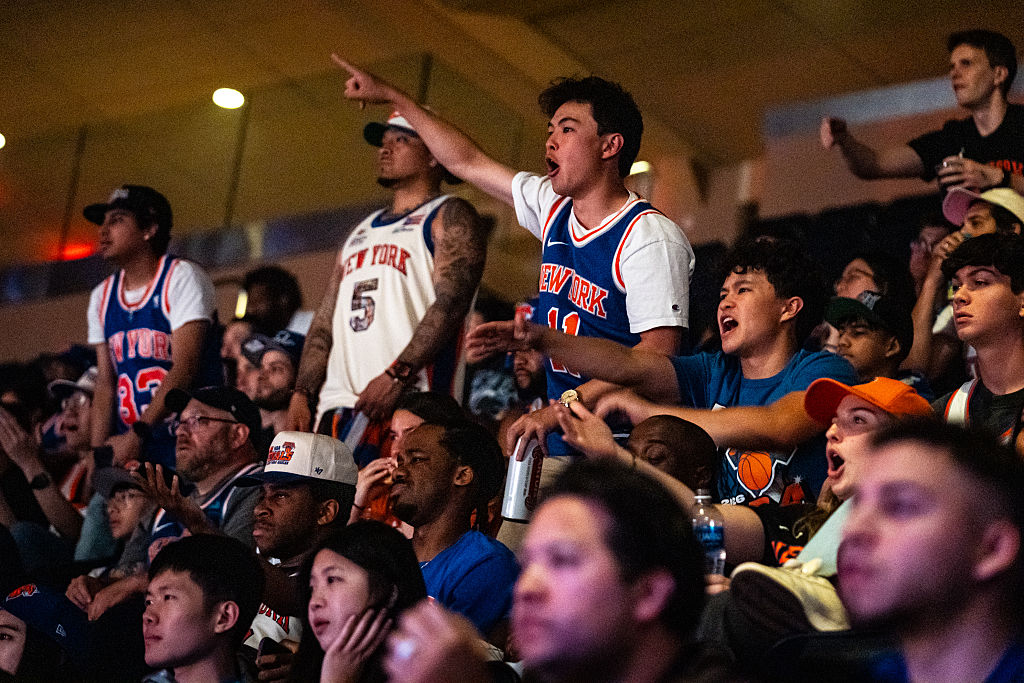
New York Knicks fans cheer during the watch party at Madison Square Garden for game two of the NBA Finals against the San Antonio Spurs on June 5, 2026, in New York City.

Prediction-market giant Kalshi recently staged a faux street video that piggybacked on Knicks fandom and support for Zohran Mamdani. As socialism’s cultural force grows, capital will seek to incorporate it into circuits of speculation and commodification. (Angelina Katsanis / Getty Images)


One of the most striking side stories of the New York Knicks’ historic NBA championship run was the centrality of politically inflected branding during the finals. As companies experiment with marketing to residents of a city that increasingly identifies with socialist politics, the trend offers a revealing window into the current political moment: a left-wing politics with growing cultural reach is becoming a target for commodification. The phenomenon raises broader questions about how the Left should respond as media-driven politics, branding, and social platforms increasingly shape political identity, engagement, and organizing.

It is not that the democratic socialism represented by Mayor Zohran Mamdani and the Democratic Socialists of America (DSA) in New York City has somehow been absorbed into consumer culture. Rather, the question is what happens when an ascendant political project finds itself reflected, commodified, and circulated through branding and media.

And we saw this play out most directly as the Knicks became NBA champions for the first time in fifty-three years. There were numerous prediction-market antics outside of Madison Square Garden (MSG), especially from two of the biggest, Kalshi and Polymarket. One of the defining moments came in game three, when MD Ahnaf Hossain, a Knicks fan, yelled into the mic of what seemed like a street reporter gathering vox pops: “My mayor Muslim, my bagel Jewish, my Christian Dior, Knicks in four!” When the Knicks lost game four, he was back, adjusting the slogan: “My mayor’s still Muslim, my bagel’s still Jewish, the pope’s on our side, Knicks in five.”

The slogan became an overnight sensation, with some New Yorkers and the media, including the New York Times and the Washington Post, praising it as a testament to New York City’s rich cultural and religious diversity.

Kalshi’s Faux Swagger

The interview with Hossain used the street-style format popularized by accounts like Sidetalk, the rowdy media brand that features various fans, mostly at Knicks games or at Coney Island, screaming into the camera, lunging at each other, and embodying the chaotic energy commonly associated with New York City. Mayor Mamdani himself earlier appeared in one of Sidetalk’s videos.

As Hossain’s first “My mayor’s Muslim . . . ” video went viral, it became clear, because of social media detectives and mainstream media attention, that Hossain wasn’t interviewed by an ordinary news organization or one of the street-style accounts. His energy may not have been entirely spontaneous.

The logo on the microphone was the giveaway: it belonged to Kalshi. The company has been in the news for its predatory behavior, alignment with right-wing figures — including Donald Trump Jr, who serves as an adviser — and criminal charges, filed in Arizona, alleging that it operated an illegal gambling business. Yet this has done little to alter people’s perceptions of the videos.

Left-leaning politicians were quick to jump on the trend. City councilor and DSA member Chi Ossé made an Instagram post chanting the slogan. A few days later, Ossé followed up with a social media post featuring Brad Lander, who is running for the US House of Representatives in Brooklyn against Dan Goldman, a rabid pro-Israeli candidate.

Ossé and Lander stand on a quiet Brooklyn street: “Our mayor Muslim, our future congressman Jewish,” they say, pointing at Lander. Then Lander says, “Chi, can you explain Pop Smoke ‘Dior’?” in reference to the murdered Brooklyn rapper, whose song “Dior” became a soundtrack of New York City nightlife in 2019. Ossé demurs: “Let’s just stick to ‘Knicks in Four!”

What is striking is that Ossé and Lander filmed their video after it had become widely known that the first Hossain video was Kalshi-branded, and after Hossain had given a slew of media interviews identifying the first video as such.

Mamdani repeated part of the slogan at a rally for Lander last weekend: “My mayor Muslim, my Brad Jewish, and I am not gonna go any further. . . . ”

Mamdani and Ossé are members of the DSA, while Lander could be described as DSA-adjacent. While DSA and its allies in New York City have built a politics rooted in popular organization — branches, meetings, conferences, and grassroots mobilization — they operate within a political environment increasingly shaped by advertising agencies, consultants, and branding strategies. The British cultural studies scholar Raymond Williams, not for nothing, once said, “Advertising was developed to sell goods, in a particular kind of economy. Publicity has been developed to sell people, in a particular kind of culture.”

Capital’s Détournement of Socialist Style

Mamdani’s mayoral campaign was instructive. His insurgent bid, which captured much of the city’s political energy, owed part of its success to a savvy social media strategy. As a democratic socialist, he embraced the street-content format, with one of his first viral videos tackling “halalflation” — using a halal cart to connect his affordability agenda to the city’s broader cost-of-living crisis.

This form of video aimed to capture his authenticity and created a template — emulated by numerous other politicians who have run for office since, who try to replicate his direct, street-style communication, although often without Mamdani’s political platform, which was the real key to his victory.

It is precisely this question that interests us: What happens when this style of communication, based in perceived authenticity and associated with democratic socialism, is mobilized not for a political platform but for profit, and how does it filter back into politics?

The Kalshi spectacle is only the latest example of the ongoing commodification of political life. Prediction markets are not merely seeking to forecast politics; they are attempting to embed themselves within its cultural language and everyday vocabulary.

What appeared to be an organic expression of enthusiasm during the NBA finals ultimately turned out to be an advertising campaign for Kalshi. Its appropriation of fan culture and grassroots-style expression illustrates how easily nontraditional media can be absorbed into commercial logics. More than that, it suggests that the capture and monetization of ostensibly organic political and cultural spaces is no longer external to the alternative media ecosystem but is becoming one of its defining features.

Rather than being a sign of chaos, disorder, and the expression of neutral political fanfare, what occurred outside and inside MSG is profoundly political, reflecting the dynamic terrain of New York City’s political economy — and who is excluded and included in its social contract. It is no surprise, then, that one of the official sponsors of MSG is Kalshi.

The Commodification of Political Life

During the playoffs, the area outside of MSG became a site of police militarization, taxpayer-funded NYPD overtime, and capital accumulation, alongside democratic socialist energy. Inside it was much the same. If the most organic expressions of Knicks fandom are found in the streets, then the spectacle around the garden revealed something else: the streets themselves can be appropriated, folded back into the circuits of branding, commerce, and political image-making.

We live in a media environment where traditional outlets are increasingly rejected in favor of supposedly more “independent” sources. What prediction markets reveal is how authenticity itself is manufactured. Rather than advertising directly, they embed themselves within the cultural zeitgeist, using seemingly independent social media accounts and viral phenomena as vehicles for billion-dollar enterprises. In the process, language and culture are increasingly ventriloquized by these platforms, as public opinion, memes, political violence, and even imperial aggression are transformed into commodities and traded as financial instruments.

Because of its economic infrastructure, Kalshi can present itself through its users not as a corporate or financial goliath but as a cultural current embedded within fans’ culture itself — hence the “iconic green mic.”

Kalshi embodies everything supposedly antithetical to a socialist project, yet it instrumentalizes the populist tactics that draw their power from the type of perceived authenticity that propelled Mamdani into office. A supposed message of religious solidarity is being popularized by a company that profits from gambling on the annihilation of people — through “prediction markets” on whether Gaza will be ethnically cleansed and face famine, or whether Iran will continue to be bombed by the United States.

A dual danger emerges from this phenomenon. The first, and most obvious, is the increasing power these corporations have to dictate culture. The second is what is currently crystallizing in New York City: an attempt to hijack “democratic socialist” culture for mass consumption, appealing to middle-class lifestyle politics.