In Europe, Too, Amazon’s Warehouses Are a Dystopia
We visited Amazon warehouses in Germany and Poland. Managers told us workers were well paid and supported. Workers described a system of surveillance, relentless productivity targets, and pressure not to organize.
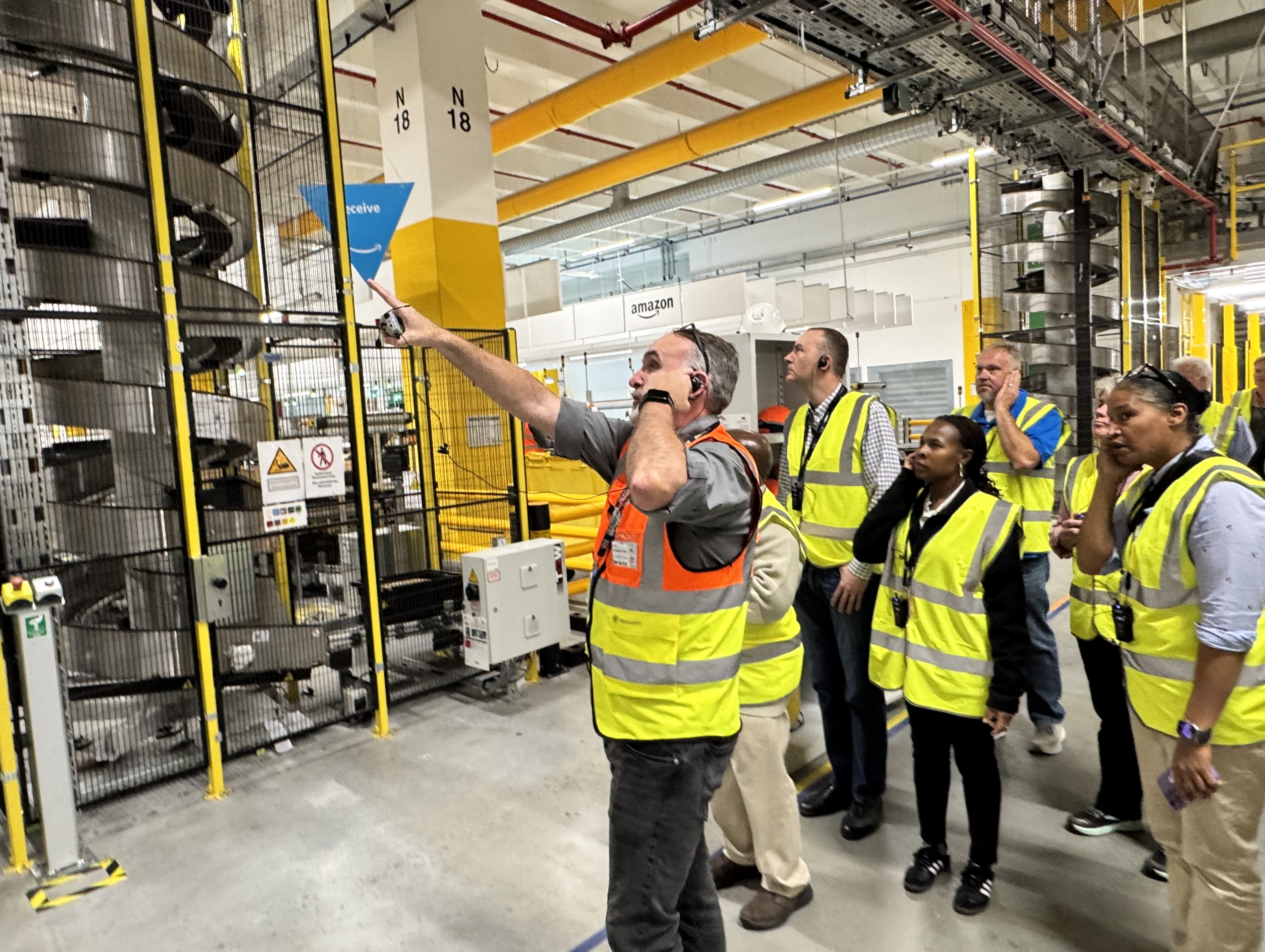
A tour of Amazon’s fulfillment center in Kaiserslautern, Germany, on May 30, 2025. (Cameron Porter / US Army, public domain)

When you see it, it’s hard to believe that nobody, at any point from planning to installation, raised a hand to say how tone-deaf it was. But there it is, emblazoned in bright colors above the gates where workers enter an Amazon warehouse in Germany:
“Work hard. Have fun. Make history.”
The corporate Americana and hyperoptimistic bravado are enough to make us wince. In Germany, of all places, words about work above an iron gate also bring to mind a much darker time and another slogan about work and freedom. It’s a terrible look.
That gate was our introduction to a fact-finding mission to Amazon warehouses in Germany and Poland. On October 26 and 27, we joined a delegation from the European Parliament’s Committee on Employment and Social Affairs at the company’s sites in Mönchengladbach, Dortmund, and Sosnowiec, near Katowice.
The visit was long overdue. In refusing to take part in the European Parliament’s hearings on warehouse working conditions, Amazon showed disrespect for workers’ rights and for democracy. A planned visit fell through in 2023, and the Parliament revoked Amazon lobbyists’ access badges in 2024. This January, the committee finally held a hearing with Amazon representatives and workers. By October, members of Parliament could visit the warehouses without signing nondisclosure agreements and with few restrictions on taking photos or videos.
We knew what we were dealing with even before we saw the sign. Amazon workers and their unions have organized campaigns and taken strike action over digital surveillance, punishing work rates, reliance on temp agencies, and the company’s resistance to collective bargaining. Amazon has also been accused of rerouting packages to blunt the impact of strikes.
The sign captured much of what we saw and heard during the visit. From the slogans on the walls to the managers’ answers to our questions, we encountered an eerie, over-the-top optimism and a single overriding concern: productivity at any cost.
At times, it was nearly impossible to discuss our concerns with the managers who accompanied us. We asked about reports of worker surveillance and algorithmic management, and whether rising productivity targets put workers at greater risk of injury. The managers dismissed our concerns as a misconception.
They said they measured workflows, not individual workers. If someone fell behind, then of course it was a manager’s job to help them. Wouldn’t we agree? When we raised collective bargaining, they said they preferred speaking to workers directly. Everyone was earning more than the minimum wage, they told us, and getting good benefits. Wasn’t that a good thing?
It felt strange to move through the warehouses with these optimistic, evasive chaperones. At one station, we stopped to watch a worker who was intensely focused and moving very fast. She looked stressed. A manager hurried over to explain that our presence was probably the reason.
The next day, at the Polish warehouse, things seemed much calmer. A worker later told us that management had diverted packages away from the site, offered an unpaid day off to anyone who wanted one, and had many of the workers who came in wait in the canteen during our visit.
We met with workers and unions in the evenings after our visits. What they told us sounded like it came from a different world from the one the managers had described.
The workers described what sounded to us like a digital panopticon. We had been unable to get a clear picture of how Amazon used technology to monitor and discipline workers. The workers had little more insight into what data Amazon collected on them, how it used that data, or how it set their performance targets.
But they knew what happened if they fell short.
Workers told us that if they went a certain number of minutes without scanning a package, the system counted that time as a break. If they couldn’t keep pace, a manager would keep dropping by their station, smiling, telling them to do better.
The uncertainty, combined with constant pressure to go faster, made workers feel paranoid, they told us. If you think you’re always being watched and need to move faster to keep your job or avoid being seen as difficult, you go faster and faster.
That is the logic of Jeremy Bentham’s panopticon, which Michel Foucault used to explain how surveillance disciplines people. The threat of punishment gets inside your head and drives you forward.
Some workers told us they barely dared to speak to colleagues at the next station, for fear of making them miss a target neither of them could see. Keep your head down and carry on. With even a quick chat out of the question, workers went faster and faster, helping set ever-higher targets they still couldn’t see.
Workers and union representatives also told us how Amazon used technology and workplace practices to thwart collective resistance. Union busting and resistance to collective bargaining have been cornerstones of Amazon’s modus operandi in Europe, too.
In Italy, the public broadcaster Rai reported that Amazon managers received recordings from people who had infiltrated union meetings during a drivers’ labor dispute. Amazon told Rai it lacked details to comment on the specific allegations and said its TERA team monitors publicly available information for operational risks. In a separate inquiry, Italy’s data protection authority ordered Amazon to stop processing personal data on workers at its Passo Corese site, including information on their health and union activity.
This fall, internal documents disclosed in a British Columbia labor dispute described a tool called Atlas that used AI to assess the likelihood of union organizing and other labor activity at Amazon warehouses. The inputs included employee feedback from channels such as Amazon’s Voice of the Associate message board. Amazon told openDemocracy that the tool assessed activity at the site level and that it did not monitor individual workers’ opinions or union affiliations. When we raised the Italian and Canadian reports during our visit, Amazon representatives denied the allegations, with a smile.
The workers’ accounts of union busting went beyond technology. In our evening meetings, workers told us the company had deliberately held works council meetings before it had hired all the warehouse workers at some sites, leaving the councils dominated by management and support staff.
Workers active in unions said they feared Amazon would find out. They told us they’d seen colleagues passed over for promotions or moved to worse workstations. They said Amazon had hired workers just before a key vote on industrial action at some sites to dilute the vote. Strikers told us they had been met with music blasting from speakers outside the gates.
This falls far short of what workers in Europe should expect from employers, even when tensions are running high.
We left the warehouses with much the same concern we heard from labor inspectors. Without fuller access to Amazon’s systems, it’s hard to tell exactly how the company uses them to pressure workers.
We could see the effects, though. As one worker put it: “It is like modern day slavery, without the whip.” At Amazon, the whip has gone digital, built into an invisible algorithm. It works alongside union busting, making workers think twice before demanding their rights. And it comes with a smile.
Our delegation left determined to keep monitoring conditions and supporting Amazon workers.
As workers strike and protest this Black Friday in Europe and around the world, the question is how far Europe is willing to go to defend collective bargaining and workers’ right to act together. That means resisting the Americanization of Europe’s labor market and the idea that large employers alone should set pay and working conditions.