The Socialist History Behind Thanksgiving’s Most Iconic Image
Norman Rockwell’s Thanksgiving painting is classic Americana. Less well-known about the painting: it was commissioned as a depiction of FDR’s “Freedom From Want” and accompanied by a socialist’s essay on the working class as the “creators of abundance.”
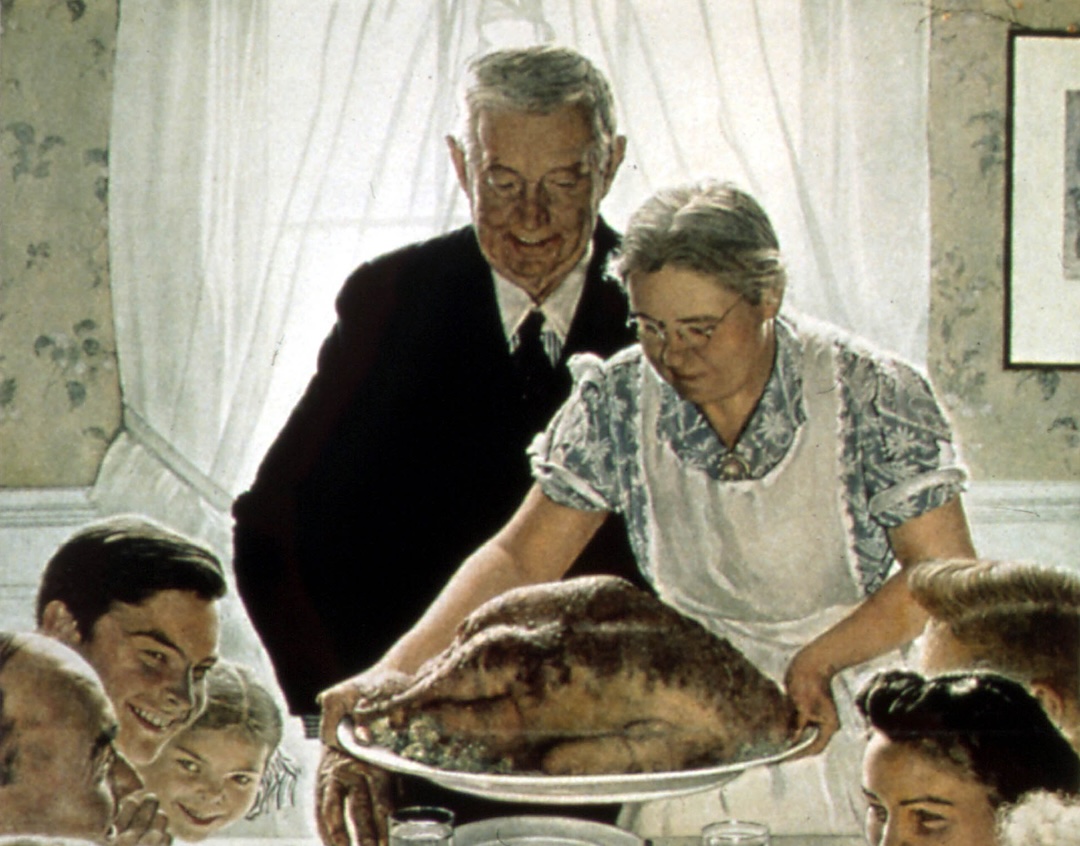
Norman Rockwell’s iconic Thanksgiving painting was commissioned to be an embodiment of the “Freedom From Want” of FDR’s Four Freedoms. (Norman Rockwell / National Archives and Records Administration)
An older woman, still wearing her apron from all her work in the kitchen, brings a large turkey to a table set with cranberry sauce and fruit and full of family, friends, and neighbors, who are smiling, talking, enjoying one another’s company. Her husband stands beside her at the head of the table, surveying the scene with pride.
The 1943 Norman Rockwell oil painting has become perhaps the most iconic and ubiquitous image of Thanksgiving in our modern era. It looks like a classic piece of kitschy, complacent Americana. Yet the image has a surprising political history. With so many in America going hungry this year, it’s a good time to remember that the painting was commissioned in honor of Franklin Delano Roosevelt’s bold call for “Freedom from Want” and released with a much bolder critique of New Deal America for failing to deliver that freedom to everyone.
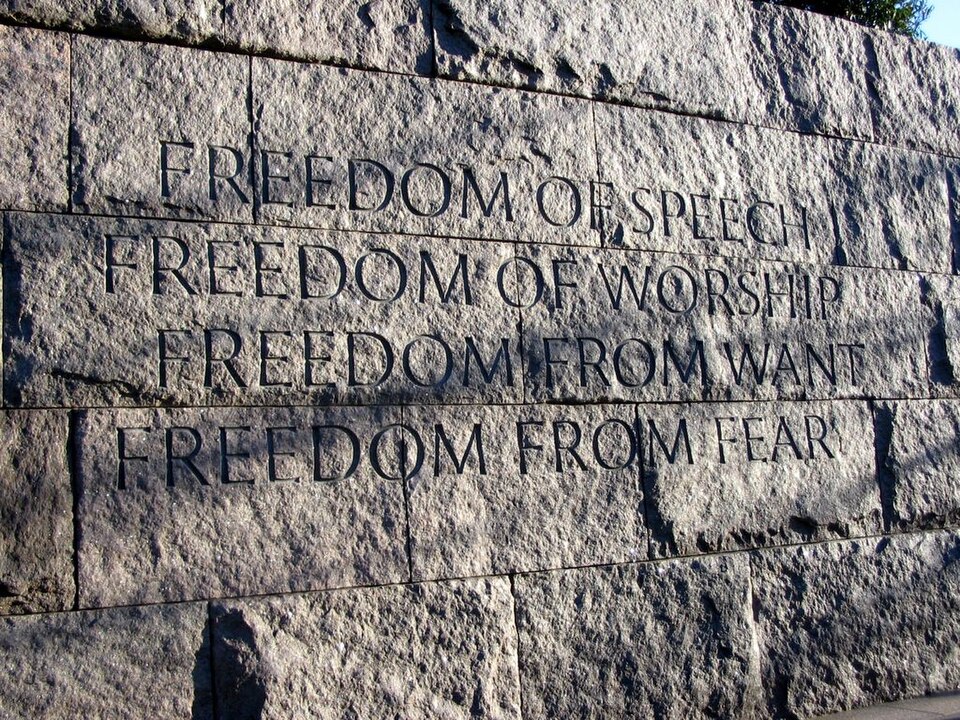
“Freedom from Want” was one of the “Four Freedoms,” values set forth in FDR’s 1941 message to Congress on the need for continued US involvement in World War II, which the US would officially enter eleven months later. In our post–Ronald Reagan world, the very idea sounds revolutionary, especially since FDR said he was describing “the kind of world attainable in our own time and generation.” He argued the entire project of America’s domestic order was an ongoing “peaceful revolution.”
The Four Freedoms speech didn’t make much of an impression on the American public when FDR first delivered it. Two years later, the war underway, The Saturday Evening Post commissioned Rockwell to illustrate each of the Four Freedoms, and the artist delivered this image of an abundant Thanksgiving feast to represent “Freedom from Want.”
Along with the illustrations, the Post assigned essays to accompany them. “Freedom from Want” was assigned to Carlos Bulosan, a Filipino socialist activist, trade unionist, and writer. Bulosan was born in the Philippines to a peasant family, did not receive a formal education beyond third grade, and grew up picking coconuts and selling them to wholesalers to pay his older brothers’ school fees. He came to the United States at seventeen and worked in a fish cannery in Alaska, eventually becoming organizer and an elected official with the longshoreman’s union. In Washington and California, he worked as a dishwasher, a farm laborer, and in other low-wage jobs.
Despite his life’s hardships, he spent many hours in public libraries. Once, during a two-year battle with tuberculosis, he claimed to have read a book a day, including the works of Karl Marx and Walt Whitman. During this same bedridden period in the late 1930s, he began writing, contributing to publications like The New Yorker and Harper’s Bazaar — and The Saturday Evening Post.
Bulosan embraced the “Freedom from Want” assignment with a paean to America’s working class, whom he called “the creators of abundance.” His description of that class is rich and expansive:
If you want to know what we are, look upon the farms or upon the hard pavements of the city. . . . We cut timbers in Oregon just as the wild flowers blossom in Maine. We are multitudes in Pennsylvania mines, in Alaskan canneries. We are millions from Puget Sound to Florida. In violent factories, crowded tenements, teeming cities. . . . We are factory hands, field hands, mill hands. . . . We are the living dream of dead men. We are the living spirit of free men.
He emphasized the working class’s role in driving history forward, seeing that class as the engine of progress, not only through its labor but through its political struggles:
We are bleeding where clubs are smashing heads, where bayonets are gleaming. We are fighting where the bullet is crashing upon armorless citizens, where the tear gas is choking unprotected children. Under the lynch trees, amidst hysterical mobs.
Bulosan celebrates the progress of such struggles, including the right to organize unions. Yet because of the barbarities and inequalities of capitalism, Americans were still suffering deprivation:
We are not really free unless we use what we produce. So long as the fruit of our labor is denied us, so long will want manifest itself in a world of slaves. It is only when we have plenty to eat — plenty of everything — that we begin to understand what freedom means. . . . Our march to freedom is not complete unless want is annihilated.
Bulosan’s writing is heavy with disappointment that this vision hadn’t already been realized, emphasizing that the New Deal hadn’t gone far enough. Yet with an end to hunger, he wrote, democracy could be fully realized. He imagined a polity of plenty:
When we have enough to eat . . . then we have the time and ability to read and think and discuss things. Then we are not merely living but also becoming a creative part of life. It is only then that we become a growing part of democracy.
Rockwell’s painting was originally titled Freedom from Want, though since then, reflecting how this political context has been lost to history, it’s also been called I’ll Be Home for Christmas or simply The Thanksgiving Picture. As many observers have noted, the people around the table are enjoying their time together and are not looking at the turkey; the guests have the luxury of taking the food for granted as they revel in one another’s company.
Although Rockwell reportedly worried that his painting didn’t match Bulosan’s radical essay, it’s not hard to see how it does: both envision an America in which the conditions of plentiful comfort support a robust and lively social world. Just about everyone in America would recognize this Thanksgiving painting, but the socialist demand for food abundance that accompanied it has been forgotten.
That demand is more timely than ever. The cost of a typical Thanksgiving feast for ten this year has increased by 6 percent since last year, according to the American Farm Bureau.
And if you live in a neighborhood with a food pantry, as I do, you are probably seeing long lines around the block. With the increase in grocery prices and millions thrown off the Supplemental Nutrition Assistance Program (SNAP) by the Trump administration’s work requirements, food banks are seeing even more hungry people than during the pandemic years, with a dramatic increase in first-time visitors. Damningly, the Trump administration has discontinued the US Department of Agriculture’s annual household food security survey, but the New York Federal Reserve, in a national survey earlier this year, found what it called a “remarkable” increase in food insecurity from 2025 to 2026, especially in lower-income households and in households with young children. The New York Fed noted at the time that food insecurity was diminishing Americans’ confidence in the future; it seems certain that this increase in hardship contributed to the recent election results.
As so many go hungry in America, even as we elect more leaders in FDR’s tradition, Bulosan’s exhortation to American workers calls to us to push beyond the frame of what seems possible under US capitalism, to make the promises of its democracy real by feeding everyone.
“What do we want?” Bulosan asked, invoking the beginning of a timeless protest call and response:
We want to share the promises and fruits of American life. We want to be free from fear and hunger.
If you want to know what we are — we are marching!