How Amazon Busts Unions, in Its Own Words

Internal documents disclosed in a British Columbia labor case give us an incredibly detailed look into how exactly Amazon carries out its union-busting operations.
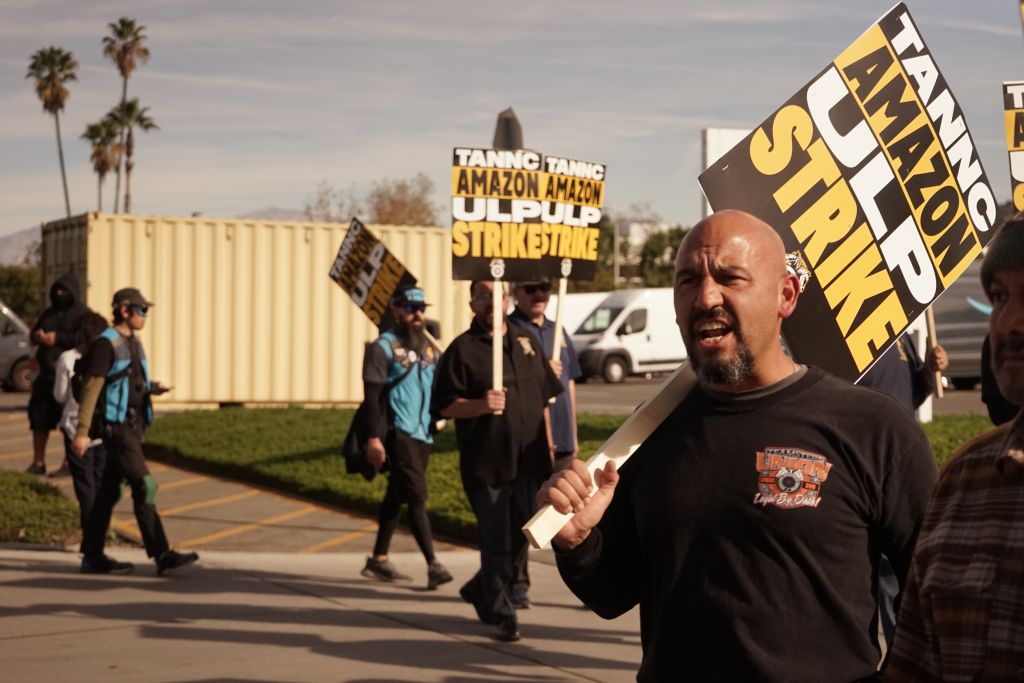
Amazon workers protest in front of an Amazon facility in the City of Industry, Los Angeles County, California, the United States, on Dec. 19, 2024. United Amazon workers from many warehouses in the United States have announced a strike beginning Thursday after they failed to reach an agreement on labor negotiations with the online retail giant. The International Brotherhood of Teamsters, the union representing 10,000 Amazon workers, said in an announcement on Wednesday night that the decision was made as the company refused to recognize their union and would not negotiate a fair contract.

Amazon’s own documents show it ranks its warehouses by risk of labor activity and tracks worker sentiment month over month, specifically to head off union drives. (Zeng Hui / Xinhua via Getty Images)


Nearly ninety years ago, Ford kept its own private security force on the payroll for whenever they needed to beat up union supporters. Having traded in the brass knuckles and baseball bats of the early twentieth century for the empathetic listening and fine-grained surveillance of the early twenty-first, Amazon today employs an entirely different set of tactics to ward off union drives — tactics that may well be more effective precisely because they are so systematic.

Amazon is, of course, a notoriously anti-union employer. Though workers at the JFK8 Fulfillment Center in Staten Island voted to form a union in 2022, Amazon has refused to bargain with them, even after the National Labor Relations Board ordered it to do so this past April. When workers at Cornucopia Logistics, a delivery service provider at its DBK4 Delivery Station in Queens, New York, sought to unionize, Amazon cut the provider’s contract. When workers at what used to be the DXT4 warehouse in Laval, Quebec, just outside Montreal, did the same, Amazon not only shuttered the facility but closed up shop in the entire province.

Thanks to the disclosure of documents related to its anti-union activity in the province of British Columbia, made available through the filing of an unfair labor practice (ULP) complaint by Unifor, which represents workers at YVR2 in Delta, BC, and is seeking to represent workers at facilities throughout the area, we now have a peek under the hood of Amazon’s anti-unionism. Included in these documents (which were produced in public hearings and not subject to a seal order, and which were provided to me by Unifor) were trainings given to managers about how to stave off organizing drives at their facilities, as well as Amazon’s own list of its facilities where there were active union threats.

The picture these documents paint is of a company meticulous and obsessive in its hostility to unionism — an antipathy it has refined into a science.

Manager Training

Amazon’s employee relations (ER) approach, as outlined in its “Amazon Employee Relations” slide deck disclosed in the document collection, is informed by a wide variety of feedback mechanisms, wherein management can systematically take the temperature of employee unrest. For instance, any employee in front of a computer or workstation device receives a workplace-related “Connections” question every day, the answers to which are compiled, analyzed with machine learning models, and summarized for manager review. There are Voice of the Associate (VOA) Boards, where employees voice concerns to senior leaders. Managers also regularly hold “All Hands Meetings,” “Standups” (preshift huddles), and “Gembas” (site walk-arounds), where they are encouraged to listen to their associates. Even birthday parties are framed as an opportunity for feedback.

This all sounds very innocuous — what’s wrong with soliciting feedback? — until we get to the very next slide after all of the feedback mechanisms are listed. Here managers are walked through TIPS, an acronym standing for Threaten, Interrogate, Promise, Spy. TIPS are the things that Amazon managers should not do when confronted with a union drive, which include obvious illegalities like “Don’t mention union or you’ll be fired” (Threaten) and “You’ll get that PA position you always wanted if you tell me who is behind the organizing” (Promise). Then comes a slide about FORE (Facts, Opinions, Rules, Experience), which describe the things a manager should do in the face of a union drive. At this point, it becomes clear what all the careful monitoring of the feedback mechanisms is for.

Slide from Disclosed “Employee Relations 101” Presentation
Slide from disclosed “Employee Relations 101” presentation.

The key “Fact” that managers are encouraged to relay to their workers is that nothing a union promises is guaranteed; the key “Opinion” is that Amazon prizes a direct working relationship with its employees. The “Rules” bit is a somewhat confusing add-on, as managers are simply guided not to change any work rules during a union drive. And the “Experience” part is vague — “share an experience you or someone you know had with a union” — but only a truly confused manager would share a good experience that they or someone they know had with a union.

The bit about a “direct working relationship” is emphasized throughout the trainings, and managers are encouraged to cultivate it through a “culture of open communication.” One slide quotes Maya Angelou, who almost certainly never made the quoted statement — “They may forget what you said, but they will never forget how you made them feel” — to illustrate a good manager’s effect on their employees. This direct relationship is opposed throughout to the supposed way in which a union, Unifor in this case, will “speak for associates.” The lesson Amazon means to impart is something along the lines of: you already have a voice at this company, and the union will take it away.

Slide from disclosed “Amazon Employee Relations” presentation.

They are also explicit about other things that could be taken away, including overtime, paths to transfer between facilities and promotion, and the company’s “open door” policy.

Scripted Empathy

The part of the training devoted to manager personability is a fascinating mirror image of labor organizer workshops: managers are encouraged to have “1:1 conversations” where they follow a script but “don’t want to come across as scripted” and listen to their employees with “care and empathy,” “acknowledg[ing] and validat[ing] any emotion . . . in order to reduce the emotional person’s resistance to logic.” They are trained to seek out “informal leaders,” i.e., people “who have influence over their co-workers,” and to not focus on employees “who will never change their mind.”

Slide from disclosed “Amazon Employee Relations” presentation.

The trainings included in the disclosed documents, including this “Amazon Employee Relations” training, are undoubtedly much tamer than those delivered elsewhere in the world. Labor law in British Columbia is fairly strong, and in one slide of its “Employee Relations 101” training, the company is even explicit that what managers can and can’t say to their employees differs by Canadian province. So in other parts of the world, where managers can be much more strident in their anti-unionism, it’s near certain that the company’s manager trainings encourage as much.

Closely Monitored

Thanks to the feedback mechanisms described above, Amazon is highly aware of labor organizing campaigns at its different facilities, and it even ranks them according to tiers following the “Atlas” model. Tier 1 facilities are those with active card signings and campaigns, Tier 2 are those “high risk” sites predicted eventually to become Tier 1 facilities, and Tier 3 sites are those where the company considers labor activity possible. There are also lower “risk” Tiers 4 and 5. Sites enter or exit Tiers 2 through 5 based on a mathematical forecasting model that assigns a “Labor Continuity Score” to sites between 100 and 900, 100 indicating a five-alarm labor revolt and 900 low levels of activity. Tier 2 sites are those with a score between 200 and 300.

Tier 1 sites include Amazon’s primary North American air hub, KCVG at the Cincinnati/Northern Kentucky International Airport; the facilities that Unifor is organizing in British Columbia; and the delivery stations, DBK4 in Queens and DAX8 in Palmdale, California, and the secondary air hub KSBD at the San Bernardino International Airport, at which the Teamsters now have active campaigns. Interestingly, at this time (which I am guessing was roughly two and a half years ago, as it does not yet list the KSBD campaign as affiliated with the Teamsters), JFK8 in Staten Island was not included in Tier 1, though it did have a low Labor Continuity Score of 224. DJT6 in Riverside, California — Amazon’s largest warehouse in the country, which had a ULP strike earlier this month — had the lowest (again, indicating the most risk to the company) Tier 2 score at 223.

Again, all of this is based on the feedback mechanisms described above. Amazon knows the key issues that are leading workers to organize at different facilities, and it closely tracks month-over-month “spikes” in worker complaints. Everything entered into the Connections questions or VOA Boards is compiled into closely monitored themes. This is a company that has maximized both worker surveillance techniques and the methods by which they can be exploited to quell labor unrest. While information about how “Employee Relations” resources are deployed according to this information is not present here, one can guess that its ER team pays particular attention to those facilities with low Labor Continuity Scores.

Though actual feedback provided is sparse in the disclosed documents, there are legible snippets that speak to a cruel reality at Amazon: while employee comments are closely monitored and synthesized into unintelligible word salads to track patterns of possible labor activity, employees themselves clearly express how their own feedback is regularly ignored.

Question for the day!!!!! Does it matter if we the associates voice our views in regards to health issues, safety issues, respect issues, values and moral issues. . . .  Fairness and no favoritism. . . .  on this platform. . . .  it appears that this platform is design so that leaders will know what your concerns are so that they can say, “Well we address the issues” . . .  that is before you the associate take the real issues a step higher. . . .  Have any of you notice any changes. If you have then God Bless you.

Baked In

Perhaps the most unassuming of the slide decks included in the collection of disclosed documents is one devoted to a “Leadership Workshop” for facilities in British Columbia. It reviews how to manage “tough conversations” by “leading with empathy” toward “healthy dialogue.” Empathy in tough conversations includes active listening, genuine interest, understanding their point of view, and other affirmable, if somewhat imprecise, suggestions. It all seems quite milquetoast and unobjectionable, until you get to the end, where FORE and TIPS make their appearance, and you begin again to understand what this deck is really about.

These slides make it clear that anti-unionism at Amazon is not merely one of several priorities among management. It is baked into the very essence of leadership at Amazon. Managers are trained to listen with “care and empathy” to the explicit end of inoculating employees against union drives. Worker feedback is solicited, not to resolve issues that are raised at particular worksites but to gauge the temperature of labor unrest. These documents portray a company that is not hotheaded and ideological but manipulative and mathematical in its resistance to unionism and willing to deploy the kindest of gestures — care, listening, empathy — in the service of corporate power.

While the brass knuckles and baseball bats have been retired, this new, more “enlightened” strategy of the twenty-first century has the same goal: workers scraping by and keeping their mouths shut all so that profits can soar. We’re already starting to see the kind of world that creates, and it’s one every bit as brutal as the days of brass knuckles.