The Indignados Movement Changed Spanish Politics Forever
This day in 2011, the Indignados protesters occupied Madrid’s Puerta del Sol to denounce Spain’s dominant parties and their austerity agenda. Ten years later, the Spanish left no longer has that insurgent dynamism — but it’s had an enduring success in breaking a previously monolithic neoliberal consensus.
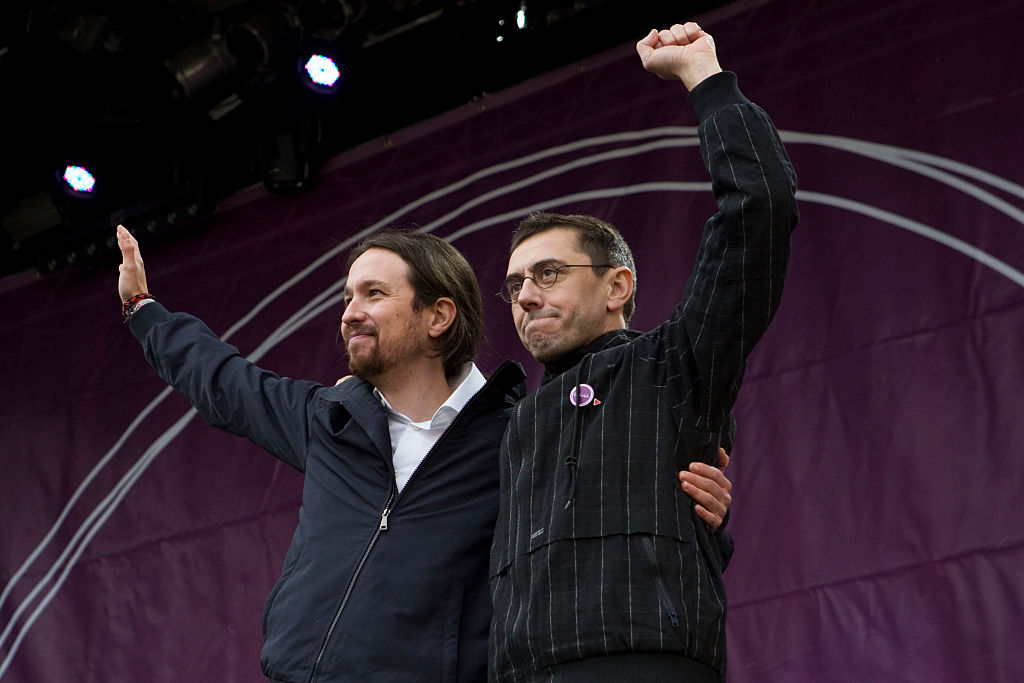
Pablo Iglesias (left) with Juan Carlos Monedero (right), after a Podemos march in Madrid, Spain, on January 31, 2015. (Rodrigo Garcia / NurPhoto via Getty Images)
Ten years ago today, a demonstration was called in Madrid’s Puerta del Sol under the slogan “We are not commodities in the hands of politicians and bankers.” Some fifty thousand people participated in the May 15, 2011, protests in the capital, launching what became known as the 15-M, or indignados, movement. As it spread over the following weeks, hundreds of thousands, if not millions, took part in assemblies and occupations in the central squares of towns and cities across Spain. With the European Union imposing brutal austerity on the country’s center-left PSOE government, and with the youth unemployment rate hitting 46 percent that year, 15-M articulated the rage of a generation toward a system that could offer only declining living standards and a hollowed-out democracy.
The wave of social-movement activism and anti-establishment feeling that coursed through Spain between 2011 and 2013, in turn, gained organized political expression. Podemos, founded at the start of 2014, and its charismatic leader, Pablo Iglesias, surged to 20.7 percent of the vote at the 2015 general election, posing a seemingly deadly threat to Spain’s entrenched two-party political system. Yet today, the situation looks rather different. With Iglesias retiring from frontline politics this May 4, less than two weeks before the tenth anniversary of 15-M, many have framed the current moment as the end of a political cycle.
Following his resignation, supporters have praised Iglesias as “the general secretary of an entire generation,” while Madrid’s right-wing mayor José Luis Martínez-Almeida, gloated that “exactly ten years later, Pablo Iglesias has cut off his [famous] ponytail — that is the only legacy of the 15-M movement.” In this respect, a certain left-wing nostalgia is reaching similar conclusions to those within Spain’s conservative establishment who are seeking to harness the anniversary to proclaim a definitive restoration of the country’s old two-party status quo.