Anwar Shaikh Changed My Life
Economist Anwar Shaikh, who died this month, spent half a century turning Marx’s categories into hard numbers. His first teaching assistant and longtime collaborator remembers the man and the work.
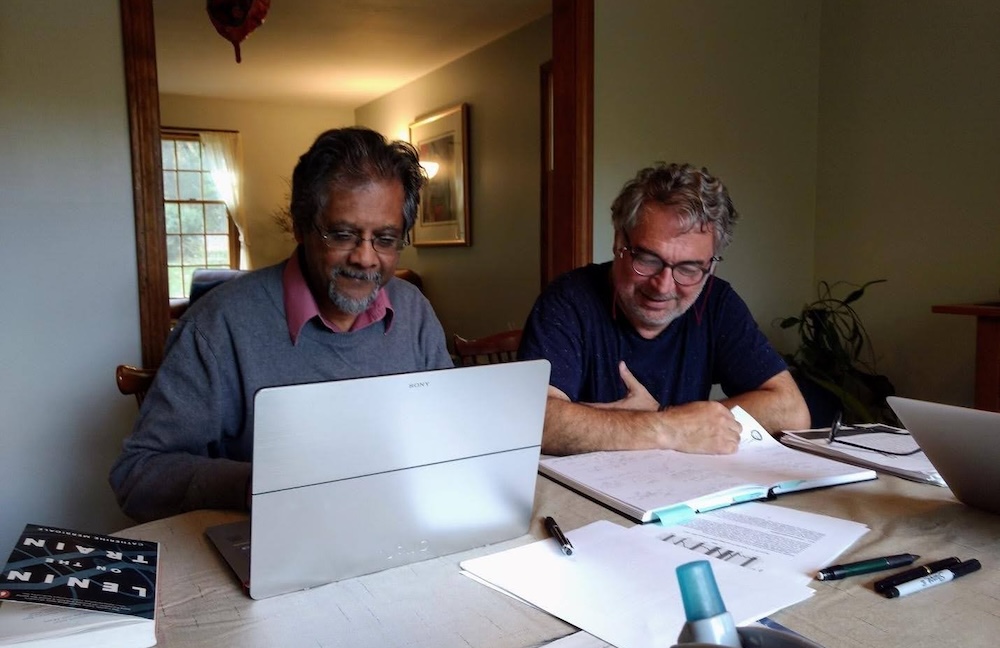
Anwar Shaikh and E. Ahmet Tonak working on their never-completed final project at Tonak’s house in Leeds, Massachusetts, in 2017. (Courtesy of E. Ahmet Tonak)
Anwar Shaikh, one of the most important Marxist economists of his generation, died on October 6 at the age of eighty in New York City.
Two years ago, a conference was held to mark his retirement from the Department of Economics at the New School for Social Research, where he had taught for fifty years. I was one of the speakers on the first panel. I opened my talk by adapting the famous first line of Orhan Pamuk’s Yeni Hayat (The New Life), knowing that Pamuk was one of Anwar’s favorite writers: “I met Anwar Shaikh, and my whole life changed!”
That is truly what happened.
After the 1971 military coup in Turkey, I went first to Sweden and then came to the United States. While doing political organizing with Turkish students in New York, I was also trying to finish a master’s degree in applied mathematics and statistics, partly to keep myself occupied. My plan was to return home at the first opportunity and work as a journalist, inspired by the politically exhilarating days I had spent at the newspaper Yeni Ortam in the early 1970s.
By then I had married, and when complications over my military service obligations made it necessary for me to stay in the United States a while longer, I began looking into the doctoral program in Marxist economics at the New School. That’s where, in 1975, I first met Anwar in his office. He was very warm toward me and strongly encouraged me to apply to the program. I think our immediate rapport came from the fact that he had lived in Turkey as a child, and that I had a background in engineering and mathematics.
In the doctoral program, I not only took all of Anwar’s courses but also became his first paid teaching and research assistant. His research helped me settle on my dissertation topic, which eventually led to the book we wrote together. In short, my life really did change. I had met Anwar, and instead of returning to Turkey to pursue journalism, I found myself drawn into economics and, eventually, an academic career.
Anything written in memory of someone who taught for fifty years — a man who left behind thousands of pages of published work and thousands of files of unpublished notes, letters, and other materials, and made contributions not just to one field of economics but to nearly all of them — will inevitably be selective. I want to touch briefly on two concepts that Anwar pioneered and on how they inspired me and a later generation of researchers to pursue new lines of inquiry.
Anwar’s unpublished 1975 paper, “IO Accounts and Marxian Categories,” and his famous 1978 paper, “National Income Accounts and Marxian Categories,” which circulated from hand to hand almost like samizdat, can be considered early drafts of Measuring the Wealth of Nations, the book we eventually published together in 1994. The 1978 paper contains a preliminary calculation of net tax (taxes on labor income minus expenditures on labor income) covering just three years. This category aimed to show how the capitalist state’s distributional policies affected productive workers and altered the rate of surplus value. In my dissertation, I extended these calculations to cover 1952 to 1980, again using the net tax category.
Later, in two papers on the subject, Anwar and I replaced net tax with the category of net social wage (expenditures on labor income minus taxes on labor income) and questioned whether a welfare state could really be said to exist in the United States. Today there is a substantial body of literature on the net social wage in various countries, including Turkey. My younger colleague Yakup Karabacak and I recently completed the most comprehensive of the Turkish studies, contributing once again to a field of research that Anwar had opened up.
Let me now turn to profit on alienation (POA), a concept that Anwar began using in the 1970s in the context of the transformation problem and that later appeared both in our joint book, Measuring the Wealth of Nations, and in his 2016 magnum opus, Capitalism: Competition, Conflict, Crises.
Marxists have generally been reluctant to embrace this concept. After all, under capitalism, the fundamental source of profit is surplus value generated in the sphere of production, while profit on alienation is discussed in the Marxist literature mainly in connection with precapitalist merchant profit.
Yet as my former student Alper Duman and I tried to show in a paper we wrote together, POA also provides a useful starting point for analyzing phenomena within capitalism itself: both privatizations, which have been central to neoliberal policies, and the gains banks extract from workers’ incomes. In that paper, we also sought to operationalize the concept in the Turkish context and estimate it empirically. In a sense, following in Anwar’s footsteps, we gave concrete empirical form to a concept whose importance he had emphasized primarily at the theoretical level.
Since Anwar’s death, social media posts and written tributes have come mostly from American academic circles, particularly his colleagues and his current and former students. Most, like this one, recall the parts of his work and character that shaped their authors. For me, one of the most remarkable tributes is the personal account of Wando Frank. Frank wrote about how Anwar’s writings had also changed the course of his life:
I won’t pretend I didn’t tear up seeing this. I remember working the backshift in Dover, a petrol pump factory, and trying to read Anwar’s excellent book Capitalism in the canteen on my break one night. Whilst I understood the gist of his arguments, it was far too technical in places for me. I was determined that I wouldn’t be defeated and would learn to understand the work. Six months later I applied to go to Dundee University to study Economics, which gave me enough of a basic grounding in statistics to grapple with the book. It became my go-to point of reference for most essays. Any essay I wrote utilising this book was marked first class. Being able to reconstruct his study of American inflation in the British context was one of the most rewarding things I have ever had the privilege to do. We both showed that in the USA, and in Britain, Marx was completely right about inflation and the central bankers were completely wrong. Without Anwar, I would not have a first-class honours degree, and that’s just a fact.
Without Anwar, I would not have the life I have today either. And that’s a fact too.