Israel Is Accelerating Plans to Annex Neighboring Lands
Israel’s ethnic cleansing of southern Lebanon and Gaza has reached a scale unseen since the Nakba. The history of Israel’s offensives shows how depopulation is soon followed by annexation.
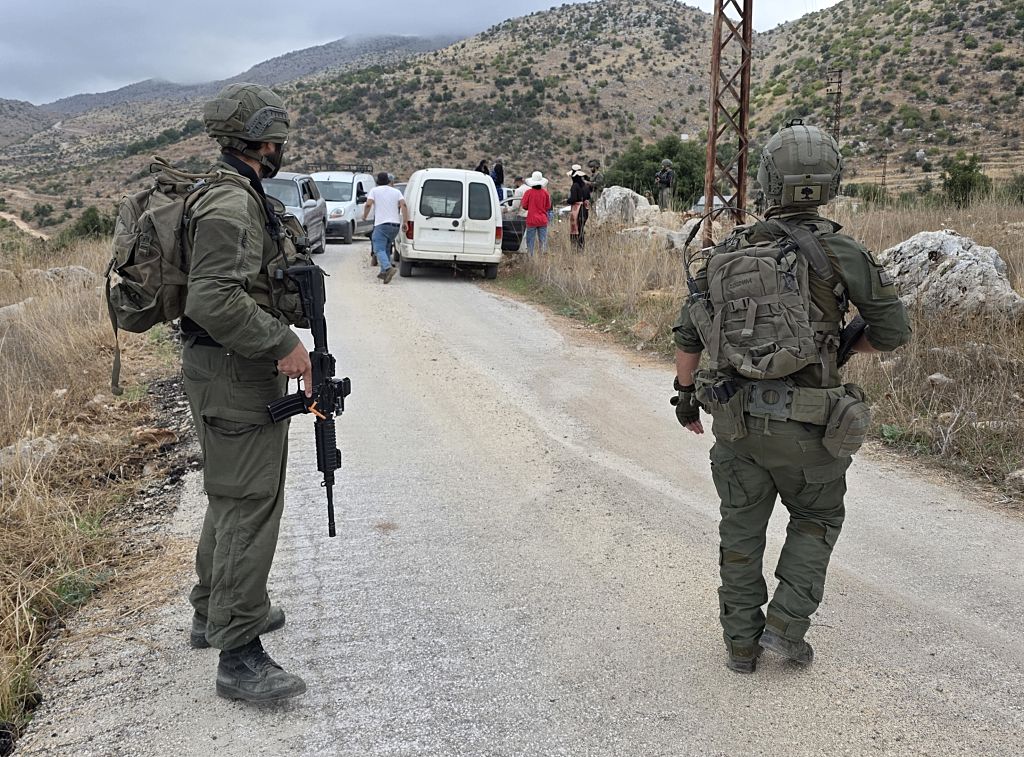
Benjamin Netanyahu’s government is ever more open about its plans to annex parts of Gaza and southern Lebanon. Ahead of Tuesday’s election, opposition leaders have shied away from criticizing the idea. (Ramiz Dallah / Anadolu via Getty Images)
To fully grasp what has been going on since October 7, 2023, in the territories newly reoccupied by Israel in Gaza and Lebanon, it is necessary to examine the pattern of these occupations against previous ones conducted by the Zionist state. As is well known, the very birth of Israel was inseparable from occupation. The new state proclaimed on May 15, 1948, spanned over 56 percent of British Mandate Palestine between the Jordan River and the Mediterranean Sea — the territory attributed to the “Jewish State” by the partition resolution adopted by the United Nations General Assembly in November 1947. By the end of the first Arab Israeli war in 1948–49, Israel ended up controlling 78 percent of that area.
During that war, the exodus of Palestinians fleeing for fear of harm at the hands of Zionist mainstream and fringe armed forces encompassed 80 percent of the Arab population of the lands seized by Israel. Many fled in the belief that they would be able to come back to their homes once the fighting was over. Many others were forced to leave. Palestinian refugees were never allowed to return across the boundaries of the new state. To literally bury the very possibility of their return, most of the four hundred depopulated Palestinian Arab towns and villages were destroyed and rendered uninhabitable. An initial pattern of occupation was thus enacted, specific to the establishment of the Israeli state, which the Palestinians and Arabs have ever since called the Nakba (disaster): a combination of “ethnic cleansing” and destruction of the built environment in order to take full control of a territory.
The next major instance of Israeli occupation did not conform to that pattern. In 1967, Israel did not reenact the Nakba’s ethnic cleansing in the Palestinian territories that it occupied during the Six-Day War. Or, more accurately, it did not reenact it on the same scale: cases of forcible depopulation and destruction of the built environment did occur and are still occurring, but not yet to the point of constituting an episode of ethnic cleansing comparable to the Nakba. One key reason for this was that the bulk of the population of the newly occupied Palestinian territories (OPTs) — the West Bank and the Gaza Strip — clung to their land and homes, knowing too well after the experience of 1948 what their fate would be if they fled.
In the wake of the new occupation, the Israeli cabinet dominated by the Zionist left devised a plan for the future of the OPTs, named after its key architect, then Minister of Labor Yigal Allon: most of the densely populated areas, with the exception of de facto annexed East Jerusalem, would be returned to Jordanian rule in a future agreement, while Israel would keep those areas that it deemed important for security reasons, such as the land along the Jordan River (the Jordan Valley), or for ideological considerations, such as the outskirts of Jerusalem and Hebron. The plan aimed at eventually annexing a major part of the West Bank and of Gaza, leaving out most of their population to avoid the dilemma of granting them Israeli citizenship or instituting official apartheid. After Jordan relinquished its claim on the West Bank in 1988, the Allon Plan was revised by replacing the monarchy with the leadership of the Palestine Liberation Organization (PLO) as custodian of the Palestinian areas under Israel’s control and its de facto annexation of most of the West Bank. This was implemented through the 1993 Oslo Accords.
The Zionist far right never endorsed this perspective. Since 1967, it has engaged in operations of creeping ethnic cleansing, constantly pushing for the seizure of new land outside the parameters of the Allon Plan. The creep accelerated when the far-right Likud party came to power in 1977, and it went into still higher gear when the present Israeli cabinet, formed in December 2022 under Benjamin Netanyahu’s premiership with the whole spectrum of the Zionist far right, took advantage of the huge shock created by the Hamas-led attack of October 7, 2023.
Annexation Plans
There was, though, one instance of 1948-style of ethnic cleansing in a territory seized during the 1967 war: not within historical Palestine, but in the Syrian Golan Heights, most of which were occupied in that war. Israel’s intention has always been to keep that land forever, for military considerations first and foremost. So, there it reenacted the 1948 pattern of ethnic cleansing: depopulation through a combination of flight and forcible removal, followed by ban on return and large-scale destruction of the built environment (more than one hundred villages). In 1981, the Likud government annexed the occupied Golan Heights in all but name — an annexation that the United States would be the first to recognize in 2019 under Donald Trump.
From this brief survey, it clearly appears that Israeli occupation resorts to ethnic cleansing through depopulation and destruction — along with colonization — wherever the aim is full annexation; but not in lands it intends to return to Arab sovereignty (the 1967-occupied Egyptian Sinai is a case in point). This fact bears clear implications for the territories in Gaza and southern Lebanon that Israel has reoccupied since October 7, 2023. Gaza has been the theater of an extreme iteration of the 1948 pattern of ethnic cleansing: expulsion / displacement of the population by way of genocidal war and destruction of the built environment at a historically unprecedented level of intensity, except for the atomic bombing of Hiroshima and Nagasaki. Southern Lebanon, where Israel controls a “security zone” that is more than twice the area of Gaza that it currently occupies, has been subjected to similar treatment, but for the genocidal dimension. The so-called security zone where long-term occupation is the objective has been depopulated by the usual combination of flight and expulsion with ban on return and extensive destruction of built environment.
The eventual intention of the present Israeli government must thus be clear to everyone: to annex as much as possible of the Gaza Strip — of which Israel currently occupies close to 70 percent; key government officials make no secret of eyeing the reoccupation of most of the rest — as well as the security zone of around 600 square kilometers in southern Lebanon. No major figure of the Israeli opposition to the governing coalition has categorically repudiated such an intention. Without firm international pressure to deter it and force Israel to withdraw from the newly reoccupied territories, this scenario might very well prevail, shattering any prospect of regional peace. The United States is the only world power that holds enough leverage over Israel to prevent this further descent into regional, and hence global, mayhem. This, too, is at stake in the upcoming US midterm elections.