A Future Beyond Israeli Genocide in Palestine
It is difficult to imagine a future in the region beyond the horrors of genocide and displacement that does not involve the Israeli state, supported by a large majority of its Jewish citizens, facing accountability.
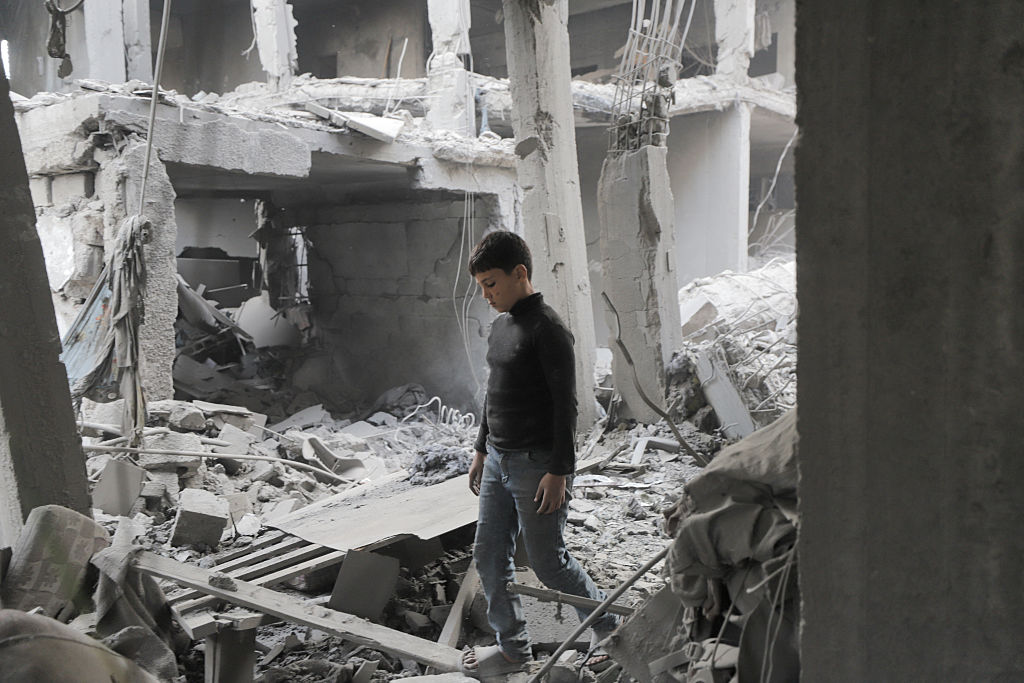
One would expect the recognition of genocide carried out by Israel against Palestinians to be followed by a call for justice and accountability. This includes the right of victims of violence to see those who targeted their loved ones and society brought to justice. (Ahmed Al Arini / Middle East Images / AFP via Getty Images)
In the last two and a half years, Israel has intensified its core project of realizing a “Greater Israel.” Its ongoing drive to eliminate Palestinians since the 1948 Nakba has escalated into full-scale genocidal violence in Gaza. The intensification of Israel’s colonial violence has also included a forced displacement campaign in the West Bank unprecedented since the 1967 war, a renewed assault on the political rights of Palestinians in Israel, and the transformation of Israeli prisons into a network of torture camps in which unspeakable cruelty is the order of the day.
Israel’s large‑scale attacks on Lebanon and Iran, and its use of the “Gaza doctrine” — particularly in Lebanon — have made the systematic targeting of civilians, neighborhoods, schools, and hospitals, and the infliction of mass destruction, suffering, and death, a regional reality. At the same time, the US-Israel war on Iran has caused an international economic crisis that underlines how genocidal regimes pose a threat on a global scale.
It is difficult to imagine a future in the region beyond this horrific reality without the Israeli state, supported by a large majority of its Jewish citizens, facing accountability. Accountability demands centering the experiences and knowledge of Palestinians confronting Israeli elimination, yet the Jewish supremacy and anti-Palestinian racism that fuel the genocide also drive the silencing of Palestinians and their activism to end it. The result is that mostly Jewish voices critical of Israel manage to gain attention through the cracks of this censorship and suppression, though they offer little in the way of thinking about accountability.
This is the case, most recently, with Israeli-American Holocaust scholar Omer Bartov’s latest book, Israel: What Went Wrong? Just out in English and slated to appear in numerous other languages, the book asks readers to think about Israel’s ongoing genocide in Gaza through a narrative that begins with the Holocaust and antisemitism. Bartov argues that Zionism emerged as a project of liberating Jews from persecution and destruction, but it changed with the establishment of Israel in 1948, when it turned into the state ideology, becoming increasingly exclusionary and violently ethnonationalist, ultimately culminating in genocide.
In fact, Palestinians and even Zionists understood Zionism as an exclusionary, settler colonial, and violent ethnonationalist ideology well before 1948. We know this, for instance, from the work of Palestinian scholars like sociologist Areej Sabbagh-Khoury, who shows in her book Colonizing Palestine: The Zionist Left and the Making of the Palestinian Nakba how left-wing Zionists, under British colonial auspices, took an active role in the dispossession of Palestinians through the establishment of kibbutz colonies in the Jezreel Valley/Marj Ibn Amer frontier area in the 1920s and ’30s.
If Zionists on the left talked about coexistence with Palestinians even as they displaced them, Zionists on the right dispensed early on with such discourse. Ze’ev Jabotinsky’s well-known 1923 essay “The Iron Wall” set the tone with an explicit acknowledgment of Zionism as a settler-colonial movement that aims to remove indigenous Palestinian Arabs to create a Jewish state.
It is impossible to understand the 1948 Nakba without considering this eliminationist Zionist consensus that had formed in the preceding three decades and which informed Zionist settlement and actions well before the Holocaust. The 1948 Nakba furthermore marked the birth of the Israeli state as clearly exclusionary, racist, and violent; to adapt the language of Bartov’s title, the Israeli state emerged as foundationally wrong.
Bartov, who counts among erstwhile liberal Zionists, rejects this position. His argument about the Gaza genocide functions in a similar way as his argument about Zionism. He eventually found it difficult during Israel’s live streamed genocide to dismiss the charge of genocide. For him, the invasion of Rafah in May 2024 signaled Israel’s turn to genocide. This means that Israel’s campaign in its initial months — its deadliest phase — was not genocidal, according to Bartov, even as he acknowledges that Israeli political and military leaders expressed clear genocidal intent at the time. This qualification of the genocide determination reflects Bartov’s rosy view of pre-state Zionism, as it aims to conceal the historical continuity between the eliminatory logic of Zionism and the Nakba and the genocidal violence unfolding in Gaza since October 2023.
Bartov argues, accordingly, that “the focus on the functional reality of [Zionist] settlement in Palestine largely misses the ideological and emotional motivations of this [Zionist] movement, as well as the underlying self‑perception of generations of Zionist activists and supporters.” Within this narrative, the victims of Zionism — now in its genocidal phase — have erred by judging Zionism through their lived experience of its dispossession and violence; instead, they should have been sufficiently “attuned to the aspirations of Europe’s Jewish refugees.” This framing renders the Palestinian and Arab anti‑colonial struggle — beginning with the Arab Revolt of 1936, or even earlier — a hostile act of aggression against Jewish settlers in Palestine, thereby creating a false equivalence between the colonized and the colonizer.
We also know that while Jewish refugees were seeking a sanctuary, the Zionist movement funneling them to Palestine aimed for their migration to create a Jewish demographic majority that would eventually facilitate Zionist control of the country. Zionists thus turned refugees into settlers. What is more, at least some of Europe’s Jewish refugees who arrived in Palestine during or immediately after the 1948 war understood this, and that the fledgling Jewish state reproduced the kind of exclusionary violence that they had experienced in Europe. It was a very bitter liberation for them, if they perceived it as such at all.
However one understands the multiple perspectives of Jewish refugees in 1948, Bartov’s approach affirms racialized epistemic hierarchies, sidelining the perspectives, knowledge, and voices of Palestinians who have faced Israel’s colonial and eliminatory violence before and after 1948, including those who have identified Israel’s attack on Gaza as genocide from the very beginning.
Acknowledgement Without Accountability?
Racialized hierarchies shape not only how the causes of the genocide in Gaza are discussed, but also how pathways forward are imagined. One would expect the recognition of genocide to be followed by a clear call for justice and accountability. This includes the right of victims of colonial violence and genocide to see those who targeted their loved ones and society brought to justice: those who committed the crimes, those who ordered them, and those who incited them. Victims are also entitled to an official account of what happened. The state itself must be held accountable for these grave crimes.
One is thus left to wonder why Bartov’s book contains no clear call for legal accountability, especially in light of the recent piercing of the veil of impunity that has long shielded Israel from accountability for crimes committed against the Palestinian people.
Why does he not explicitly support accountability efforts before the International Criminal Court? Bartov does refer to the 2024 Advisory Opinion issued by the International Court of Justice (ICJ) on the illegality of Israel’s presence in the West Bank and Gaza, but he does so without explaining that it calls on third states neither to recognize nor to aid or assist in maintaining this illegal situation — thereby opening a window of opportunity for the imposition of effective measures to pressure Israel to cease and remedy its violations of peremptory norms of international law. Instead, Bartov warns that if Israel does not change course, it will face isolation akin to that suffered by apartheid South Africa.
Many liberal Zionists share Bartov’s concern. The celebrated Israeli writer David Grossman, for example, told the Italian daily la Repubblica in early August 2025 that “Israel’s curse began with the occupation of the Palestinian territories after 1967” — thus erasing the 1948 Nakba — and that he remains “desperately committed” to the two-state solution; that is, a Jewish state and a Palestinian state with “no weapons.” Mainstream liberal media also seems desperately committed to Nakba denial and a Jewish state, even if cursed, which explains the space it affords to people like Bartov on opinion pages, while its reporting largely reproduces anti-Palestinian racism.
Bartov does go further than other liberal Zionists in criticizing Israel and Zionism. He now sees no future for Zionism, as it has become an ideology of genocide, although he rejects the label “anti-Zionist.” Consequently, he cannot imagine a future without a Jewish state, albeit different from the current one. For this sort of criticism and his belated recognition of the Gaza genocide, Bartov has faced intense hostility, including being labeled a Jewish “traitor” and other epithets commonly hurled at Jews who refuse to repeat the talking points of the Israeli state and major Jewish communal organizations.
Yet his visions for Palestine/Israel are largely centered on salvaging Israel as a Jewish-majority state from a feared future or “nightmare” marked by the exodus of the educated and skilled, increasing international isolation, and the prospect of sanctions. What remains unaddressed is the moral and political imperative of accountability for historical and structural injustices inflicted on Palestinians by the Zionist settler‑colonial regime since its inception.
Bartov’s “fundamental rethinking of the relationship between the seven million Jews and seven million Palestinians who live between the river and the sea” mostly entails ending the war in Gaza, rebuilding it, and replacing Hamas’s control of the Strip, with the ultimate goal of creating a Palestinian state in the West Bank and Gaza that would be viable only as part of a confederation with Israel. In this scenario, based on Dahlia Scheindlin’s writing, Gaza could become “the Dubai of the Mediterranean,” and a confederation model is presented as an alternative to the failed Oslo logic of the two‑state solution.
According to this vision, Palestinian refugees forcibly displaced during the ongoing Nakba may return as Palestinian citizens to the West Bank or Gaza, whereas in Israel they may be granted only residency rights. Their “rights” inside Israel will be analogous to those afforded to Israeli Jewish colonizers living in the West Bank: they would retain their Israeli citizenship and be permitted to reside in the West Bank not as citizens, but as residents, provided they accept Palestinian sovereignty.
Palestinian refugees forcibly expelled from their homeland are thus granted the same package of rights inside Israel as those guaranteed to West Bank settlers inside a future Palestinian state. According to this vision, Palestinian refugees may return to Haifa, Yaffa, Safad, and Lydda as tolerated guests, not as beneficiaries of the right to self-determination in the homeland from which Israel had expelled them. While they might be allowed to reside there and vote in municipal elections, they would have no right to benefit from the land and resources that belonged to them before the Nakba for the development of their communities. Nor would they be recognized as part of the political community entrusted with determining the political, economic, and cultural future of their own homeland.
Bartov misses how relegating Palestinian refugees to a status comparable to that of West Bank settlers — active participants in a criminal settlement policy — reaffirms a colonial logic, especially when this vision says nothing about restitution or reparations.
It is telling that Bartov draws on a recent scheme formulated by Scheindlin, an Israeli Jew who grew up in the United States, even though a Palestinian alternative exists: the plan by the Palestine Land Society, under the leadership of Salman Abu Sitta. It contains detailed and viable plans for refugee return, developed in consultation with refugees and their descendants, that allow return inside the Green Line without requiring any major relocation of Israelis.
“Alleviating the fear of demographic imbalances,” as Bartov puts it, lies at the heart of the plan that he supports. In practical terms, this means that more than thirteen million Palestinians would be granted 22 percent of Mandatory Palestine to exercise their collective national aspirations and rights, while approximately two million Palestinians who hold Israeli citizenship are reduced to a minority, not an indigenous group entitled to self-determination.
A similar position has been adopted by the political movement Land for All. In its program, the movement affirms that the State of Palestine would have the sovereign power to grant citizenship to Palestinian refugees. Upon receiving Palestinian citizenship, refugees would be able to travel freely to Israel “for work, tourism, and residence.” More importantly, to avoid “inundation,” an agreement would be reached on the number of Palestinian refugees eligible for residency in Israel.
Such arrangements would secure a body politic where Israeli Jews remain a majority within 78 percent of historic Palestine, controlling its natural resources. This scheme reenacts the logic of Jewish supremacy that Zionists have long invoked to justify the forced displacement and political and physical elimination of Palestinians. The language of demography is the language of dominance.
Jewish Supremacist Frameworks
It is not surprising, then, that Bartov hails Israel’s Declaration of Independence as a missed opportunity, failing to see how it officially established a regime of Jewish supremacy by excluding Palestinians from its “We the People.” It recognizes only the exclusive natural right of the Jewish people to the land, as if Mandatory Palestine were terra nullius. Palestinians who had survived the Nakba and remained in what became Israel are treated merely as “minorities,” nominally entitled not to collective national or sovereign rights but only to “complete equality of social and political rights to all its inhabitants irrespective of religion, race, or sex.”
One might have expected the genocidal escalation of the Zionist settler‑colonial project to expose the catastrophic implications of this logic of supremacy, leading critics of Israel to abandon it once and for all. Instead, we are once again confronted with attempts to prioritize the security concerns of the colonizers at the expense of the colonized, now articulated through the language of demography. The security concerns of the colonized — and the imperative of providing the victims of colonial genocidal violence with the international legal guarantees of non‑repetition — are either entirely absent or, at best, relegated to the margins.
Bartov concludes his discussion of this vision with a rather odd comment on how, absent serious US pressure on Israel, Germany could serve as the main force pushing Israel in this direction. The reality is that Germany has worked mostly to push Israel in the genocide direction — by providing Israel with military support, depicting Palestinians as Nazis, and violently silencing and shutting down pro-Palestinian activism, including police violence against Palestinians and anti-Zionist Jews on the streets of German cities. The ongoing case in the ICJ that Nicaragua brought against Germany in March 2024 for complicity with Israel’s genocide in Gaza (which Bartov does mention) renders his comment particularly problematic.
Given this qualified recognition of the genocide in Gaza, marked by the absence of any call for legal accountability and a political vision capable of comprehensively addressing the ongoing harms of the Nakba, it is hard to escape the conclusion that the outrage expressed by Bartov and other liberals over what Israel has become is not, in fact, centered on Palestinians. Rather, it remains an effort to salvage Israel, within a Jewish supremacist framework, from what liberal Zionists, however they call themselves, view as a self‑destructive course.