Eric Hobsbawm Owed His Success to Mass Culture

Eric Hobsbawm was a master of what he self-deprecatingly called haute vulgarisation, Oxbridge-inflected confident generalization based on selectively chosen data. He combined this elite education with popular appeal in a way few had done before.
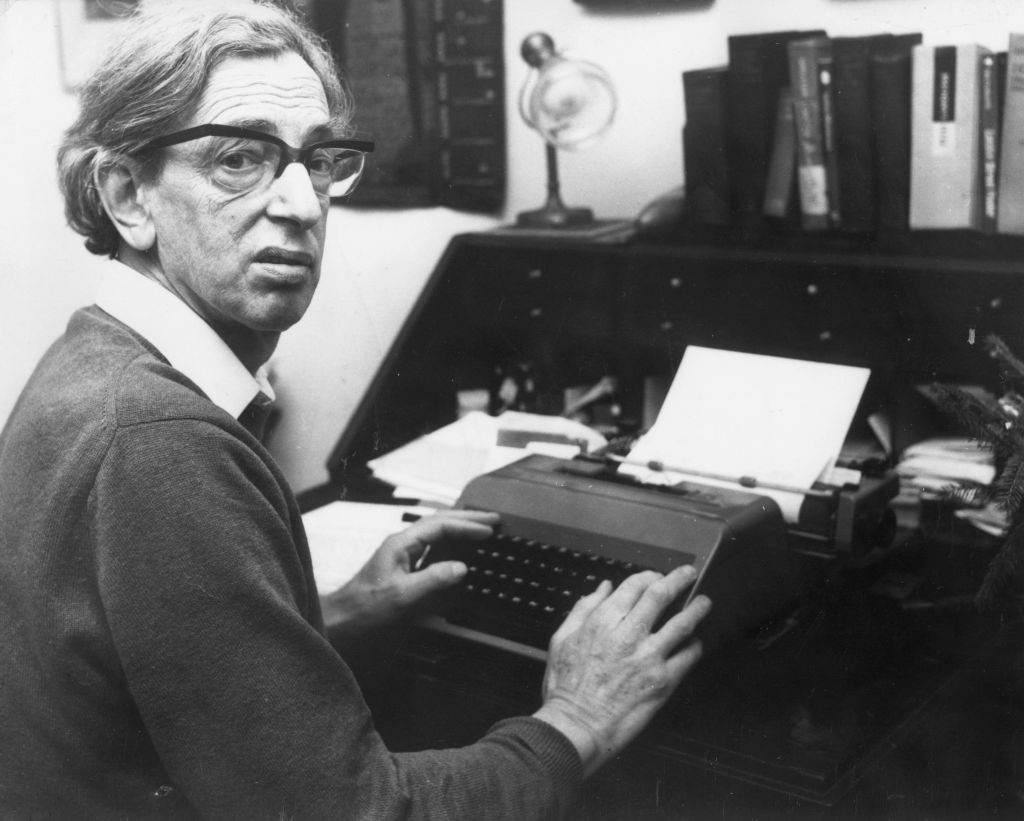
January 1976: British historian Eric Hobsbawm, author of 'The Age of Empire', 'The Age of Capital' and 'The Age of Revolution'.

Eric Hobsbawm observed and accepted the cultural values of the educated bourgeoisie and produced popular history that cast the working class as their rightful inheritors. (Wesley / Keystone / Getty Images)


More than the “revolutionary historian” promised by the subtitle, the Eric Hobsbawm chronicled in Emile Chabal’s biography is above all a canny academic entrepreneur. Early in his career, Hobsbawm found a literary agent and converted his lectures for undergraduates into a series of best-selling books. He made valuable contacts with rising-star scholars and publishing houses in continental Europe. He traveled widely: not so much for archival research, which he practiced sparingly, but for conferences, lectures, and intellectual tourism in appealing destinations. The Soviet Union, which occupied a central place in his thought for obvious reasons, did not qualify for more than a brief, unpleasant visit.

He displayed a knack for keeping himself in the public eye, with a steady stream of journalism and polemics, and for a degree of tactical adaptation. In the 1980s, he pivoted from writing the histories of the working class that defined his early work to studies of nationalism and invented traditions. By the late 1990s, he had achieved such eminence that he could turn down a knighthood while requesting — and receiving — a considerably more prestigious and exclusive appointment to the Order of the Companions of Honour, an award also tied to the monarchy but with less symbolic baggage.

Eric Hobsbawm, Careerist?

If all this sounds less than flattering, it isn’t because Chabal has written a hatchet job. On the contrary: The Age of Hobsbawm is admiring of the historian’s accomplishments while mercifully free of the emotional overinvestments he inspired in earlier generations. The absence of tedious Cold War moralism — alternately prosecutorial or tortured on such questions as Hobsbawm’s failure to leave the party after 1956 or his enjoyment of establishment privileges — is refreshing. Chabal offers a decidedly twenty-first century perspective, concerned more with explaining the global phenomenon that was Hobsbawm than judging the man or seeking to revive his ideas. But the line between demythologization and deflation is thin. Turning a high-resolution lens on the sausage-making of academic advancement and intellectual reputation-building is bound to leave any subject diminished.

While some of the details will be familiar to those who have read Richard Evans’s 2019 biography, Chabal’s cool-eyed appraisal repeatedly brings the legend down to earth. As a supervisor of graduate students, Hobsbawm was usually inattentive, veering into downright hostility to approaches he disliked: women’s and feminist histories foremost among them. He never made peace with the New Left sensibility that took gender and race as seriously as class. For all his interest in cultural production — an enthusiasm shaped, though not straitjacketed, by the Marxist catechism of base and superstructure — his tastes were fusty. He found jazz a worthwhile topic in the 1950s only insofar as it met his standards for popular authenticity, which meant embodying black folk traditions while retaining mass commercial appeal. For a man whose aesthetics were enduringly forged in the same 1930s youth as his politics, Miles Davis and John Coltrane missed the mark. As for the actually existing popular music of rock and roll, Hobsbawm thought Elvis Presley “peculiarly unappealing” and wrote dismissively of the Beatles that “anyone can produce that sound.”

Old-fashioned in some ways, Hobsbawm was extremely well matched to his time in others. The success of his books reflected their timeliness. The massive expansion of higher education on both sides of the Atlantic created demand for accessible introductions to economic history, such as his Industry and Empire (1968), and modern Europe, covered in the famous tetralogy that began with The Age of Revolution (1962). The “paperback revolution” described by historian Peter Mandler solidified the market for serious nonfiction in affordable editions. Not least, Marxism enjoyed enormous intellectual cachet — and a mass following — in societies as disparate as Italy, India, and Brazil. The Eurocentrism of the Ages volumes, so conspicuous in retrospect, mattered less at a time when many of the most pressing Marxist debates — about the demise of feudalism, the advent of industrial production, and the immiseration of workers — were being waged on the terrain of British history.

Little wonder that Hobsbawm’s work repeatedly circled back to what he saw as the formation of mass society in the late nineteenth century. Universal education, rising literacy, new communication technologies, a popular press: these were not just the preconditions for nationalism, democracy, and ideological politics in the fin de siècle. They were also the foundations, in a more distant way, of Hobsbawm’s success in the literary marketplace. The volume devoted to the late nineteenth century, The Age of Empire (1987), marked a turning point in the series, arguing that the forces that destabilized and ultimately destroyed bourgeois society emerged from the triumphant capitalist order it had built. Hobsbawm doubtless savored the irony, in his own career, of leveraging the commercial incentives of the book business to deliver left-wing history to hundreds of thousands of readers.

An Annaliste From the Anglosphere

Particularly in the Ages series, it is difficult to disentangle Marxism from other historiographical influences. It is also true that the tetralogy is at its least convincing when it hews most closely to orthodox Marxism. Yes, the elegant architecture of the series derives from the interlocking advance of a new mode of production (industrial capitalism), a new social grouping (the bourgeoisie), and a new ideology (liberalism). But this master narrative strains to meet the facts at crucial moments. Hobsbawm’s interpretation of the French Revolution — one half of the “dual revolution” that kicks off the series — in the strict class terms of a “bourgeois revolution” was outdated almost as soon as the ink was dry. The risk of historiographical obsolescence became more acute as the interval between volumes lengthened; by the 1980s, historians were questioning whether the bourgeoisie anywhere in nineteenth-century Europe was really so triumphant in the face of what Arno Mayer called “the persistence of the old regime.” At the same time, as Chabal points out, Hobsbawm’s decision to elevate political principles of liberty and equality to the same explanatory rank as the Industrial Revolution marked a bold departure from strictly materialist analysis.

It is something of a cliché to describe Hobsbawm as cosmopolitan because of his birth in Alexandria, childhood in Vienna, and adolescence in Berlin. The label fits best as a statement of his role as an intellectual intermediary, bringing elements of the French Annales school into mainstream Anglophone historiography at a time when few others were doing so. I am less sure than Chabal that “total history” is the right term for the Ages series; Fernand Braudel’s The Mediterranean and the Mediterranean World in the Age of Philip II (1949) and Emmanuel Le Roy Ladurie’s Montaillou (1975) traded specific geographic boundaries for depths of environmental and anthropological texture not captured by the ostensibly global scale on which Hobsbawm was working.

Marxist annalistes such as Ernest Labrousse, who in 1955 issued a prominent call for a history of the nineteenth-century bourgeoisie, represent a more obvious influence. But if Hobsbawm and the other towering figure of his generation of British historians, E. P. Thompson, both subordinated high politics to social history, Hobsbawm’s route to that destination — reflected in the pages of tables and charts that adorned many of his books — was paved with the quantitative data that the Annales valued so highly. Without ever bogging down the fluent prose of the Ages series, price cycles and export volumes provided the materialist grounding for Hobsbawm’s confident pronouncements on everything from urban planning and domestic architecture to music, painting, and literature.

Looking Back

That confidence in the power of empirically derived data, Chabal shows, might be the most British thing about Hobsbawm. He was a product of the Oxbridge system in his talent for generalizing from well-chosen details, though probably no one could do it as artfully. A flair for what Hobsbawm himself called haute vulgarisation served him well as a university lecturer and is the reason that the Ages books remain so readable today. Unlike Thompson, Hobsbawm did not forsake high culture along with high politics, and his sympathetic interest in popular protest did not foreclose writing about the likes of Ludwig van Beethoven, Honoré de Balzac, and Albert Einstein. Hobsbawm’s identification with “history from below,” more pronounced in some works than others, was always more equivocal than for some of his peers — perhaps because, at least to some degree, he absorbed and accepted the cultural values of the Bildungsbürgertum.

Chabal emphasizes the critical edge of Hobsbawm’s take on the superficiality and artificiality of the bourgeois world. But there was also nostalgia, or at least ambivalence, in Hobsbawm’s attitude to the class that dominated his magnum opus. In the introduction to The Age of Empire, the historian’s affective connection to the era in which his parents came of age inspired some of his most lyrical lines:

For all of us there is a twilight zone between history and memory. . . .  For individual human beings this zone stretches from the point where living family traditions or memories begin . . . to the end of infancy, when public and private destinies are recognized as inseparable. . . .  It is itself an incoherent, incompletely perceived image of the past, sometimes more shadowy, sometimes apparently precise, always transmitted by a mixture of learning and second-hand memory shaped by public and private tradition. For it is still part of us, but no longer quite within our personal reach.

The tantalizing proximity, yet ultimate inaccessibility, of those years before 1914 is especially poignant because Hobsbawm’s parents died young. But there is a hint of social as well as personal loss, a longing for the solidity of the bourgeois order swept away by the war. The final volume in the series, The Age of Extremes (1994), has an unmoored quality as violent events overwhelm structures and processes in the maelstrom of what Hobsbawm termed “the short twentieth century.” The better companion for the first three Ages volumes is arguably Peter Gay’s The Bourgeois Experience (1984–1998), the work of another Jewish émigré from Central Europe, born six years after Hobsbawm, though with Sigmund Freud rather than Karl Marx as the theoretical lodestar. In different ways, both works are about the “fragility” and the “tenuous grip” of bourgeois dominance (to borrow from Chabal’s gloss on Hobsbawm).

The twentieth century might have appeared less disjunctive in Hobsbawm’s telling if colonial violence had featured more prominently all along. The treatment of the Haitian Revolution as an afterthought in The Age of Revolution is symptomatic of the series as a whole: the world-systems weighting of “center” and “periphery” applies not only to capitalist development but to ideas, experiences, and people as well. Even The Age of Empire fails to live up to its title in large part because Hobsbawm leans so heavily on the Hobsonian-Leninist model of imperialism as an outgrowth of monopoly capitalism. It is a book about the “apotheosis” and “destruction” of the bourgeoisie, Chabal writes, while the human catastrophe of imperial conquest is reduced to the abstract “terms of a political and historiographical debate that needed to be settled.” Even on Hobsbawm’s own terms, this focus on Europe represents a missed opportunity, because the vulnerability of the bourgeoisie was nowhere more acute than in the colonial outposts that strove to replicate European society far from home.

Though he famously refused to join Thompson and others in leaving the Communist Party of Great Britain in 1956, Hobsbawm emerged from the shattering of its intellectual milieu with a more flexible and questioning attitude to the party line, producing some of his most interesting work as a consequence. His 1959 book Primitive Rebels took seriously the political aspirations of peasant uprisings far removed from the industrial proletariat privileged by Marxist theory. His later work on nationalism discussed ideological regimes of collective identity with only limited reference to material causes.

Where Hobsbawm evolved least was almost certainly in his Eurocentrism: an imperfect term, not least because it masks the novelty of his attention to the ways that global and imperial forces remade Europe. It would be difficult to imagine Sven Beckert’s “war capitalism” or Kenneth Pomeranz’s “ghost acres,” for instance, without the pioneering argument of Industry and Empire, which linked the onset of the Industrial Revolution to the demand boost of imperial expansion. Of course, Hobsbawm’s books will continue to be read for the sheer artistry of their craft: the subordination of narrative to structure, the fluency in shifting between macro and micro scales, the promiscuous variety of sources, the plain yet vigorous expository prose.

Yet his reluctance to wrestle with topics that most historians today would consider central — genocide and decolonization — shows that the path for history after Hobsbawm is not only a matter of geographical rebalancing. Rather than writing Europe out of the story, we must write about it differently: no longer as the cradle of an immanent logic of history but as the cockpit of a violent, acquisitive, sometimes irrational, and often unpredictable project of domination whose consequences we have yet to fully grasp.