Historian Eric Hobsbawm Was a “Communist Polymath”
Emile Chabal, author of a new biography of the massively popular and influential historian Eric Hobsbawm, explains how Hobsbawm’s Central European roots set him apart in Britain — and why he kept faith with communism through the devastation of his century.
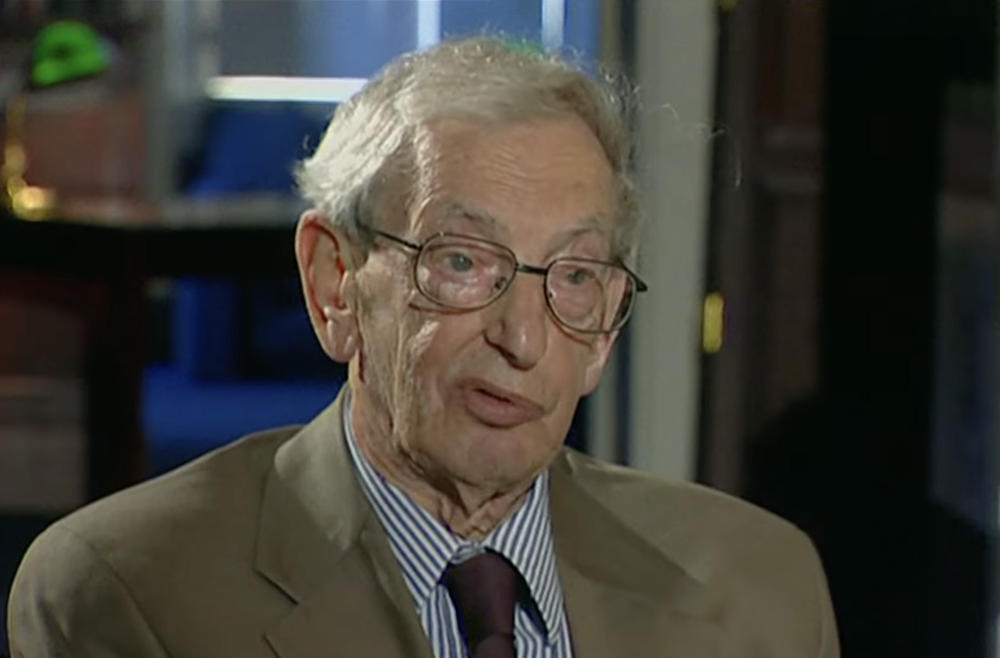
Eric Hobsbawm arrived in London as a teenager, a British national who had never lived in Britain. He picked up British intellectual habits quickly, but his sense of class was formed elsewhere, and his work kept one foot on the Continent for life. (BBC / YouTube)
- Interview by
- Michael Schapira
Eric Hobsbawm’s life began just as the “long nineteenth century” was drawing to a close. Born in Alexandria, Egypt, and formed as a youth in Red Vienna and Weimar-era Berlin, he came to intellectual maturity in interwar Cambridge and postwar London. His Ages tetralogy firmly established him on course syllabi and on the bookshelves of what he called, in The Age of Revolution, “the intelligent and educated citizen, who is not merely curious about the past, but wishes to understand how and why the world has come to be what it is today and whither it is going.” And he was, paradoxically for someone who rose to such popular heights, a proud communist who, for better or worse depending on whom you ask, bound himself to a particular vision of a better future as he bore witness to an epoch he dubbed the “age of extremes.”
Yet despite being, as his biographer Emile Chabal puts it, a “communist polymath, with a remarkable reach over the theoretical and empirical landscape of modern history,” Hobsbawm, unlike many of his continental counterparts, “rarely features in the canon of left-wing or Marxist thought.” Why that is so is one of the questions animating Chabal’s fascinating and wide-ranging new intellectual history, The Age of Hobsbawm.
Chabal is a professor of contemporary history at the University of Edinburgh, and the book’s publication brought him up to St Andrews, Scotland, for an author event at our local independent bookstore. It is a testament to Hobsbawm’s enduring appeal that even now, in a town dominated by golf enthusiasts and posh students, a crowd of unreconstructed Marxists from the 1970s, left-wing autodidacts, and curious graduate students turned up for a spirited discussion of the theory and politics of the twentieth-century left and their prospects today. What follows is an extension of our conversation that evening and an introduction to Hobsbawm’s world and legacy.
Michael Schapira
You mention in the preface that you initially had designs on “writing a history of postwar French Marxism, which would capture some of the richness and complexity of radical politics in France.” But you soon realized you could “achieve the same goals by looking closely at Hobsbawm.” Hobsbawm had strong connections to French intellectual life and Eurocommunism more generally, but both he and British Marxism have a very different flavor than their French variants. In what sense did Hobsbawm satisfy your initial aspirations, and how did shifting the focus to him open new avenues to explore radical postwar politics?
Emile Chabal
When I started working on Hobsbawm in late 2012, I was a freshly minted postdoc. I’d spent the previous five years working on contemporary French history and politics, so it was perhaps inevitable that French concepts like the “intellectual” and the Sartrean idea of engagement [in English, “commitment”] loomed so large in my mind.
You are right though: postwar British Marxism has a very different flavor from its French (or continental) counterpart. It was less abstract, less ideological, and less overtly philosophical. What is interesting about Hobsbawm is that he straddled the British and continental European intellectual traditions much more than his other British Marxist contemporaries.
As a student in the late 1930s, he was profoundly shaped by the peculiar environment of Cambridge, but he also saw himself as an integral part of a global communist movement with its base in Paris. After World War II, when he wanted to make his name as a historian, he continued to move between Britain and continental Europe in an effort to find useful interlocutors and mentors.
As I learned more about Hobsbawm’s incessant back-and-forth between the UK and Europe, I was grateful for having been a scholar of France in my younger days; it gave me a unique perspective on his intellectual formation and identity. And it also helped me bridge the often rather sterile divide between the intellectual histories of radical politics in the English-speaking world and continental Europe.
Michael Schapira
Toward the end of his life, Hobsbawm returned to his formative years in Vienna and Weimar Berlin, framing his experience as that of a generational cohort whose worldview was fading. However, he also developed habits of mind and manner that clearly reflected his years at Cambridge and became recognizably British in so many aspects of his writing and work.
This reminded me of Owen Hatherley’s wonderful profile of Central European émigrés who arrived in Britain around the same time as Hobsbawm and were, in the words of Walter Gropius, shocked by the “sentiment-laden inartistic world” that greeted them. This may be unfairly reductive, but did Hobsbawm meaningfully retain this “alienation effect,” as Hatherley puts it, or did aspects of his biography and personality make him especially suited to British cultural and political life?
Emile Chabal
I think it’s important to emphasize that Hobsbawm was not a Central European émigré or refugee. He followed a similar trajectory (in his case, from Vienna to Berlin to London in the mid-1930s), and he certainly felt that London in 1933 was desperately boring compared to Berlin. But he was a British national and a native English speaker. When he arrived in London, he had, on paper, come “home,” even if he had never lived in the UK. He was therefore an outsider, not a foreigner.
It would be more accurate, then, to see the young Hobsbawm engaged in a very rapid process of acculturation and assimilation after his arrival in London — and, since he was only a teenager, he discovered that the school system was a very good way of becoming British. Inevitably, this meant that some of his most obviously British qualities — his intellectual agility, his commitment to concision, his facility with self-deprecating rhetoric and debate — were forged during his final years of high school in London and as a student at Cambridge. These intellectual traits were easily recognizable for the rest of his life.
In other ways, however, he was not very British at all. It is noteworthy, for instance, how little class discomfort he appears to have felt. Most British left-wing intellectuals of his generation — whether communist or not — were resentful, if not angry, about the straitjacket of the British class system, but Hobsbawm’s class coordinates lay elsewhere, in the bourgeois universe of Central Europe. Crucially, he missed the vital period between late childhood and early teenage years when the British class system is most aggressively inculcated through schooling and wider society.
By the time he arrived, he could simply transcend class prejudices by being extremely good at school (and, later, at university). This made him remarkably tolerant of manifestations of class prejudice in Britain’s higher educational system. If he disliked High Table at Cambridge, it was because he found the people boring, not because it was an expression of class inequality!
Michael Schapira
Hobsbawm is unusual in his commitment to communism — especially of a Leninist, party-led variant. Whereas so many took 1956 as an off-ramp from the cause completely or charted a new path (including those who would found influential journals like New Left Review), Hobsbawm stayed the course to the best of his abilities.
This is most clearly on display in his 1994 BBC interview with Michael Ignatieff, where he defends what Ignatieff considers an indefensible position: supporting the aspirations of communism in the wake of the events of the twentieth century.
Do you think this helps explain why he never really found a home in the canon of Marxist thought? And how does it square with his elevation to the status of a celebrity intellectual and best-selling author?
Emile Chabal
Following on from the previous question, one could argue that Hobsbawm’s commitment to communism was another decidedly un-British character trait of his. Rather than adopt a pragmatic position toward the future of the Left by moving away from the Communist Party after 1956, he maintained his attachment to a political idea, which is exactly the kind of “dogmatism” that many in Britain saw (and still see) as a pathology of continental European politics. Hence, I think, why many of his interviews in the 1990s — including the famous one with Ignatieff — were so awkward. He and Ignatieff were talking past each other: Hobsbawm was trying to explain his deep commitment to an ideal, a future utopia, something that transcended him, whereas Ignatieff was insisting he make a moralistic judgment.
It’s interesting to reflect on how Hobsbawm’s communism might have affected the reception of his work and his mass-market success. I don’t actually believe that his communism is the reason for his relative neglect in the Marxist “canon.” I think this has much more to do with the fact that he always presented himself as a “historian,” not as a “theorist.” In the book, I try to make the case that Hobsbawm was quite a serious thinker and that he had a strong theoretical grounding, but some might disagree with me, simply because he worked so hard to downplay his theoretical credentials.
What is unquestionably true is that he was a mass-market publishing sensation, and this may well have had to do with his communism. Paradoxically, though, it’s probably not because people saw his writings as dogmatically communist — a novice reader of Age of Extremes might not even realize he was a Marxist! — but because his communist framing of history provided a powerful basis for his work. Many people have been attracted to Hobsbawm’s writings because they feel as if history is in motion in his texts; this derives, in large part, from his underlying philosophy of history.
Michael Schapira
You have extensive chapters devoted to Hobsbawm’s work as a critic (e.g., of jazz, on which he wrote a regular column) and his travels around the world. These inclusions expanded the project tremendously, including interviews with figures from around the world but also opening up a whole new archive of writings that many might not take to be central to his work. When did these become an important part of your project?
Emile Chabal
Yes, I am proud of these chapters in the book! In both my exploration of him as a cultural critic and in the section devoted to his travels, I wanted to widen the frame of intellectual history to take in different kinds of writing. It was particularly important to me to show that Hobsbawm was as much a journalist as he was an academic — and that the two identities were mutually reinforcing.
Given that he was a lifelong academic and very clearly a professional historian, it might seem odd to put his journalistic and scholarly writings on the same level, but all you have to do is look at his bibliography: he published hundreds and hundreds of journalistic op-eds, essays, and reviews. They were a huge part of his published corpus. In the pages of the New Statesman, Rinascita, or the Times Literary Supplement, you can see him commenting on current affairs and working out new ideas (about the role of culture in society, for example). I expect it was the work I did on the complete Eric Hobsbawm online bibliography in 2019–2020 that really brought home to me the importance of these supposedly ephemeral writings.
Michael Schapira
As part of the chapters on his travels, you have descriptions of Hobsbawm’s extensive use of interviews and conversations, sometimes in methodologically questionable ways. In the back of your book, there is a long list of interviews you conducted with historians, activists, politicians, and others over several years and in various locales. What inspired you to extend beyond traditional archival research and embark on this ambitious interview project?
Emile Chabal
I always wanted the book to be global so that it would reflect the global character of its subject. But, as Hobsbawm himself knew very well, one’s global ambitions are limited by the hard cash that is available. And so it was for me: it was only when I was awarded a major fellowship grant in 2017 that I was able to undertake interviews in India, Brazil, Peru, Chile, Argentina, Mexico, the United States, France, Germany, and the UK.
These were primarily with Hobsbawm’s friends, students, colleagues, and those influenced by him, and they were tremendously useful to me as I was trying to frame Hobsbawm’s life within a global context. But they also did something more: they helped me understand how Hobsbawm approached foreign countries. He and I did similar things. We both arrived in a new city with an address book and sought out interesting people with whom to talk. In this way, the time I spent interviewing members of the twenty-first-century left intelligentsia gave me a unique insight into how Hobsbawm did more or less the same thing half a century before.
Michael Schapira
In our talk at Topping & Company Bookshop in St Andrews, an audience member reminisced about the Marxist grandees who made up his curriculum at Warwick in the 1970s. And of them, Hobsbawm has had the most enduring power.
Bernie Sanders and Jeremy Corbyn, arguably responsible for the biggest injection of energy into left-wing electoral politics in recent times, were also relics of a less fashionable era of leftist thought, closer to Hobsbawm. Why do you think this is? Does it have something to do with another topic you discuss in the book, namely the Left’s history of dealing with disappointment and defeat?
Emile Chabal
There’s no question that being on the Left — whatever we take that to mean — involves accepting and rationalizing defeat. Enzo Traverso has written very eloquently about the “left-wing melancholia” that has been part of the story of the Left since the defeat of the Paris Commune in 1871. Hobsbawm embodied this tradition: he understood the history of the Left to be one of adversity. This is part of the reason why he did not take the myriad “failures” of the Left during his lifetime — from the [Treaty of Non-Aggression between Germany and the Union of Soviet Socialist Republics] of 1939 through to the crushing defeats meted out to the British Labour Party in the 1980s — as a sign that he should jump ship.
Having said that, I agree with Traverso when he says that the collapse of the Soviet Union in 1991 was a more fundamental and unsettling kind of defeat than anything that had happened before. You can see this even in Hobsbawm’s private correspondence in the early 1990s, where he was forced to reckon with the total failure of his lifetime of political commitment. And yet he came out fighting: in public, at least, he defended communism, and he refused to recant his beliefs.
I think this sort of steadfast commitment to a political ideal is something that is very difficult to understand for left-wing activists born into the post–Cold War world. They look at Hobsbawm — or Sanders or Corbyn — and see a certainty about the future that they don’t have. Some admire this certainty and want it to be the foundation of a renewed left, but it’s also important to recognize that it was the product of a very particular set of mid-twentieth-century historical circumstances, none of which exist today.
Michael Schapira
Perhaps we can conclude by returning to the present. By his own admission, Hobsbawm was not someone whom you’d find shoulder to shoulder with factory workers or miners on the front lines of class struggle. But one area where he was directly active was in the university, an institution that nurtured and formed the basis of his scholarly output.
At the moment, you are several weeks into a strike at the University of Edinburgh as conditions across the “higher education sector” continue to deteriorate across Great Britain and elsewhere. How did working on this project over the past decade inform your understanding of continuities and changes in the status and nature of the university in the past seventy years?
Emile Chabal
Hobsbawm entered the university system as a student at Cambridge in 1936, and he remained in it until the end of his post-retirement visiting professorship at the New School in New York in the mid-1990s. He never took extended sabbaticals beyond the standard allowance, and he continued teaching in some way or another throughout his career. He was as fully institutionalized as was possible within the higher educational structures of the time. The fact that he was able to be productive and successful while depending on his university for financial support and logistical infrastructure should give those of us who are in a similar situation today some reassurance. Hobsbawm too got tired of marking essays, chasing collaborators, and doing university paperwork!
And yet something feels different about the twenty-first century. This could be because universities in Western Europe and North America are now contracting, whereas they were expanding in the 1950s, ’60s, and ’70s. This could also be because wage deflation has made it increasingly difficult to aspire to a comfortable middle-class life on a university salary.
To me, though, the real difference lies in the dramatically enhanced role of public-sector institutions — like universities — in postwar Europe, a point Hobsbawm himself discussed in the late 1970s in his famous lecture “The Forward March of Labour Halted?” When Hobsbawm first became a professional academic in the late 1940s, universities were small and elite institutions, but their rapid growth made them — especially in Europe — essential components of local and regional economies. Today they are every bit as important as factories were in the early twentieth century, and the closure or bankruptcy of a university risks the same catastrophic effects that many European countries experienced during deindustrialization in the 1970s and ’80s. That is why today’s fight to defend higher education feels existential in a way that it did not for Hobsbawm and his generation.