Eric Hobsbawm, Historian of Defeat
Eric Hobsbawm was in Berlin when Adolf Hitler took power, in Paris at the Popular Front’s peak, and in the Communist Party when it all came down. Emile Chabal’s new biography follows a historian who always asked what remained possible after defeat.
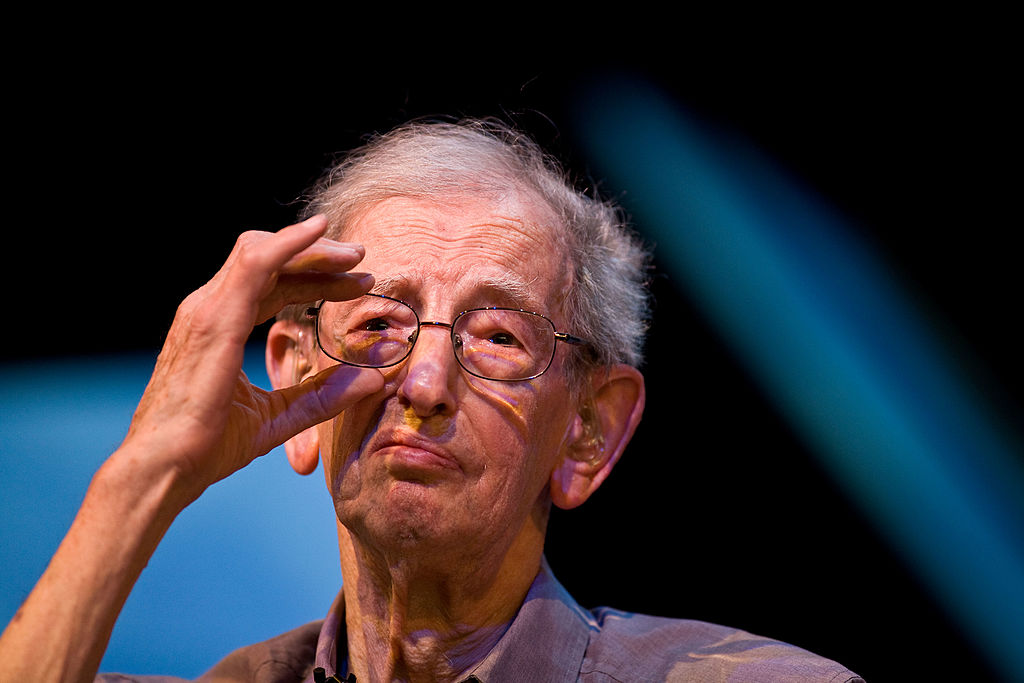
A pessimistic communist and best-selling historian, Eric Hobsbawm left behind a body of work that holds vital lessons for a Left living in a historic global retreat. It’s no wonder he’s become a hero to young activists across the world. (David Levenson / Getty Images)
Five years after the fall of the Berlin Wall, the communist historian Eric Hobsbawm published his best-selling history of the twentieth century, The Age of Extremes. The book presented a man coming to terms with the fate of the political project to which he had committed his adult life while trying to understand the twentieth century as a historical epoch. Though famous for its pessimism, the book, like the work of many left-wing authors in the 1990s, was also an opportunity to rethink what the project of the Left might become after the collapse of communism.
In its final pages, Hobsbawm reflected darkly on the future. The “titanic economic and techno-scientific” development of capitalism, he wrote, had unleashed forces capable of destroying “the material foundations of human life” while eroding the social bonds of the past, including the ones capitalism itself depends upon. “Our world risks both explosion and implosion. It must change.” Humanity could not survive the third millennium by prolonging the past or the present, he warned, and “the price of failure, that is to say, the alternative to a changed society, is darkness.”
Almost twenty years later, in 2011, mass protests erupted across the world. The Arab Spring overthrew dictatorships in Egypt and Tunisia, while the uprising in Syria descended into civil war. Elsewhere, Occupy Wall Street emerged in the United States, and the Indignados movement occupied the streets and squares of Spain. I was among those participating in these demonstrations and at the time was reading The Age of Extremes with my classmates. The book made a lasting impression on how we thought about both the past and the possibilities of the future. It was not only the history Hobsbawm was telling but the feeling that we were somehow living through the same story again. For a left that had struggled to articulate a vision of the future since the collapse of communism, the Indignados movement became a moment of political imagination, when a different future seemed possible. For a new generation of politically committed historians, the struggles of Eric Hobsbawm — a communist who had lived in Berlin when the Nazis came to power, been in Paris at the height of the Popular Front in 1936, and traveled to Spain during the civil war — could be inspiring.
I wasn’t alone. In 2018, the historian Emile Chabal traveled to Delhi where he encountered a group of left-wing students who admired Hobsbawm’s work. They encouraged him to search for the hashtag #Hobsbawm. To his surprise, he found numerous social media posts featuring the historian’s books: typically an open laptop flanked by a copy of The Age of Extremes accompanied by hashtags about the challenges of student life. But as Chabal asks, what can the life of Hobsbawm — the historical figure rather than the myth — teach us about the prospects of the Left today?
A Historian With a Historical Life
Few twentieth-century historians have generated as much biographical interest as Eric Hobsbawm. Born in Alexandria in 1917, raised in Vienna and Berlin, and arriving in Britain shortly after Adolf Hitler’s seizure of power, Hobsbawm joined the Communist Party of Great Britain in 1936 and remained a member until its dissolution in 1991. He also became one of the most influential historians of the twentieth century, moving from the relatively confined world of British Marxist historiography to an extraordinary international readership. Emile Chabal’s The Age of Hobsbawm therefore enters crowded territory. Yet his new biography provides an excellent opportunity to revisit the life of a committed communist through the wider history of twentieth-century communism and to ask what Hobsbawm might teach us at another moment of profound uncertainty for the international Left.
Chabal is less interested in discovering an unknown Hobsbawm than in explaining the making of the historian and political intellectual. His is fundamentally an intellectual biography. Rather than separating Hobsbawm’s historical writing from his communism, journalism, friendships, travels, and political interventions, Chabal reconstructs the environments in which Hobsbawm’s ideas were produced. The result is something larger than a biography: a history of twentieth-century intellectual life viewed through an individual who moved between communism and academia, Britain and continental Europe, specialist scholarship and mass publishing.
As the historian Alberto De Bernardi has argued, antifascism needs to be reconsidered as a central component of European political culture, one that shaped political identities through the second half of the twentieth century. Hobsbawm belonged to what might be called the “generation of the October Revolution”: those who lived through the rise of Nazism, the antifascist response, and World War II. These experiences forged a powerful political commitment that, in Hobsbawm’s case, proved impossible to break even after the communist crisis of 1956. If 1945–48 marked the high point of communism’s appeal in Europe, the following decades witnessed its gradual decline and eventual collapse in 1989–91. Hobsbawm lived through all of it without renouncing communism. His generation was defeated and had to adapt to a world shorn of the project to which so many of them had dedicated themselves. Few intellectuals experienced these transformations with the same degree of proximity or persistence. Fewer still attempted, as Hobsbawm did, to interpret these upheavals historically while simultaneously participating in the debates that animated them. His political identity may sometimes have appeared understated, but the extraordinary reach of his historical writing ensured that his engagement was far from marginal.
While Hobsbawm’s formative years and the crisis of 1956 are among the best-known aspects of his biography, less attention has been devoted to Hobsbawm during the crucial middle and later decades of the Cold War. How did a committed partisan of the October Revolution navigate the successive downturns of communism, and what might his responses teach us about the prospects of the Left? Each major crisis — in 1956, ’68, and ’89 — prompted Hobsbawm to reconsider fundamental Marxist concepts such as revolution, class, and political organization. His responses were shaped by a combination of personal experience, scholarly research, and interactions with international political movements, particularly those in Latin America.
A Communist in Retreat?
Until 1956, Hobsbawm remained a loyal communist, even an open Stalinist. Chabal’s biography argues that the crisis of 1956 transformed him into a semidetached communist. He interprets Hobsbawm’s subsequent turn toward primitive rebels, bandits, and millenarian movements partly as an intellectual retreat. This is a persuasive interpretation. Yet a closer examination also reveals a Hobsbawm attempting to reconstruct a theory of revolutionary agency at a moment when old certainties had collapsed and the search for alternative models of political transformation increasingly led beyond Europe’s borders.
After 1956, the problem of who makes history, under what conditions, and through which forms of organization became increasingly central to his thinking. This inquiry took him beyond the industrial heartlands of Britain to the rural peripheries of Spain and Italy and, eventually, to Latin America. Between the early 1950s and the late 1960s, these travels became a means of thinking through some of the dilemmas exposed by 1956. In Andalusian villages, in the hills of Calabria, and later in the Andes and the Cuban countryside, he encountered agrarian worlds that appeared to exist outside conventional categories of modern politics, inhabited by millenarians, rebellious peasants, and bandits whose forms of resistance often predated the structures of modern class politics. These encounters culminated in Primitive Rebels (1959) and Bandits (1969).
His travels to Cuba, Peru, Chile, and Colombia exposed him to forms of political struggle that reshaped his understanding of Marxism. The so-called Third World became not simply an object of European theory but a generator of concepts and political strategies. The Cuban Revolution, Andean guerrilla movements, and the nationalist experiment of Juan Velasco Alvarado in Peru suggested that radical political transformation might emerge from unexpected sources (armies, states, and rural insurgencies) rather than exclusively from the industrial working class.
Such encounters broadened the geographical and conceptual horizons of European Marxism. They also fed back into Hobsbawm’s reflections on the politics of his own continent. The global circulation of ideas that characterized the postwar left is often narrated as a one-way movement from metropole to periphery, but Hobsbawm’s trajectory reveals a more complex picture: Latin American thought and political experience helped transform European debates about revolution, development, and political strategy. In this sense, Latin American revolutionary movements contributed to what Christoph Kalter has termed the “decolonization of the imagination” within the European left.
Hobsbawm and ’68
The second great crisis, 1968, represented by the events in Paris and Prague, exposed a widening gulf between Communist parties and the new social movements transforming political culture. It revealed tensions long present within Western Marxism: between cultural critique and political strategy, democratic aspirations and party orthodoxy, and working-class traditions and new political identities. For Hobsbawm, it raised a central question: What was the future of socialism in advanced industrial societies in which the traditional working class was changing, fragmenting, or losing its political coherence?
His answer evolved through his deepening contacts with the Communist parties and intellectual cultures of Italy, France, and Spain, the emergence of Eurocommunist strategies, and political events ranging from the Prague Spring of 1968 to Augusto Pinochet’s coup in Chile in 1973. They informed his important contribution to British politics in the late 1970s and ’80s, when he applied decades of intellectual and political reflection to the specific conditions of the United Kingdom. His landmark 1978 essay, “The Forward March of Labour Halted?,” argued that the working class was undergoing a profound transformation, that new social groups were emerging, and that the labor movement had failed to provide adequate strategic leadership. It sparked fierce debate.
Chabal critically reconstructs how Hobsbawm remained skeptical of, and at times openly hostile toward, aspects of the legacy of the New Left and postmodernism. One revealing example is a letter reproduced by Chabal in which Hobsbawm responded to a student who proposed reconstructing a historical narrative in which gender, race, sexuality, and subjectivity would be central rather than adjuncts to a “grand narrative.” Hobsbawm rejected the proposed approach as neither his “kind of history” nor, in his view, Karl Marx’s, and regarded the project as symptomatic of the retreat of the Left.
Hobsbawm’s attitude toward the New Left had two important and contradictory consequences. It left him poorly equipped to understand some of the new political forces that emerged after the 1960s, including feminism, identity politics, new social movements, cultural politics, and some forms of anti-colonial and postcolonial politics. It narrowed his political analysis, but in some respects it also strengthened it. Less attached to the revolutionary optimism associated with parts of the New Left, Hobsbawm became one of the first major Marxist intellectuals in Britain to confront directly the decline of traditional industrial working-class politics. By the 1970s, he was increasingly concerned not with proclaiming revolutionary possibilities but with identifying the social forces and political alliances capable of producing meaningful change. This suggests that Hobsbawm’s analysis of the relationship between Britain, the labor movement and the working class was shaped neither by British exceptionalism nor solely by the history of the British left. Rather, it emerged from global Cold War experiences and, in particular, from the history of international communism and Marxism during the critical years between 1956 and 1978.
The End of the Cold War
Finally came the collapse of communism in 1989–91 and the emergence of the post–Cold War world, an episode that, for Hobsbawm, brought the “short twentieth century” to an end. For some, the fall of the Eastern Bloc signaled the triumph of liberal capitalism and the exhaustion of ideological alternatives. For Hobsbawm, however, it marked the disappearance of the historical horizon that had structured the twentieth century. The collapse of the communist project did not vindicate capitalism in his eyes. Rather, it exposed the fragility of a world order deprived of a credible vision of collective emancipation. The post-1989 decades were characterized by what he and others perceived as a profound fragmentation of political and social life: the resurgence of nationalism, the assertion of American military power, and the deepening individualism of neoliberal societies.
For Hobsbawm, the collapse of communism was therefore not simply a geopolitical event. It represented the disappearance of the world that had shaped his political and intellectual imagination since his youth. Many welcomed 1989 as a moment of liberation; Hobsbawm experienced it as the closing of a horizon. The moment echoed earlier defeats that weighed heavily upon the Left’s collective memory, but it carried a deeper sense of finality. He faced fundamental questions: What remained of Marxism when the political project historically associated with it collapsed? How should a historian write in an age that appeared to have lost its belief in alternative futures? Could history itself function as a form of political intervention when political horizons had narrowed?
Confronting the end of the project that had animated his generation, he turned increasingly to history itself as a mode of political engagement. The collapse of communism did not silence him; it compelled him to find a different voice, one that combined melancholy with realism and realism with a persistent belief that historical understanding could still serve the cause of human emancipation. The Hobsbawm who emerged after 1989 was continuous with the earlier historian of rebels, revolutionaries, and Eurocommunists, but his task had changed. If the twentieth century had been defined by competing visions of the future, the world after communism demanded something different: an explanation of history in the absence of the very future that had once animated it.
His biography reveals that his greatest political strength was not his loyalty to a particular communist doctrine but his capacity to rethink socialist strategy after defeat. Yet it also shows the danger of letting loyalty to inherited categories blind the Left to new agents of change.
What, then, can Hobsbawm’s life tell us about the future of the Left? Hobsbawm belonged to a political world that has disappeared: the world of mass communist parties, powerful trade unions, organized industrial working classes, and a socialist project that, however compromised by the realities of Soviet power, appeared to millions of people to offer an alternative future. Yet this distance from our own political circumstances is precisely what makes his trajectory worth revisiting. Hobsbawm’s political life was defined not simply by commitment but by a succession of defeats that forced him repeatedly to ask what remained possible when inherited expectations no longer corresponded to political reality.
Wisdom in Defeat
There is much in Hobsbawm’s answers that cannot simply be recovered for the present. His commitment to broad alliances could also become excessively cautious, privileging electoral viability over political mobilization. And his lifelong loyalty to communism sometimes prevented him from confronting fully the failures of a political tradition to which he remained emotionally attached.
Yet Hobsbawm also understood something that remains indispensable: political strategy cannot be constructed from desire alone. The Left has to begin with the world as it exists, identifying the social forces capable of changing it rather than assuming that the agents, organizations, and strategies inherited from an earlier period will somehow return. This was the enduring insight behind “The Forward March of Labour Halted?” The industrial working class that had sustained the European left was being transformed. The task was therefore not to abandon class politics but to understand class anew and to construct alliances capable of turning fragmented social interests into a political project.
This problem has hardly disappeared. The twenty-first-century left confronts a working class that is larger globally but transformed in its composition, fragmented across services, logistics, care, technology, and precarious employment. It confronts climate change, migration, and racial inequality alongside the older questions of exploitation and economic power. At the same time, the crisis of the neoliberal order has not automatically benefited the Left. Across much of the world, the far right has proved remarkably effective at transforming economic insecurity, political alienation, and anger at established institutions into nationalist and authoritarian politics. The contemporary challenge is therefore not simply to demonstrate that capitalism is in crisis. Hobsbawm knew better than most that capitalism could survive crises. The harder task is to build the social forces, organizations, and political imagination capable of turning crisis into progressive transformation.
Here Hobsbawm’s relationship with the New Left offers perhaps the most productive lesson. His skepticism toward its politics simultaneously narrowed and strengthened his analysis. He failed to appreciate the extent to which feminism, anti-racism, and new forms of political subjectivity were permanently transforming the meaning of emancipation. But his insistence on class, organization, strategy, and the construction of political majorities identified a weakness that continues to trouble parts of the Left. A viable socialist politics must be capable of incorporating the expanded understanding of emancipation produced after 1968 while recovering Hobsbawm’s insistence that political movements ultimately have to organize social interests into durable forms of collective power.
This brings us back to 2011. For those of us who occupied squares during the Indignados movement, as for those who participated in Occupy Wall Street and the movements that followed the Arab Spring, those months seemed briefly to reopen a future that had been declared closed after 1989. The years that followed demonstrated both the possibilities and the limitations of that political moment. Protest could recover political imagination, but imagination was not the same thing as power. The movements that emerged from the crisis of 2008 succeeded in changing political language, creating new organizations, and returning inequality, class, and capitalism to public debate. But they also encountered the old problems that had preoccupied Hobsbawm: organization, social alliances, political strategy, and the difficult transformation of popular mobilization into durable power.
This is why returning to Hobsbawm now is more useful than simply celebrating him as the great historian of a vanished left. The value of his life lies neither in nostalgia for twentieth-century communism nor in finding a political blueprint among his writings. It lies instead in his persistent willingness to ask difficult questions after defeat. Who are the agents of political transformation when the old working class changes? How can movements with different interests be brought into a common political project? How should the Left respond when its inherited organizations cease to command loyalty? And, most importantly, how can political defeat become an opportunity for strategic reconstruction rather than permanent retreat?
There is an irony here. Hobsbawm ended The Age of Extremes warning that humanity could not enter the third millennium by simply prolonging the past or the present. More than thirty years later, the warning appears remarkably contemporary. The climate crisis, deepening inequality, geopolitical instability, and the resurgence of the radical right make the future no less uncertain than it appeared to Hobsbawm after 1989. But the history reconstructed by Chabal also suggests that uncertainty need not mean political paralysis. Hobsbawm’s twentieth century was punctuated by moments when apparently settled political worlds suddenly collapsed, and new possibilities emerged from their ruins.