Fatherland Feels Both Ancient and Tragically Contemporary
In the new film Fatherland, Thomas Mann is a standard-bearer for a tradition of liberal humanism that, though in many ways noble, proves completely incapable of fending off the most terrible evils.
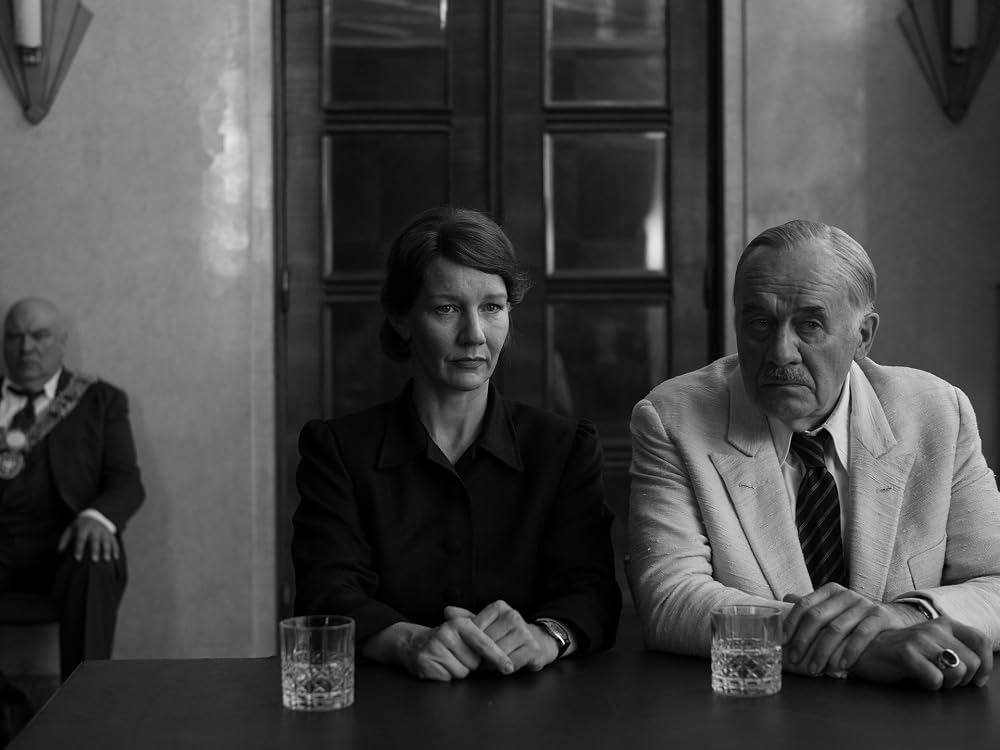
With its stripped-down aesthetics, swift storytelling, and striking shades of black and white, Fatherland tells the story of an entire era in roughly an hour. It achieves an almost mythical stature, summoning an inheritance that extends from the ancient Greeks to the Germans. (Extreme Emotions / Nine Hours)
Fatherland, the new Paweł Pawlikowski film about Thomas Mann’s 1949 trip to Germany, may be the most powerful film about the current moment — really, the last ten years — that I’ve seen. It’s not about the current moment at all, in fact. It’s about Mann’s olympian, and doomed, effort to remain a man of culture, a voice of liberal civilization in the face of that civilization’s total collapse. In other words, it’s about the current moment.
As Thomas and his daughter, Erika Mann, played by the brilliant Sandra Hüller, tour a Germany divided in two and still struggling to get back on its feet, they confront the detritus of the barbarism that has consumed Europe and the gentility of the collaborators who helped bring that barbarism about. The relationship of the Manns to those collaborators is personal: one is an ex-husband of Erika, another two (the grandchildren of Richard Wagner) look to Thomas as their patron saint and potential savior.
Played by the also brilliant Hanns Zischler, Thomas Mann slices through the screen with a stiletto of irony, honed across decades of urbane detachment and sly observation. His honorable refusal to collaborate with the Nazis gives him a passport to cross borders while remaining aloof and above the evil that guards the gates. He is devastatingly cool toward his enemies without suffering their discomfort or disturbance.
He’s also repeatedly exposed, most powerfully by his daughter and by a lonely dissenter in the eastern zone of the country, as a preening moralist. The futility of his refusal, the fecklessness of his resistance, are as pronounced as the serenity of his self-regard. Never has the liberal humanist seemed so entitled to our respect — and so incapable of holding it.
Amid the moral catastrophe of the film, it’s tempting to look to Erika as its moral center. She confronts her father in a scene that is as devastating as any of his confrontations with the Nazis. Yet she, in her way, is as attached to the myth of Thomas Mann as he is. She stays with him throughout his trip, while her beloved brother, Klaus, who has begged her to come to his protection, spirals downward into suicide. We’re left uncertain, by the film’s end, whether she and her father will attend Klaus’s funeral. Her voice and actions are as compromised as her father’s, and as ours.
With its stripped-down aesthetics, its swift story telling and immediate shades of black and white, Fatherland tells the story of an entire era in roughly an hour of film. It achieves an almost mythical stature, summoning an inheritance that extends from the ancient Greeks to the Germans.
The fate of Mann, the father, recalls Wagner’s Götterdämmerung, the twilight of the gods who are no longer fit or able to rule the world and thus lose their place in it. In the film, Mann carries a tradition that has proven completely incapable of fending off the most terrible evils. While many have returned in recent years to the literature and biography of Mann — most notably Colm Tóibín in his wonderful novel The Magician (Tóibín is thanked in the film’s credits) — no one, aside from Pawlikowski, has looked to Mann as, or made him into, such a disturbing exemplar of the feebleness of liberalism in our current moment.
The relationship between Thomas and Erika also recalls Wagner’s Die Walküre, where the love of an olympian father, Wotan, for his beloved daughter, Brünnhilde — like Erika, Brünnhilde seeks to protect her half-brother, Siegmund, but fails in doing so — is ultimately destroyed by her disobedience of Wotan. In Fatherland, it is Klaus’s suicide that rips open a painful tear in the fabric between of Erika and Thomas.
Reaching further back, Fatherland recalls Sophocles’s Oedipus cycle, particularly the second and third plays in the trilogy. In Antigone, Oedipus’s daughter Antigone struggles to honor her brother, Polynices, who has been killed in battle and is denied a proper funeral by the new king, Creon. Erika’s fidelity to and love for her brother, her anguish over his suicide, and the question of whether she and Thomas will attend his funeral — all of this recalls the struggle of Antigone. Oedipus at Colonus, the third play, in which Antigone accompanies her father Oedipus, now exiled, also figures in Fatherland. Oedipus, of course, is now blind, as is Thomas Mann, in his way.
Despite these ancient and mythic resonances, it is the contemporaneity of the film that presses itself upon us. Both Erika and Thomas Mann struggle to maintain their composure and their integrity, but each betrays their values, suggesting how difficult it is to remain a moral being in an immoral world. The father toggles between nobility and narcissism, the daughter between judgment and despair. The last scene conveys the terrible futility and sadness of it all, the music of Bach painfully sounding as a register of the desolation enveloping us.