Greed and Economic Desperation Are Fueling Sudan’s Civil War
The militias wreaking havoc in Sudan also profit from plunder and can pay their recruits a wage much higher than any civilian job available to them. This simple calculation is one of the most important factors behind the country’s horrifying war.
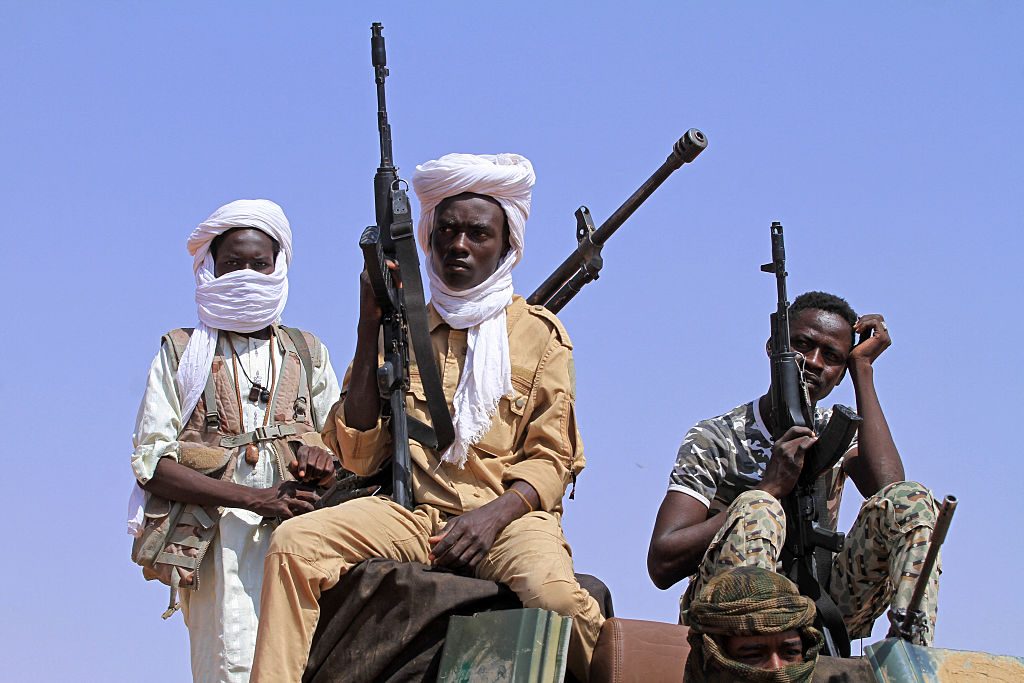
Sudan’s civil war is generating big profits for militia leaders and their allies outside the country. The profiteering is not an incidental feature of the war — it’s one of the main engines driving it. (Ebrahim Hamid / AFP via Getty Images)
I used to pass the biscuit factory in Soba without going in. People I knew went in for a twelve-hour shift on a line that smelled of sugar and oil. In 2021, the number that stuck was 1,500 pounds for the shift.
In Haj Yousif, where Iqbal lived, the rent for a single room was 30,000 pounds a month. You had to work twenty factory days just to cover rent. Meanwhile, the Rapid Support Forces were offering people 15,000 a day, a uniform, and a phone.
Those three numbers explain more about Sudan’s war than any map I have been shown since. What happened in Sudan was not primarily a story of people choosing violence. It was a story of people choosing the wage that was available.
A Bus That Does Not Come
Iqbal sold tea in front of the medical campus at the University of Khartoum, setting up with three low stools, a few plastic chairs that did not match, a kettle that was black at the bottom, and a sugar jar with a spoon that was always wet. She kept her coins in a small tin.
She lived in Haj Yousif. Traveling to the university from her home involved hours on buses, not to mention the time spent walking and standing in the heat for a bus that does not come. She did it every day.
Her husband had run away — her choice of words — to fight with Abdelaziz al-Hilu in South Kordofan. I do not know the full story of what took him. What I know is that the farm outside the city had stopped paying for a life inside it, and that a rifle and a cause offer the kind of wage a collapsing farm cannot.
Iqbal stayed with their four children, who would be fed or not fed depending on how the day went. Around her, on the same stretch of pavement, Asyaa ran two kettles at once, while Fatouma sold tea and roasted nuts and knew which patients in Shar al-Hawadith had not eaten.
The women had come in numbers when the farms stopped paying. Men left for the mines or the militias. Khartoum needed cheap food, cheap warmth, and cheap care for students who could not afford a meal or companions waiting a week in a hospital corridor. The city got what it needed, but the women who provided it were deemed illegal.
The local authority sent a pickup with two or three men in uniforms that never looked fully clean. They seized the chairs, the kettle, the sugar, sometimes the gas cylinder, too. You had to go to their office and pay to get your own things back. We called the practice kasha.
The state had decided that Iqbal’s labor was not a business. It was an obstruction — and what it could not ignore, it taxed. When we saw the truck turn the corner, we hid her stools behind the labs.
A different truck offered her neighbor 15,000 pounds a day and a story he could tell his family. Two days of that wage was a month of rent on her street. You did not need a lecture on identity to explain why a boy answered the recruitment call. In a city where the state had made survival illegal and a collapsing currency had made the factory irrelevant, a soldier’s wage was the only thing that replaced the state.
In 2018, a man sat at her stall like any customer. He noticed her phone, which was basic and worn at the edges. Over the course of several visits, the talk moved toward money, and he offered her a new phone and weekly payments of real money. He wanted her to sit among us and report what the students said: who was organizing, who came and went.
She refused the offer. She did not tell us at the time and carried that refusal alone until the regime fell. When she finally mentioned it, I asked why she had never said. She said she did not want us to worry or do something stupid. Mostly — and this is the sentence that has not left me — she did not want fear to change what we were doing at the gate.
There was a small room in the pharmacy faculty where leftover donated drugs went to patients from the hospital next door. The tea women brought their children. A registrar looked at a sick child on a stool, and a pharmacist walked out with the medicine. There were no forms, and nobody paid 15,000 a day for any of it.
Guns and Gold
I sat with a miner from Jebel Amer whose hands were burned from mercury during the sit-in in May 2019, in the place we called Kolombia, the open ground behind the railway tracks. He said the RSF took 30 percent of everything.
The mine had closed after fighting with Musa Hilal’s men, and he had come to Khartoum with nothing. He joined the sit-in. He said if the RSF came, he would fight. On June 3, he disappeared, and I never found him afterward.
After clashes with Hilal, the RSF took Jebel Amer. At the peak, they were extracting something like forty kilograms a day. The metal was processed with mercury, then flown from Khartoum airport to Dubai — sometimes a hundred kilograms a flight, once a week — with no customs paperwork on the Sudanese side. From Dubai, it entered the global gold market, occasionally passing through European refineries that did not ask where it came from. Investigators later put the annual take at more than a billion US dollars.
From 2015, the same force was sending men to Yemen for Saudi and Emirati pay. The UAE had been cultivating Sudanese military figures since the early 2010s; when the Yemen war needed ground forces composed of men who could move fast and not ask questions, they called the RSF leader Mohamed Hamdan Dagalo, better known as Hemedti. Estimates of the deployment range from 14,000 to 40,000 fighters between 2015 and 2020.
The pay was invdollars, which meant you could recruit faster than the army, buy equipment, and build a buffer against any future rupture with Khartoum. Fighters rotated home having been trained in urban combat and logistics. I remember the new trucks in Khartoum that year. I did not know the money was Gulf money, although I knew the men who had burned villages in Darfur were moving through my city as if they owned it.
The RSF was not, by this point, a paramilitary force sustained by weapons. It was a mining and logistics operation that maintained an army. The weapons were evidence of its power, which derived from gold.
With that gold, Hemedti built an empire that ran parallel to the state instead of through it. Al Junaid, the family conglomerate, became one of the largest mining and construction operations in the country. In October 2019, people in Talodi, South Kordofan, set fire to one of its cyanide plants after the runoff poisoned their water and killed their cattle. Guards opened fire, but the crowd burned it anyway.
Investigators at Global Witness later traced RSF payments moving through UAE-based front companies into accounts at the National Bank of Abu Dhabi and documented the purchase of more than 900 Toyota Hilux and Land Cruiser vehicles. There were real estate holdings across the capital, farms in Darfur, and a trucking fleet. The gold bought more than guns — it bought a parallel economy, booked in Dubai.
Russia’s Wagner Group arrived around 2017 for the same metal, exchanging military training and equipment for mining concessions in RSF territory. When the US Treasury sanctioned those operations in 2020, the networks reorganized through UAE-based intermediaries. The buyer did not change.
Swissaid, reading the UAE’s own trade figures for 2024, found that Dubai imported twenty-nine metric tons of gold from Sudan that year, a big increase from seventeen metric tons the year before. According to the same figures, eighteen additional metric tons came from Chad and nine from Libya, two countries that are not famous for their gold mines but serve as transit routes for metal moved out of RSF territory.
Supply and Demand
In September this year, Michael Waltz and Massad Boulos argued in Foreign Policy that peace in Sudan can only come after a weapons embargo, extending the old Darfur ban of 2005 across the whole country. Drones, they write, do not stop at Darfur’s border, and they are right about the geography. On September 11, the United Nations Security Council extended existing measures for one month, until October 9. Washington has been pushing for a nationwide ban, while Moscow opposes any expansion.
Waltz and Boulos frame the problem as one of supply: more than a dozen countries are feeding both sides, and an extension of the ban will block them from doing so. Some of that is right. But an arms embargo addresses a supply problem — the flow of weapons — while the political economy of militia recruitment is a problem of demand.
The UAE is not just one supplier among others. It is the buyer of last resort for Sudanese gold and the logistics node for the air bridge into Darfur. Dubai’s refineries process the metal, and the same financial infrastructure enables the flights.The profit is not incidental to the war. A force paid from the mine, through Dubai, does better when the country is in pieces.
None of this is a defense of the Sudanese army. It has a history of coups, of alliances with Islamists, of violence in the peripheries. But a ruined army still has to pretend it employs people on behalf of a state. It still needs ports, a capital, a population that eats if the flag is going to mean anything.
There are steps that could be taken in response. One important move would be to complement the weapons ban with Kimberley-style certification for Sudanese gold at the point when it enters refineries. Another would be to apply sanctions on UAE-based entities that form part of the air bridge and on the front companies and bank accounts that convert the metal into Toyotas.
Filling the Silence
Iqbal had to leave Haj Yousif when the fighting reached her neighborhood. She went to her sister’s place in Omdurman, not to work but to wait.
I called her from Halfa, near the Egyptian border, after I left. The line is always bad, always dropping in the middle of a sentence so you do not know if she heard you. At first, I talked too much, filling the silence the way you do when you are afraid the other person has gone. Then I learned to wait.
I kept asking whether she had found a stall. She had not. She said the city was not hers. Her voice came through tired but still the same.
I can still do the arithmetic from Soba to Haj Yousif in my head: 1,500 for twelve hours; 30,000 for a room; 15,000 for a day with a gun.
The truck paid better. She asked if I was eating anyway.