Blame South Sudan’s Civil War on Elites, Not “Ethnic Tensions”
South Sudan’s post-independence instability is often blamed on ethnic tensions. But exploitation by international companies and zero-sum competition over resources between local elites are the real causes of ongoing violence in the country.
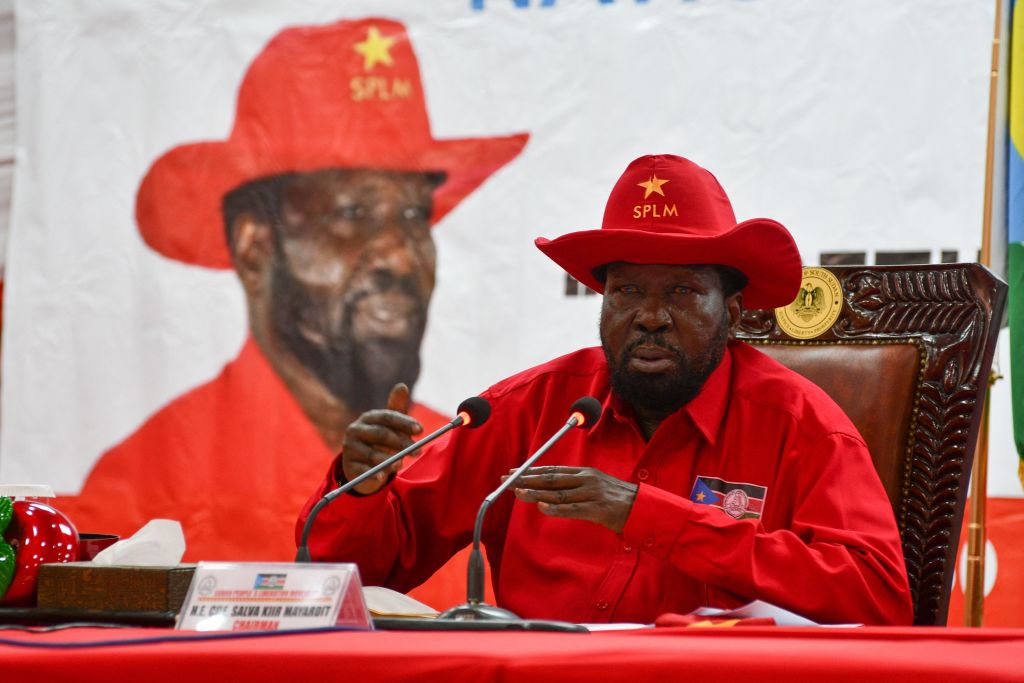
Salva Kiir, the president of South Sudan, attends the meeting of the National Liberation Council at the Freedom Hall in Juba on December 2, 2022. (Samir Bol / AFP via Getty Images)
In South Sudan, generals and politicians have siphoned off the country’s oil wealth (98 percent of state revenue in 2013 alone), bolstered by a “gun class” of government soldiers, community militias, cattle raiders, and private guards who then fight over cattle, mining, and timber industries. While public reporting and official narratives largely focus on the ethnic nature of South Sudan’s violence, an unrestricted race for wealth and power is what really undergirds this contest. South Sudan may be the world’s youngest country, but the ongoing conflict is a process decades in the making. Since the 1950s, foreign governments and corporations have consistently legitimized the most predatory actors in the region.
Elite Conflicts
After two civil wars spanning virtually all of independent Sudan’s history (1955–72, 1983–2005), South Sudan achieved independence by popular referendum in 2011. The conflicts were often framed as “Arab” Khartoum versus “African” South Sudanese tribes, but struggles for oil wealth and factional enrichment were far better explainers. Indeed, some of the most brutal fighting, including the massacre of two thousand people in Bor in 1991, was between South Sudanese factions.
Accordingly, only two years after independence, coalitions under President Salva Kiir and Vice President Riek Machar (architect of the Bor bloodbath) came to blows in the capital of Juba, initiating a civil war that engulfed much of the country. Parties to the conflict would employ systematic sexual and gender-based violence, hate speech and ethnic cleansing, and starvation as a weapon of war. Kiir’s centralization of access to state oil revenues was important to the war’s initiation, and the oil fields of Unity State and Upper Nile became key battlegrounds. Though the conflict technically ended with a peace deal in 2018 and a power-sharing government in 2020, the parties have merely decentralized their economic and political contests. Accordingly, violence against civilians and between proxy forces and militias persists.