Social Democracy Won the Century and Lost the Future
Social democracy transformed the 20th century, giving working people a share of wealth and power their grandparents could scarcely imagine. But the movement that set out to overcome capitalism ultimately struggled to defend what it had won within it.
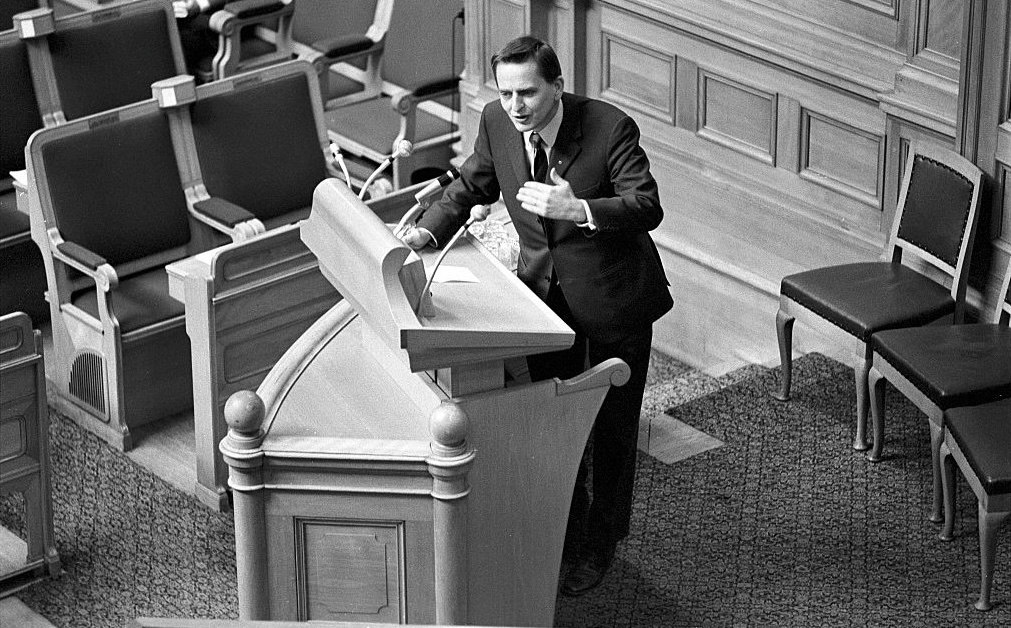
For half a century, Swedish social democracy built the most egalitarian society in history. Then its labor movement asked for the one thing capital would never give up: ownership. (Sjöberg Bildbyrå / Ullstein Bild via Getty Images)
On Sunday, Sweden’s Social Democratic Party (SAP) emerged as the largest party in an election that will be remembered for all the wrong reasons. Magdalena Andersson is poised to return as prime minister, with her four-party bloc holding a one-seat majority in a 349-seat Riksdag. The SAP won just 28 percent of the vote, its worst showing in more than 110 years.
This is what victory looks like today for the most electorally successful left-of-center party in history. The SAP went from pioneering social democratic governance, ruling almost uninterruptedly for nearly half a century, and even debating the transfer of large firms to worker ownership to serving as a fading bulwark against the far right, with little more than a quarter of the electorate behind it.
The Swedish “model” can only be described in the past tense. How that happened is not a story of betrayal. It is a story about what a strategy for reforming capitalism can achieve and about the point where it runs into the structure of capitalism itself.
In 1976, Swedish Prime Minister Olof Palme remarked that there were two paths for socialists: “Either to return to Stalin and Lenin, or take the road that joins the tradition of social democracy.” As the leader of the state that embodied the latter, his choice was obvious. The Swedish model had such prestige that even a Gaullist like French President Georges Pompidou said his ideal society was “Sweden — with a bit more sun.”
But though the divergent paths of socialism could not have seemed starker in Palme’s day, it wasn’t always so. In the immediate aftermath of the Russian Revolution, significant social democratic minorities joined communist splits, but most social democrats rejected insurrection and accommodated themselves to the democratic republic as the political form for their ambitions. At the same time, almost all these social democrats were still doctrinally Marxist and shared a horizon of socialism. Their parties had been built on the model of the German Social Democratic Party’s 1891 Erfurt Program, which married a maximal goal — the socialization of all private production — to a minimum program of immediate reforms, and which assumed that capitalism’s own development would eventually deliver the first by way of the second. For most, that meant a nationalized economy in which the tyranny of the market gave way to rational planning. They wanted to bring about a successor system to capitalism and doubted how much could be changed within capitalism.
Social democracy never achieved its desired ends, but the reforms it brought about proved successful far beyond expectation. Sweden in the 1970s was not simply the most livable society in history; it was also the European country where, after World War II, socialists got the furthest along in undermining capital’s power. While capitalists worried about Nikita Khrushchev’s shoe-banging promises to bury the West, another threat to capital was emerging in Scandinavia, where the combination of a universal welfare state, full employment, and centralized unions gave labor enormous power. Swedish trade unions even came out with a proposal for wage-earner funds in 1976 that would have slowly socialized private firms. How Sweden’s social democrats got to that point, and why their experiment eventually fell apart, is an unlikely, instructive story.
Socialists in Office
Yet to understand the success of postwar Sweden, we first need to understand the failures of interwar social democracy and the important lesson they offer about the pitfalls socialists encounter when governing without a plan to achieve economic and political change.
European socialists were presented with the chance to move from opposition to power more quickly than many imagined. They came out of World War I with a great deal of legitimacy — in some cases, as in Germany, because elites were discredited; in others, partly because of their own wartime support for the national cause. As Karl Kautsky put it in 1924, “We had learned how to be an opposition” before the war. Now “we had to take over Government, and that in the fullest sense; in industry, in the localities, in the State.” But his party, like other socialist parties during the interwar years, governed only through minority or coalition governments.
Left parties had varying success pushing through democratic reforms. They tried to remove any existing barriers to universal suffrage and democratize upper houses of parliament. Surviving monarchies across Europe were stripped of their political power. Like his predecessor Jean Jaurès, French socialist Léon Blum saw the republican state as a tool to “define, protect, and guarantee the condition of the working class.”
The radical dream — replacing capitalism with a socialist economy operating for the common good — was still alive. In the immediate postwar years, strike waves created fertile terrain for new demands, and with the onset of the Great Depression, capitalist collapse became a reality. Nationalizing big firms and introducing economic planning would be the first steps. But social democrats only had a vague idea of what they wanted to do.
Indeed, outside of France, no firms were nationalized by interwar social democracy at the federal level (despite socialists participating in eight other West European governments). Instead, socialists formed commissions to study the subject, grappling for the first time with the technical difficulties of constructing a new political economy. Not much resulted from these commissions, and even Kautsky was forced to admit within a few years that “the creation of a socialistic organization is therefore not so simple a process as we used to think.”
The 1929–31 British Labour government under Ramsay MacDonald was the most extreme example of interwar futility. Labour had long been more moderate than many of its European counterparts; the party eschewed Marxism and from the beginning operated within a liberal-constitutional framework. It was a party driven by trade unions’ interests, and it never had the same radical ideological influences as the German Social Democratic Party (SPD). Labour was refused admittance into the Second International for years for its emphasis on class collaboration, but it took a turn to the left after the Great War. Clause IV of its constitution, adopted in 1918, called for “the common ownership of the means of production, distribution and exchange.”
The party’s first stint in power came after the 1923 general election, in which Labour won over a million fewer votes than the Conservative Party but was able to form a minority government with Liberal support. The experiment only lasted ten months, and with fewer than a third of the seats in Parliament, MacDonald was unable to pass anything other than minor education, housing, and employment reforms. A minority government always runs on borrowed time, but Labour also had to contend with a red-baiting Conservative campaign challenging its mild diplomatic overtures to the young Soviet Union.
In 1929, Labour ran on a platform calling for public works construction and a reduction in the workweek to combat unemployment. It was rewarded with a 136-seat gain, making it the leading party in Parliament, though it was short of a majority. Again Labour was dependent on Liberal Party backing.
MacDonald’s second ministry was formed in June 1929, just a few months before the start of the Great Depression. The timing couldn’t have been worse for Labour’s reform agenda. As unemployment rose, the party leadership clung to a rigid economic orthodoxy rather than expanding a public works program. The leaders wanted to reassure markets, and they faced a run on the pound and a growing deficit. Advocating austerity, MacDonald reasoned that defending the currency was a more urgent task than fighting unemployment, and that maintaining free trade and “the strictest regard” to the prevailing economic wisdom would in time allow the unemployed to be reabsorbed into industry. Their urgent task was to avoid shipwrecking democracy “on the hard rock of finance.”
MacDonald himself came from exceptionally humble origins, but he clashed with the trade unions and saw himself as a responsible steward of an entire society, not just a class. Some Labour parliamentarians closer to the unions opposed cuts to unemployment benefits and welfare, advocating increased state planning and spending instead. Though they had far different political aims from MacDonald’s, most of the extraparliamentary left shared the party leadership’s belief that not much could be done through government. “No matter how able, how sincere, and how sympathetic the Labour men and women may be who undertake to administer capitalism, capitalism will bring their undertaking to disaster,” an article in the Socialist Party of Great Britain’s Socialist Standard would say.
The MacDonald government ruled without attempting to bring about a socialist alternative and without believing that it could reform the existing system. At best, it reassured workers that they alone would not be asked to sacrifice in an era of scarcity, but that fatalism helped bring Labour to disaster. In August 1931, MacDonald broke with his party and formed a National Government with Conservatives and Liberals. In October, that coalition won a landslide, while Labour suffered a crushing defeat.
It was the economist John Maynard Keynes, a liberal who believed socialists were well-intentioned idiots, who presented the best approach of the time to taming capitalism. The methods laid out in his 1936 work, The General Theory of Employment, Interest and Money, once implemented, would help spur employment, ensure productive investment, and mitigate crises. Before the Keynesian Revolution, the reigning classical theory claimed that cyclical swings in output and employment would be self-adjusting — as aggregate demand fell, production and employment would decline, along with prices and wages. Lower prices and wages would then encourage capitalists to make employment-generating capital investments, restoring growth. Any interference in that cycle would only prolong agony for workers. The Great Depression, however, was not going away. Wages were low, but unemployment remained high. Keynes advocated a countercyclical fiscal response: deficit spending, tax cuts, and other measures to stimulate aggregate demand during a recession, and tax increases and spending cuts when times were good.
During MacDonald’s second government, however, Keynes had not yet published his General Theory, though he already advocated public works to combat unemployment. Just as the workers inspired by Ferdinand Lassalle in the nineteenth century clung to a belief in an “iron law of wages” that limited the gains of trade unionism, it would be a struggle to disabuse the twentieth-century workers’ movement of orthodox economics. Two years after its sympathetic remark on the “sincere” effort of MacDonald’s Labour Party, the Socialist Standard would look back on the experience of government as definitive proof that “it is not possible for the Labour Party or any other party to administer capitalism in such a way that the workers’ problems can be solved within the framework of the existing system.”
The Popular Front’s Limits
The Popular Front government of French socialist leader Léon Blum (1936–37) was more determined than MacDonald’s to deliver change. French socialists had lost much of their industrial base to the new communist movement but were still very much Marxists. Rebuilding the party’s infrastructure throughout the 1920s, Blum grappled with the question of why and under what conditions a socialist would enter government. He distinguished between the “exercise of power” (taking office to prepare the groundwork for socialism) and the “conquest of power” (the actual dismantling of capitalism). In the end, Blum settled for “the occupation of power,” to keep it out of the grasp of fascists.
When the Jewish radical Blum rose to power in 1936, the antisemitic politician Xavier Vallat complained, “For the first time this ancient Gallo-Roman land will be governed by a Jew.” Just before becoming prime minister, Blum was dragged from a car and beaten, nearly to death, by a right-wing mob. A picture of him, heavily bandaged with swollen features, appeared on the March 9, 1936, cover of Time magazine.
Reactionaries hated Blum both for being a Jew and for being a socialist. He could have complained that his immediate ambitions were not so shocking. The French Communist Party supported the Blum government, but, against his wishes and those of its own leadership, it was pressured by Moscow to stay out of the cabinet.
Under the sway of the Comintern’s Third Period strategy, from the summer of 1928 until a year or two after the rise of Nazism in 1933, the communist parties had seen reformist social democrats as their primary enemy. They even went as far as to call them “social fascists.” But by 1934, relations between socialists and communists in France had become more fraternal.
In a dramatic about-face, the Comintern began seeking alliances — “popular fronts” — with other left movements where possible. The justification for staying out of Blum’s cabinet in 1936 was not leftist purity. In fact, Joseph Stalin was worried that Communist involvement would scare away the centrist Radical Party’s support for the Popular Front.
The election of Blum’s socialist government, however, unleashed a massive wave of industrial action. Over two million workers took part in strikes, occupying factories and paralyzing production. Marceau Pivert, leader of the Socialist Party’s radical left, proclaimed that “everything is possible” in the new environment. Business leaders appealed to Blum to restore order. The result was the Matignon Accords, which secured collective bargaining rights, strengthened union protections, and provided substantial wage increases. Separate legislation gave French workers the forty-hour week and two weeks of paid vacation. Exhausted but overjoyed, millions flocked to the countryside and the sea for the first time that summer. The dignity these reforms afforded to working people was undeniable. Though they were the product of grassroots rebellion, not Blum’s program, they couldn’t have been implemented without the Popular Front in power.
The reforms also contained the seeds of their undoing. The upsurges of May and June 1936 triggered capital flight and a business counteroffensive over the implementation of the reforms. With political instability growing, Blum’s middle-class coalition partners abandoned the fight. The leader had neither the support nor the resolve to pursue more radical measures or to offer adequate aid to his fellow socialist-republicans fighting a bloody civil war against fascists in Spain. Blum was pushed out of power again in 1938, all the while pleading that he had attempted to be a “loyal manager of capitalism.”
Blum might have been selling his reforms and radical vision short. But unable to protect its policies, the Popular Front in France was little more successful, in the end, than the first two British Labour Party governments. It was only in Sweden that interwar socialists were able to mount a serious challenge to fiscal orthodoxy. Swedish economists had long pursued heterodox economic ideas, and starting in the 1930s, the SAP put them into practice.
Building the Swedish Model
Accounts of the rise of social democracy in Sweden often focus on the country’s exceptional features. Its civic culture, limited state repression, and even racial homogeneity are commonly invoked. But on the whole, the country’s left faced similar challenges to its counterparts elsewhere; it just managed to find ways to overcome them. One relevant difference was that the nation underwent industrialization relatively late, in the 1870s. Trade unionism expanded in the following decades, and the Swedish Trade Union Confederation (LO) was founded in 1898. This relatively late development gave advocates of industrial unionism greater scope to organize across craft divisions.
The late start meant that Swedish unionism developed under the ideological influence of socialism — the SAP was founded in 1889, the same year as the Second International. The party’s founders were drawn to socialism through the example of movements in Denmark and Germany, and the ideology quickly took root in Sweden. Socialists faced the intransigent opposition of elites, with a 1902 New York Times article describing battles between workers and capitalists and fears of the “dreaded red flag” flying in a Sweden that was only rivaled by Russia as “the most feudal and oligarchical country in Europe.” Sweden was described similarly in SAP literature as an “armed poorhouse.”
Sweden did not grant universal male suffrage until the early twentieth century, meaning that, like the Bolsheviks, Swedish socialists were forced to focus most of their initial efforts on the shop floor rather than in parliament. In the political struggle for civil reforms, socialists proved themselves abler than the country’s liberals. As in Germany, the limited power of elected office also papered over potential differences between a would-be parliamentarist right and more radical forces. Yet in Sweden, under the leadership of Hjalmar Branting, the Social Democrats were able to maintain a relatively stable broad tent and engage in productive coalition work with liberal and agrarian forces.
Despite some reformist inclinations, from early on the Swedish movement was built on socialist ideological grounds: it advocated policies that bridged gaps between craft and industrial workers, and it put emphasis on uplifting the most poorly paid. Social Democrats consistently prioritized universal programs — of benefit to both the poor and farmers — and not just the narrow interests of workers. Instead of pursuing shortcuts in their early years in opposition, Sweden’s socialists began to build a hegemony more durable than that of other Second International parties.
By the 1920s, things were going according to plan: the struggle for political democracy had been largely successful, and as a result the party had a growing electoral mandate. Early SAP minority governments, however, proved unable to usher in phase two — the winning of social democracy. That began to change in 1932, when the party embarked on nearly half a century of almost uninterrupted rule. The SAP had campaigned on an expansion of public works and more state intervention in the economy and, after taking power, began to implement some of the countercyclical policies forsaken by socialists elsewhere.
The real breakthrough, however, came later in the decade, when the SAP formed a parliamentary coalition with the Agrarian Party, and the LO negotiated the 1938 Saltsjöbaden Agreement, or Basic Agreement, with the powerful Swedish Employers’ Confederation (SAF). Reconciling working-class interests with those of small farmers meant that nationalization was off the table for the time being. The agreement consolidated a compromise whose foundations had been laid in 1906, when the LO recognized management’s “right to manage” — to direct the labor process and make personnel decisions — in exchange for employers’ recognition of workers’ right to organize. Planning was gradually redefined from state nationalization to public investment and economic forecasting.
The party had made a significant shift from representing workers’ interests in opposition to constructing a cooperative “people’s home” for the entire population. It recognized that prosperity depended on growth, and that there was no immediate alternative to private enterprise. Way back in 1897, amid pitched industrial battles, Swedish socialists made their stated goal “the fostering and development of intellectual and material culture.” Nationalization, at the time, was their assumed means, but the goal was more open-ended. Unlike MacDonald’s Labour Party, however, they didn’t capitulate to the market as it was but made a radical attempt to change how it operated.
The Swedish model matured after the war. During the gestation period of the SAP’s 1944 “postwar” program, Finance Minister Ernst Wigforss argued that the concentration of economic power was the problem, not necessarily private ownership. It was another acknowledgment that Sweden’s main issue was underdevelopment, and that it was better for labor to share part of a growing pie with capitalists than to try to capture all of a small one.
Yet the SAP did not rule out immediate socialization if the tamed private market didn’t prove itself compatible with the party’s values and goals. The debates at the time show a party that still took its commitment to socialism seriously. Some socialists even shared the expectation of Minister of Social Affairs Gustav Möller that a wave of revolutions might follow the war’s conclusion and ripen conditions for a more traditional socialist program.
With the Communist vote tripling to 10 percent, the combined Left had an absolute majority in the 1944 elections. And even in a period with emergency wage, price, and consumption controls, planning had a great deal of mystique. Despite Wigforss’s assurances about the continued role of private capital, the 1944 program advocated government takeovers of basic industries and finance and an overarching state responsibility for shaping investment and maintaining full employment. Economist and Trade Minister Gunnar Myrdal spoke of a “harvest time” for the labor movement, in which the fruits of recent economic development would fall to workers. Yet a push for nationalization found resistance from a capitalist class that could credibly threaten to withhold investment. That climate, combined with the onset of the Cold War, tempered the SAP, which forsook an alliance with the Communists in favor of a new coalition with the Agrarians.
Equality Without Expropriation
With the march toward socialization blocked, the party eventually adopted a 1951 plan created by LO economists Gösta Rehn and Rudolf Meidner. They shared the SAP’s desire to promote and influence economic expansion but advocated doing so through centralized collective bargaining backed by an active state. The starting point for the Rehn–Meidner strategy was a commitment to using that sectoral bargaining between the LO and the SAF to help equalize pay levels for all workers. That didn’t mean everyone earned the same, but the gap between higher- and lower-paid workers was reduced. The “equal pay for equal work” principle also meant that differentiated wages should be determined by the type of work performed, not by a particular employer’s ability to pay or an employee’s power on their shop floor.
This was done for three reasons. First, because of an ideological commitment to equality: even if wages can’t be equal, at the very least we should lift up the incomes of the worst off and limit the advantages of the best off. Second, because wage compression was politically useful: it reduced divisions within the working class and promoted solidarity across industries. Third, because it played an important macroeconomic role in the Rehn–Meidner plan.
Wage demands would be set so that firms at an average efficiency level could survive, but less efficient firms would be squeezed and forced to radically restructure or go bankrupt. The most productive firms, however, would benefit from the wage restraint of their workers and garner excess profits. These profits would allow them to expand their productive capacity and thus generate more wealth. The system helped encourage high-wage, capital-intensive industry.
These negotiations were done directly between labor and capital, but the role of the state was crucial: “active labor market policies” helped workers formerly employed in less productive firms get reabsorbed in expanding parts of the economy. Social guarantees — for health care, education, childcare, and so on — meant that there was a growing state sector to help ensure full employment. It was a program for “functional socialism,” in that it made certain socialist priorities clear but would seek them by shaping the outcomes of capitalist enterprise rather than through nationalization. Such a model, however, was one that capitalists would agree to only under duress. As Meidner put it, “management prefers decentralized bargaining” and “wage differentials as instruments for managerial control.”
Even though capitalists benefited from the Rehn–Meidner plan in many respects, it was only implemented because a powerful labor movement and social democratic party pushed it through. Nevertheless, it was a “socialism” jointly administered by a powerful employers’ federation, which was able to set redlines around how far private ownership rights could be eroded.
This contradiction would only emerge later. Sweden thrived in the postwar period. It had not been ravaged by the war, and a rebuilding Europe needed the raw materials it exported. What was good for Volvo also seemed to be good for Sweden. Under the twenty-three-year tenure of Prime Minister Tage Erlander, companies enjoyed soaring profits, and the spoils of that growth were shared widely.
The dream of constructing socialism through nationalizations was abandoned, and as late as 1976, only 5 percent of Swedish industry was under public ownership. But the results were undeniable. The Rehn–Meidner model combined the dynamic power of capital and free trade, on the one hand, with the might of an organized trade union movement and a social democratic state, on the other, to ensure egalitarian outcomes. Beyond distributing income more fairly, the system allowed Swedes to meet basic needs outside the marketplace through welfare-state guarantees. It was what Wigforss called a “provisional utopia.”
International observers like Anthony Crosland drew profound lessons from the Swedish example. The British Labour parliamentarian believed that socialism was compatible with the private ownership of industry. His 1956 book The Future of Socialism criticized the traditional socialist focus on means — the preference for nationalization, for example — instead of the end goal of social equality. “The worst sort of confusion,” he wrote, “is the tendency to use [socialism] to describe, not a certain kind of society, but particular policies which are, or are thought to be, means to attain this kind of society.” It was the most influential revisionist work since Eduard Bernstein’s Evolutionary Socialism, perfect for an era in which capitalism seemed dynamic and the scope for reform within it almost boundless. Crosland was explicit about his intention, telling a friend that he was “engaged on a great revision of Marxism, and will certainly emerge as the modern Bernstein.”
The comparison was apt. Bernstein had been a coauthor of the Erfurt Program and one of the most respected Marxists of his generation before, in a series of articles in the late 1890s, he began questioning its orthodoxy. Society was not “splitting up into two great hostile camps,” as The Communist Manifesto claimed; intermediate classes and smaller firms were alive and well, and workers’ material standing was slowly improving rather than deteriorating. Capitalism, he argued, had found ways to self-regulate and avoid crises, and the working class had won the means, in the form of parliaments, to shape its development and slowly legislate reforms.
“The ultimate aim of socialism is nothing,” he wrote, “but the movement is everything.” Social democracy would reach new heights when it freed itself from “obsolete phraseology” and was “willing to appear what it really is today; a democratic-Socialist reform party.” Kautsky and Rosa Luxemburg led the reply, and the SPD formally repudiated Bernstein in 1898. But the revisionists would have their moment.
While Bernstein had inklings of how malleable capitalism was, Crosland had proof. Despite the Depression and war of the 1930s and ’40s, the system had not collapsed but was instead being transformed. Living standards were improving, and private capital increasingly found itself subordinated to both the state and labor. This was the case in Clement Attlee’s Britain and even more so in Erlander’s Sweden. Taxing the gains from capitalist growth and expanding social spending, rather than outright expropriation, seemed to be sufficient. Going further than Bernstein ever did, Crosland wrote, “Marx has little or nothing to offer the contemporary Socialist, either in respect of practical policy, or of the correct analysis of our society, or even the right conceptual tools or framework.” Three years after The Future of Socialism’s publication, even the venerable German Social Democratic Party abandoned the Marxist concept of class struggle in its Godesberg Program. The reconciliation to capitalism that social democracy had long made in practice was finally codified in theory.
An Unlikely Radical
Yet in 1969, when Olof Palme took over as prime minister of Sweden, the class compromise that underpinned the system was starting to come undone. That Palme came to prominence was no great surprise — that he did so on the back of working-class politics was. He was born into an aristocratic Lutheran family and spent much of his childhood on estates and in the company of private tutors. His uncles were so rabidly right-wing that they fought in the Finnish Civil War as foreign volunteers supporting the brutal White Army. One of them, after whom he was named, was killed by the Reds at the Battle of Tampere in 1918.
Palme might have always had some egalitarian instincts. After his 1986 assassination, an old household servant recalled that he was different from his family members, even as an eight-year-old, “always helping us maids carry the dishes and talking to us as equals.” But from what we know of his days in primary school and in the military, Palme was hardly political and even displayed some conservative tendencies. As unlikely as it seems, he was won over to socialism during his time in the United States.
In 1947, Palme received a scholarship to study for a year at Kenyon College, a liberal arts school in Ohio. He came to love America, filled as it was with postwar confidence and a vibrant trade union movement. Palme was a member of a socialist society while at school and studied under progressive professors. He wrote his thesis on the United Auto Workers (UAW), and he even conducted research at a ball-bearing factory near Kenyon. That summer, Palme also talked with UAW leader Walter Reuther in Detroit, admiring what he saw of the American social democratic movement.
Free from rigid boarding schools and military discipline for the first time, Palme hitchhiked and took Greyhounds across the country. In the process, he discovered how widespread racism was in Jim Crow America. He recalled sitting in the back of the bus with black patrons in the South. When asked to move to the front by some white men, he refused. As he wrote in a letter home, he probably only avoided a beating because “they took me for a crazy foreigner.” By the time Palme returned to Sweden, the young man who not long ago thought the Swedish tax rate needed to be halved was writing articles about The Communist Manifesto.
The newly politicized Palme became involved in the SAP and was elected chairman of the Swedish students’ union in 1952. Many took notice of his charisma and intelligence, and he was soon brought in as an assistant to Prime Minister Erlander. His role in the administration became so vital that the media would sometimes depict Palme as Erlander’s puppet master. The prestige and attention didn’t please some members of his family, however. His grandmother, proud of her own children’s sacrifices against the “Finnish barbarians,” regretted that her beloved grandson was “in the service of a party that is busy destroying our country.”
When he became prime minister at the age of forty-two, Palme hoped to take the model built under Erlander and widen its scope. His ambitions were rooted in his own views but also reflected growing pressure from the rank and file of the LO and the SAP. Decades under a strong welfare state, it turned out, didn’t satisfy egalitarian demands but fostered more expansive ones. Following SAP setbacks in local elections, a 1967 conference committed the party to an “industrial policy offensive” that hearkened back to the 1940s planning debate. Previously, Swedish social democracy had engaged in little direct industrial planning, relying on the demands of unions and targeted interventions to shape market forces. But now, the government set up a public investment bank and expanded state enterprises and mechanisms for the coordination of those firms. The changes were not necessarily anti-capitalist: business needed labor and state support to adjust to a changing world market. But though capitalists could accept active industrial policy, the push to expand workplace democracy was bitterly resisted.
LO leaders had to contend with a wave of wildcat strikes and were pushed to the left as a result in the early 1970s. The federation began advocating the extension of collective bargaining to noneconomic concerns. The employers organized in the SAF refused any such reform, so labor (both the LO and the white-collar federations) resorted to pushing its demands through social democratic legislation. With the backing of Palme’s Social Democratic Party, employers were forced to negotiate with unions on just about every workplace issue. The balance established by the 1938 Basic Agreement was being challenged, with labor firing the first shots.
The Ownership Question
The most radical shift was the 1976 LO endorsement of a new Meidner Plan, a proposal for a collectively owned wage-earner fund. Decades of wage restraint in productive firms had curbed inflationary pressures and allowed for expansion. But these policies also led to massive “excessive profits” — the product of centralized bargaining, not weak shop-floor power — which weren’t always productively invested. Many workers, especially those with valuable skills, felt that the wage increases they had been granted were less than they deserved. Those feelings were compounded by the realization that some of Sweden’s largest companies were earning extremely high profits, in large part because of labor’s willingness to limit its demands. A Communist parliamentarian, C.-H. Hermansson, could point out that even after years of uninterrupted social democratic rule, “fifteen families” owned the majority of Swedish industry. The LO proposal, which was not cleared beforehand with the SAP, would address both the ideological and the practical problems of capitalists’ unilateral control of socially created wealth.
Wage-earner funds had been floated in Germany, the Netherlands, and Denmark in the postwar years, but the Swedish plan was more ambitious. A small working group set up in 1973 spent two years formulating a strategy to shore up the nation’s solidaristic wage policy. They ended up presenting a report that advocated a form of profit sharing: firms with more than fifty employees would have to issue new shares equivalent to 20 percent of their annual profits to worker-controlled wage-earner funds. Though the proposal was at first received indifferently by LO leaders, they came to see it as a possible solution to the problems facing the Swedish model. The response from the trade union rank and file was more enthusiastic, particularly because of the plan’s anti-capitalist implications. Within several decades, the funds (controlled by workers through union boards) could wrest ownership from private capital. As Meidner said in a 1975 interview, “We cannot fundamentally change society without changing its ownership structure.” It was a left-wing repudiation of “functional socialism.”
For their part, many workers who had been indirectly exercising political power through the Social Democratic Party felt they had the skills and expertise to run their own workplaces without compromising with capital. The resolution’s adoption at the 1976 LO convention was followed by a spontaneous rendition of “The Internationale.”
The Meidner committee anticipated strong business resistance and stressed that employers were not being expropriated. They would retain their existing shares, but their ownership stakes would be diluted as new shares accumulated in the funds. And since that share of profit wouldn’t be taxed, the state was itself subsidizing the funds. The plan could even have promoted further wage restraint and less adversarial relations between workers and management. Yet after some consideration, business leaders saw the plan for what it was: an existential threat.
A More Equal Society
Meanwhile, Palme pressed his larger project throughout his first seven years in office. He was fond of using poetry to describe the world social democracy sought to build, a world that acknowledged that “man, not the moon, is the measure of everything. An open city without fortifications is what we are building together, its light shining up against the loneliness of space.”
For Swedish women, in particular, social democracy was a great boon in what was once considered the most patriarchal country in Scandinavia. Historically, socialists had acquitted themselves far better on the question of sexual equality than their rivals, as most agreed with August Bebel that there couldn’t be a just society without “equality of the sexes.” But radicals like Alexandra Kollontai and Vladimir Lenin who recognized the “double oppression” that women faced — both from capital and from sexism — thought the scope for reform was limited within capitalism. (In the early 1900s, Kollontai could dismiss the feminist movement itself as “poison.”) Socialists, in general, favored universal suffrage, employment, and other civil rights but were less proactive in other struggles and were suspicious of cross-class feminist causes.
Sweden showed just how much sexual oppression could be diminished within capitalism. Child allowances, family leave, childcare, even the provision of school meals — all eased the burdens placed on women. Beyond such legislation, “equal pay for equal work” and industry-level bargaining that favored the lowest-paid sectors disproportionately helped women. Still, in the mid-1960s, roughly half of Swedish women of working age stayed at home. A popular 1961 pamphlet pointed out that now women had the right to compete with men in the labor market but also had to maintain their household duties, making it difficult to do both in practice.
Amid debate over this question, the state took steps to facilitate women’s participation in the labor force. An advisory council on sexual equality working directly with the prime minister’s office was created to generate policy that encouraged “free development” for women and challenged traditional gender roles. Palme committed himself wholeheartedly to the effort, writing in a thoughtful essay called “The Emancipation of Man” that women’s struggle for equality meant taking on the “pressure of thousand years old traditions.”
By the end of that decade, roughly three-quarters of women in the country were in paid employment — the highest rate in the world. Combined with the wider social and economic transformation underway, Swedish society was upturned — traditionalism declined, secularism grew, and new forms of sexual liberation flourished. What was once a hierarchical nation, a culture still yearning for past imperial glories, could now take pride in being a democracy committed to equality at home and anti-colonial struggles abroad.
Capital Fights Back
By the time the 1976 general election came around, the Social Democrats had been in power almost continuously for forty-four years, longer than most Swedes had been alive. They had faced a stiff challenge in 1973, and then, in 1976, the socialist bloc fell short of a majority. The immediate cause of the defeat might have been a debate over nuclear power. It was favored by the Social Democrats but opposed by the Center Party, which expanded its scope to green politics.
The larger challenge came from the structural dilemma of social democracy. No matter how creatively implemented, it was still dependent on private sector profits and the calculation by business that maintaining the peace with a powerful labor movement was worth the cost. Sure enough, employers enjoyed stability: from 1938 to the start of the wildcat strike wave in 1969, strike levels were lower in Sweden than elsewhere in Europe. But political unrest and the end of the postwar economic boom meant that the truce could not last forever. The Left began to break with aspects of the 1938 Basic Agreement. In some instances, this was an ideological act, such as in the encroachment on management prerogatives and the push for industrial democracy. In other cases, as with the wage-earner funds, it was a mix of practical and ideological imperatives.
The employers’ federation, for its part, radicalized as well. For the first time in decades, the SAF began a media campaign against the core pillars of social democracy. It attacked the Meidner Plan, portraying it as an attempt by union bureaucrats to concentrate power in their own hands. The LO rank and file still rallied behind the plan, but the SAP was never much committed to it to begin with. Nor were white-collar professionals who voted for the Left. The charges stuck. Some seventy-five thousand people marched through Stockholm against the Meidner Plan on October 4, 1983, in what was then the largest demonstration in the country’s history.
At the same time, employers began resisting even moderate demands for wage increases. Amid broader economic shifts that resulted in the internationalization of the Swedish economy, and developments including the 1973 worldwide oil crisis, the threat of unemployment and inflation grew. Still tasked with absorbing private sector job losses and maintaining broad welfare supports, the state began growing rapidly, with public expenditure reaching almost 70 percent of GDP.
Social democracy was always predicated on economic expansion. Expansion gave succor to both the working class and capital. When growth slowed and the demands of workers made deeper inroads into firms’ profits, business owners rebelled against the class compromise.
Neoliberalism — a set of policies to use state power to restore employer profits by rolling back regulations and challenging unions — was one way to solve the crisis of the 1970s. Its advocates argued that Keynesian capitalism worked up to a point but had fixed limits: stimulus beyond them would yield inflation without growth, and unleashing growth again meant not spending more but dialing back the welfare state and constricting the bargaining power of unions. In short, the working class would have to accept less. Wresting control of investment from capital was another way out of the crisis. But social democrats were unprepared for this choice. Thinking they had abolished the business cycle through state intervention, they forgot a core tenet of Marxism: that the contradictions of capitalism, and its tendency toward crisis, cannot be resolved within the system. After attempting and failing to borrow their way out of the crisis, social democrats eventually responded to the charge that social democracy itself was at the root of the economic crisis by wholeheartedly agreeing.
Perhaps things would have played out differently if Palme and his party had backed the Meidner Plan wholeheartedly in the 1970s. However, they ran into another big dilemma of social democracy: social democratic leaderships have to win elections and build stable institutions. They didn’t necessarily want working-class mobilization outside the voting booth. To maintain electoral stability and their own ability to mediate between capital and labor and to enact reforms, social democrats shied away from leftist solutions to the crisis. In doing so, they ironically ended up undermining their own voting bloc, the true source of their power.
Despite the SAP setback in 1976, the basics of social democracy went unchallenged longer in Sweden than elsewhere in Europe. But in the 1980s, centralized bargaining policies and practices began to crumble, and the Meidner Plan was stripped of its transformative ambition. The wage-earner funds introduced in 1984 bought shares on the market rather than requiring firms to issue them, and limits on their holdings curtailed their capacity to challenge private control. After the center-right victory in 1991, the new government moved to dismantle them. Full-employment policies were dropped by a social democratic government as Sweden entered its financial crisis in the early 1990s. Though Sweden still has better social indicators than almost any other nation, its welfare state was reshaped through reforms that privatized key aspects of service provision. Entry into the European Union in 1995 further challenged what remained of the Swedish model.
The Great Retreat
Though other social democratic experiments sputtered and failed, the Left was not in full retreat everywhere. In France, forty-three years after Léon Blum’s second government fell, François Mitterrand’s 1980s socialist government was an attempt to rage against the dying of the light. His program was the most radical from a mainstream party in decades. “You can be a manager of capitalist society or a founder of a socialist society,” Mitterrand could say. “As far as we’re concerned, we want to be the second.”
By the time Mitterrand took power with Communist support in 1981, France already faced growing unemployment, economic stagnation, and an unfavorable international business climate. Despite his rhetoric, Mitterrand’s immediate program was a radical Keynesian one. His “110 Propositions for France” proposed a public works program and the construction of social housing, nurseries, and clinics. The government’s early legislative victories expanded shop-floor union rights, along with codetermination measures. The minimum wage and pensions were increased, while the working week was reduced to thirty-nine hours. A 1982 nationalization bill put five industrial groups, almost forty banks, two steel companies, and much of the armaments and aerospace industries under state control. These nationalizations, decried as Bolshevism in the business press, were made less on ideological grounds than to help maintain employment and oversee economic restructuring.
Nonetheless, business resistance grew to unprecedented levels, and $5 billion was lost to capital flight. Just a few years after asserting his revolutionary credentials, Mitterrand was pleading with France’s business leaders: “This will be one of the ways to end the class struggle. We want to develop a mixed economy. We are not revolutionary Marxists-Leninists.” He might have recalled what he had told one of his aides only a few months earlier: “In economics, there are two solutions — either you are a Leninist or you won’t change anything.”
Mitterrand’s program did spark a wave of popular support, but he was unable to harness that energy or to deal effectively with employer resistance. His choice of retreat was made easier by restrictions imposed by the European Monetary System, which linked the franc to the deutsche mark and other European currencies within agreed exchange-rate bands. France devalued the franc three times between 1981 and 1983, but Mitterrand ultimately chose austerity to remain in the system (today the eurozone allows for even less monetary flexibility). The bold “110 Propositions” could not overcome the discipline of both domestic elites and the international market. The French socialists were forced into a dramatic U-turn, not just halting their march forward but embracing the politics of austerity.
Olof Palme didn’t live long enough to oversee such a retreat in his own country. But within a few years of his 1986 assassination, both state socialism and social democracy were widely pronounced dead. Social democrats still governed in many places. Since mid-century, they had given up the ambition to construct a successor to capitalism, settling for doses of socialism within it. Now they ended up, as they had in the interwar period, following the path of the Ramsay MacDonald governments and, at most, marrying redistributive measures to economic orthodoxy.
Tony Blair in Britain, Gerhard Schröder in Germany, and North American counterparts, including Bill Clinton and others in the Democratic Leadership Council, helped codify the social democratic retreat into a new ideology. The newly minted Third Way promised “opportunity, not government” and “a politics of inclusion,” not welfare. The social democrats who had once demanded a middle way between communism and capitalism, French socialist leader Lionel Jospin lamented, now proposed one between social democracy and neoliberalism. The goalposts had moved to the right. As part of this shift, historic labor parties were transformed into social liberal ones, their appeals designed more for middle-class professionals than their long-neglected working-class bases.
The substitution was deliberate. After Labour’s loss in the 1992 general election, the Fabian Society published Southern Discomfort, a pamphlet calling for the party to reorient toward professionals in the South of England. Its conclusions — an emphasis on “opportunity,” “individualism,” and fiscal constraint — were embraced by Blair in his successful 1997 campaign. New Labour was, at least in part, a project to turn Labour from a social democratic party of the working class into “the political wing of the British people” — young, cosmopolitan, and dynamic. Clinton did much the same, embracing suburban professionals and “knowledge workers” as replacements for his party’s lost voters and finding new sources of capitalist support in finance and Big Tech. Chuck Schumer stated the logic plainly on the eve of the 2016 election: “For every blue-collar Democrat we lose in western Pennsylvania, we will pick up two moderate Republicans in the suburbs in Philadelphia, and you can repeat that in Ohio and Illinois and Wisconsin.”
The consequences show up in the voting data. According to Political Cleavages and Social Inequalities, edited by Amory Gethin, Clara Martínez-Toledano, and Thomas Piketty, in the 1950s the working class in Western democracies voted for the Left at a rate 31 percentage points higher than voters of other classes. By 2020, that margin was 8 percentage points. The rich have maintained their allegiance to parties of the Right, but the professional classes shifted in response to the social liberal turn of social democratic parties. Parties of labor became parties of the educated. Over the course of decades, social democracy abandoned workers; then workers abandoned social democracy.
Anthony Crosland’s The Future of Socialism was at its most poignant in its demands for “not only higher exports and old-age pensions, but more open-air cafes, brighter and gayer streets at night . . . brighter and cleaner eating houses, more riverside cafes, more pleasure gardens on the Battersea model.” The welfare state certainly should not be the end point of human ambitions. But those who embraced Crosland’s moderate legacy in bids to modernize their old parties proved better able to enact his dreams of green urban renewal than of social equality.
Beyond the Welfare State
Does that mean that the decades of effort to build social democracy were in vain? We can recall Rosa Luxemburg’s comparison, in her 1899 polemic against Bernstein, of reformism with the “labor of Sisyphus,” the king in Greek mythology condemned to push a boulder uphill for eternity, only to see it slide down again when it nears the top. Without a decisive rupture with capitalism, she argued, all that reforms could win was the momentary “suppression of the abuses of capitalism instead of suppression of capitalism itself.” But even after years of slippage, the boulder hasn’t come crashing all the way down. In advanced societies shaped by social democrats, key working-class victories have proven durable, and people enjoy protections from the most extreme forms of poverty and insecurity. Democracy prevents capitalism from returning to its “war of all against all” worst. But for those still aspiring to an age of abundance and solidarity, defending existing victories or negotiating terms of defeat isn’t enough.
A decade ago, the movements around Jeremy Corbyn and Bernie Sanders looked like a surprising challenge to the Third Way. Corbyn is still the moral voice he’s always been, but that voice is now back on the fringes of British politics. Sanders is in his mid-eighties and destined to go down as a great “what if” of American history. But a “class-struggle social democracy” is emerging elsewhere. It has a mayor in New York City, Zohran Mamdani, a bench of state legislators and city councilors across the United States, and a generation of organizers seeking to use public office to build organized working-class power.
But if they succeed in ways they can only dream of now, they will encounter the same structural challenges that the Swedes did: reliance on the profitability of capital and the economic contradictions that accompany empowered workplaces and full employment. The resolution of those issues will lead down one of two paths, albeit different ones from those Palme suggested — back to economic orthodoxy or toward a more radical, democratic socialist tradition.