Reforming Capitalism Is Not Enough
The era of class compromise is never coming back. Any serious democratic socialist politics must pursue a politics of rupture with capitalism.
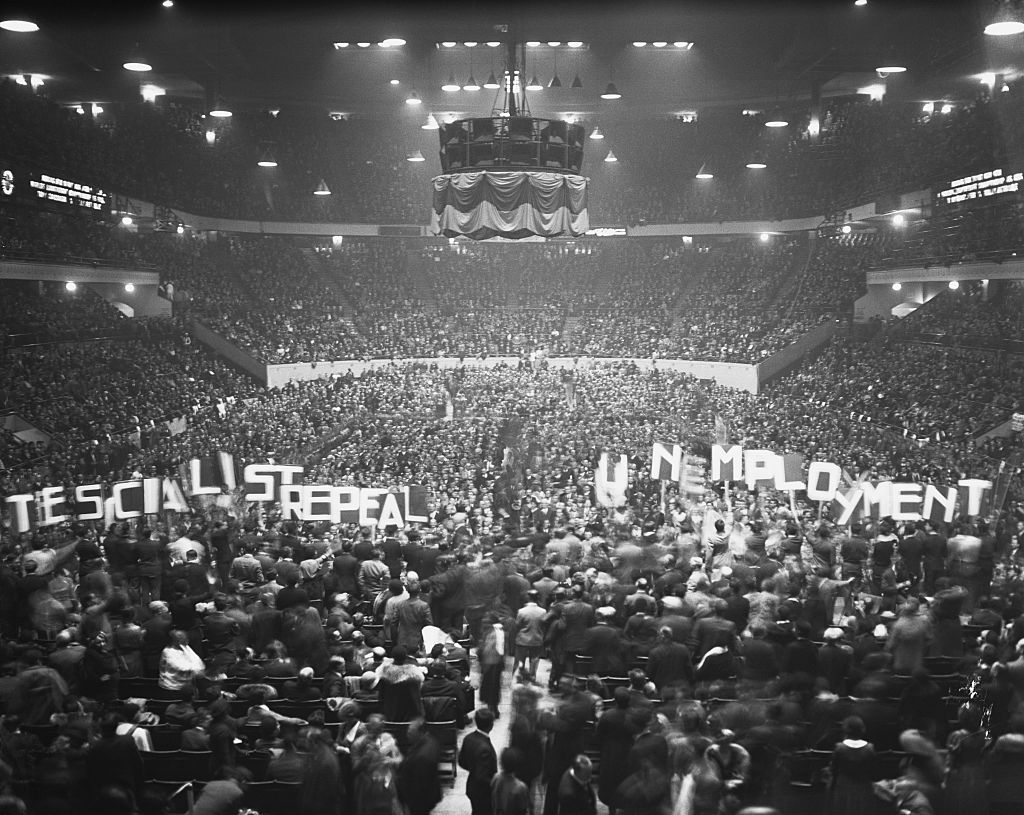
You can’t reach the abolition of class through an infinite series of small reforms. At some point, ownership has to change hands. (Bettmann / Getty Images)
Victorian Trades Hall is the oldest continuously operating trades hall in the world. And even before it was constructed, in 1856, the stonemasons and building workers of Melbourne downed their tools and marched for the eight-hour day — eight hours of labor, eight hours of recreation, and eight hours of rest. For a while, this city was the closest thing the nineteenth century had to a model of what an organized working class could wring out of capital.
I mention it not to flatter you but because that slogan — eight, eight, and eight — is still relevant today. It wasn’t a basic reformist demand; it was a revolutionary claim about what a human life is for. And I want to argue that the whole socialist project is, in the end, a fight over that question.
Historically, our socialist movement could be said to have done three things within a broader workers’ movement. First, it gave an agitational account of the crimes of capitalism and imperialism, to remind people about the daily realities of the system we were confronting. Second, it gave us a vision of a world after capitalism. And third — the part that set the socialist movement apart from our anarchist comrades — it provided a compelling account of how to get from here to there.
I want to focus on this last question, of socialist strategy and transition, and then touch on the need to actually have a compelling vision of what a socialism after capitalism could look like.
I want to make a few arguments tonight: I want to explain why social democracy is at an impasse it can never fully recover from. I want to explain why, paradoxically, the collapse of reformist socialism has been a catastrophe, even and especially for the revolutionaries who have always stood to its left and predicted its impasse. And I want to explain what a viable third road would look like and why this third road cannot dodge the question of rupture, however much we’d like it to.
Finally, I want to assert the technical viability of a socialism after capitalism and why sketching out “recipes for the cookshops of the future” is actually a necessity for all of us struggling for a world beyond capitalism today.
The Bind
There is a temptation, when we look at the postwar social democratic golden age, to treat it as a different sort of recipe. Sweden cooked this, Australia did a variant of it, the Danes and the Austrians put their twist on it — strong unions, full employment, rising wages, welfare states. We often look at that world that’s still within living memory and naturally say, “That worked; let’s just get the chefs back in the kitchen.”
This idea has a real power. The memory of postwar arrangements, nostalgia for aspects of the stability and dignity it afforded people, and the idea that the greed of bosses and the corruption of politicians are the reason why we today, as the saying goes, “can’t have nice things,” has benefited our generation of the Left significantly.
But for the cadre of our new left, it’s worth thinking about the particular set of conditions in the 1950s and ’60s that produced postwar social democracy. High economic growth and rapid productivity gains alongside it. Strong, dense labor unions fighting for higher wages at the point of production and delivering votes for labor parties electorally. Relatively closed national economies and limited capital mobility. Expanding industrial employment, which meant the working class was being concentrated in large workplaces where it was easy to organize, rather than scattered. And a favorable demographic structure — lots of working-age people and relatively few retirees, so the emerging welfare state was cheaper to fund.
Those conditions papered over the central contradiction of social democracy. They allowed a movement that generally never challenged who owned the means of production to nonetheless, from a low base, radically transform the lives of working people and the trajectory of entire societies. A worker in 1945 and that same worker’s child in 1975 lived in almost different worlds, and social democracy could take much of the credit. For a while, the contradiction — that you’ve empowered workers politically and on the shop floor while leaving the power to direct investment and generate wealth in private hands — didn’t overwhelm the system. There was enough for higher wages, enough for profits, and enough for the welfare state on top.
And then the conditions changed dramatically. In advanced capitalist economies today, production is organized in globalized networks that are harder for national governments to control. Financial capital is extraordinarily powerful and mobile; and it disciplines any government that frightens it, as it disciplined François Mitterrand’s France in 1983, and as the bond markets remind every finance minister to this day. Not to mention, there are enormous technology sectors that will continue to rapidly change economies in ways that are hard to anticipate.
Beyond that, populations are aging, so the dependency ratio that made the welfare state cheaper has inverted. Productivity growth has slowed, especially in Europe, which makes capital less willing to accept corporatist compromises. Relatedly, union density has collapsed across almost the entire advanced capitalist world. And in a more globalized world, states compete even more with one another to attract investment, bidding down their own taxes and labor standards in the process.
A government that walks into office today with a traditional social democratic program faces constraints that were much looser in the postwar period. I’m convinced at the political level that a “1970 playbook” can still be used to win elections in 2026, but I’m equally convinced that it’s doomed to fail as a governing program.
However, it’s not just that the constraints are tighter. It’s that social democracy has lost its social base. The dense industrial working class that was the body of those parties has been thinned in its numbers and become more ideologically scattered. In this environment, only partially of their own creation, social democrats have had to expand their appeal to a less coherent class basis.
Through these adaptations, in most parties of the world, social democratic parties are still viable as broad progressive electoral coalitions. But these coalitions are likely more apt to limit its program to ex post redistribution through taxes and transfers than to the thing that actually made postwar social democracy revolutionary in its effects: the harnessing of investment and the predistributional shaping of the economy.
The economic crises of the 1970s played a larger role in reshaping social democracy into a pale imitation of itself than the obvious lack of moral fiber of some social democratic leaders. It became clear that the old model could not continue, and it had to be changed.
To the right of social democracy, you saw a more headlong embrace of the new environment. Think of Tony Blair’s New Labour, which accepted the Thatcherite settlement on labor markets and financial deregulation and embraced the rhetoric of flexible markets and “welfare to work,” while marrying these policies to the defense of existing welfare state institutions like the British National Health Service and targeted redistribution to help those in the most extreme distress, like Blair’s push against child poverty.
From what I know of Australia’s own history, the Accord [a series of agreements struck between the Hawke–Keating government and the union movement in the 1980s and early ’90s] was among the most ambitious attempts to manage the crisis through a centralized bargain. Workers agreed to restrain their wage demands; in return, they were promised a “social wage” as compensation. You might have gotten more consolations than some of your peers elsewhere, but you still had the same dose of financialization and deregulation of the Australian economy and developments that made capital more mobile and labor weaker.
Compare these responses from the right and center of social democracy with the road not taken. In 1970s Sweden, faced with declining investment and growing economic crisis, the LO trade union federation proposed to take a slice of profits each year and gradually transfer ownership of large firms to worker-controlled funds — a real bridge from social democracy toward socialism, paid for by wage restraint that workers were already practicing in Sweden’s system of centralized wage bargaining.
It targeted both an economic crisis and the wider contradiction of social democracy itself by addressing the question of ownership of the means of production directly. But ultimately the proposal was gutted, not only because of strategic missteps and the opposition of capital but also because of the opposition of the Social Democratic Party leadership itself. It had not built the mass support for socialization of production, and — even if it wanted to, which it did not — it couldn’t mobilize anyone but the most class-conscious workers for the transformation of property relations. A party that had been built to manage capitalism in the interests of workers could not manage a transition to socialism.
Today social democrats, rather than debating greater social ownership, are struggling in a new social and economic environment to maintain even the existing compromises they made with capital.
So that’s the bind. The Left is still able to summon electoral victories through social democratic rhetoric, but the social depth of our winning coalitions is far thinner, and the scope for governance within capitalism is even more narrow than before. Simply willing ourselves back to 1970 is not a viable strategy.
The Paradox
Some of you in the crowd might be saying, “This isn’t my problem. I never was and never will be a social democrat.”
But the decline of reformist socialism has been a catastrophe for revolutionary socialism as well. For most of the twentieth century, revolutionaries regarded the reformist leaders — the union bureaucrats, the parliamentary socialists, the precinct captains — as obstacles to a more radical politics. People who would lead the workers up to the edge of a decisive moment of truth with capitalist power and then flinch or sell out. And there was truth in that, of course.
However, look at the universe that those reformist parties and unions helped create. They politicized workers — they took people from a myriad of different backgrounds and gave them an identity, as subjective members of a class, based on their objective position in the economy. They built and maintained the institutions in which that identity lived: the unions, the cooperatives, the workers’ societies, the labor press, and halls like this one. They trained organizers and taught people how to run meetings, how to take a collection, how to hold a picket, and how to deliver an oration. And they did this on a mass scale, touching the lives of millions.
The revolutionary left emerged from the same soil of the workers’ movement as the reformist left, but even after splits rendered it a minority, it still fed from the mass class politics the reformists often led. A communist party could go out and recruit the most militant, most class-conscious workers precisely because there were millions of organized workers to recruit from. Though these parties aimed for more than this, at the very least, they were skimming the most advanced layer off the top of a movement that mass reformist politics was largely responsible for maintaining.
Capitalism itself produced the worker as an objective category, as a condition of exploitation that we aim to abolish. But the worker as a political subject was built deliberately, through institutions, and as we know too well in our bleak times, mass class politics is no guaranteed feature of politics under capitalism.
When union membership collapsed, when the labor parties drifted and weakened, when the working-class associations long captured by reformists closed their doors, workers did not become more revolutionary. Deprived of the institutions that had made them a class, they instead became more politically disengaged, individualized, and sometimes more nationalist or xenophobic, or at least more deeply cynical about politics of any kind.
The “school of socialism” — the idea, which even sharp critics of reformism like Rosa Luxemburg held, that the daily struggle over wages and hours and conditions educates the working class, develops its capacities, teaches it its own power — now seems closed. If collective action is too difficult or dangerous or doesn’t seem viable to people — and most workers experience only work and individual cost-of-living struggles, not coordinated struggles over wages and housing and shop-floor democracy — then the appeals of the revolutionary left have even less daily resonance.
I dwell on this because it has a strategic implication: there is no shortcut around the patient rebuilding of mass working-class organization and identity. The revolutionary trying to create a radical breakthrough from today’s low level of politicization and the nostalgic social democrat who wants to fire up their 1970 Ford Falcon right away will both find themselves in want of a class agent and an organizing climate that will only exist if we build it.
The Third Road
The third road is not a zombie social democracy, and it is not a pure opposition. It is a democratic socialism whose purpose is not to stably administer capitalism in workers’ interest — because we’ve seen that the conditions for stable administration have largely evaporated — but to push along the axes of democratization and socialization. To use every position it wins, every reform it passes, every institution it builds, to expand the democratic capacities of working people and to expand the sphere of social ownership. And to do this through mass parties that thousands of ordinary people can actually join and shape that are nonetheless programmatically committed to socialism as an openly articulated destination and as a daily practice.
The openness and the programmatic commitment to socialism have to go hand in hand. A party that is open but has no destination becomes a progressive catchall organization that drifts wherever the electoral winds blow. A party that has a destination but is closed — with excessively tight membership standards — will find it harder to both build and eventually merge with a wider workers’ movement. We need both: a broad, welcoming mass party with a clear socialist horizon as well as a socialist transition plan written into its program and in its public declarations.
This isn’t a novel proposition, but it is different from the left-populist approach that is still dominant on the global left. Whether we build new socialist parties or transform existing parties into mass socialist parties depends on the country in which we’re organizing. But it does little good to uncritically build catchall parties just committed to a purer form of social democracy.
Our socialist parties must win reforms that materially improve people’s lives, because if we can’t do that, it’s safe to say no one will trust in our ability to accomplish anything else. But we should prioritize reforms partly by a second criterion: Do they expand the democratic capacities of working people, and do they connect to the more radical socialist transformations we hope to see in the future?
We must pursue reforms that strengthen (and democratize) unions and construct cooperatives and democratic public institutions to rebuild the working-class infrastructure we’ve lost over the last few decades. We should steadily increase the sphere of social ownership and worker control. And we must deliberately create constituencies with a material interest in pushing further.
Welfare state capitalism can’t be our final destination, but at every turn and at every level of governance, socialists will be confronted by a contradiction that we must figure out how to overcome: our reliance on the accumulation of private capitalists to fund the state and provide productive employment for workers. We might even hit the brakes ourselves. Nothing could be less desirable as a program than a socialism that goes too far for capitalism but not far enough for socialism.
The broad strategy of what an older tradition called “nonreformist reforms” — reforms measured not only by the good they do today but by whether they shift the balance of power and open the door to tomorrow — still seems like our best path out of this bind. But such a strategy only makes sense if we foreground our ultimate destination of socialism.
Today there is almost no growing left party — from Die Linke to La France Insoumise — that systematically articulates socialism as a theory and practice. When confronted by the structural dilemma of social democracy in our age, there is no reason to believe that these parties, much less the Greens here in Australia or in Great Britain, will pursue a program much different than those of today’s center-left parties.
The Question of Rupture
It’s worth acknowledging that, in practice, “nonreformist reforms” have themselves often been used as rhetorical cover for a comfortable gradualism that we should reject on a few different grounds. Even if there is a social democratic road toward a postcapitalist socialism — even if the relatively patient sequence I’ve just described is the right one — we cannot get around the question of rupture.
At some point, somewhere in that sequence, there has to be a definitive break with capitalist property relations, a point at which ownership of the decisive productive wealth of society passes out of private hands. You cannot reach the abolition of class by an infinite series of infinitely small adjustments, to tilt the playing field against capital. At some point, there needs to be a big change that requires popular support and extraparliamentary mobilization to bring about, at considerable risk to the stability of a democratic socialist government.
The old image, which we can find in old texts from the left wing of social democracy and the Gramscian traditions of left Eurocommunism, is of the workers’ movement slowly surrounding the fortress of capital. You dig your trenches, you build your moats and your siege engines, you encircle the citadel with counter-institutions, and one day the war of position is won, and the fortress falls.
The problem is that the fortress will not be sitting still. Capital is not a castle; it is a dynamic foe. While we are patiently digging our trenches, it is restructuring production, moving offshore, automating our most militant trade union sectors, capturing our institutions, splitting our coalition, and changing the ground we’re standing on. The longer the transition to socialism is drawn out, the stronger the capitalist counteroffensive will be, and the more exhausted the workers’ movement will be. And in the context of exhaustion and the need to institutionalize victories, the more the pressures of bureaucratization set in.
I want to speak briefly on bureaucratization, because I think it’s easy in certain traditions to treat it as simply a moral failing, a story of good radicals who went soft and bad leaders who sold out. But more often than not, the process comes out of something necessary: the need to consolidate a victory, to make a gain permanent, to institutionalize the lessons of a struggle so they don’t have to be relearned by the next generation. We can’t keep our militants permanently mobilized at peak levels.
The problem is that the very apparatus built to defend yesterday’s victory develops an interest in not risking that victory on tomorrow’s uncertain victories. The party machine that protects a gain begins to ossify around it. The radical union leadership that delivered a contract grows comfortable administering it. I don’t have a real answer to this problem other than that we should understand and anticipate it and build in the pressure to keep momentum in our struggle for socialism.
But what this means, broadly, is that we need two things at once in productive tension. We need a free, extraparliamentary class movement — tenant organizations, workplace committees, struggles against oppression, and other institutions of a politicized working class. And we need a democratic socialist party that genuinely aims to govern, on the basis of a clear socialist program and an explicit program of transition.
If all of that sounds fanciful, it’s because we are very far away from socialism. I don’t want to pretend otherwise. The distance between where we stand and the society I’m describing is enormous and not just one or two good election cycles away.
But even while being aware of our present weakness and our relative lack of rootedness in the class itself, we have no honest choice but to keep rupture in view. If what we want is merely a somewhat more humane capitalism, then fine, we can lower our sights and join the center left and hopefully find ways to keep the far right at bay. But if we actually believe, in our bones, not just in a kinder society but in a society that rids itself of exploitation and oppression, then a humanized capitalism cannot be the destination. And if we can’t shake that belief in socialism, we have to refuse both the dead end of nostalgic social democracy and the dead end of sectarian politics and try to construct a mass socialist politics of governance, transition, and rupture.
But Is It Even Possible?
This brings me to the last and most important thing, because everything I’ve just said about strategy assumes something we are no longer entitled to assume: that the people we’re trying to win to our program will actually believe that socialism could work.
The lesson the twentieth century taught many people — not through capitalist propaganda alone but also through real historical experience — is that all the disparate varieties of socialism failed in one way or another.
Social democracy ground to a halt. It hit the contradiction we discussed earlier, the standoff between an empowered labor movement and a capitalist class that still controlled investment, and when growth slowed, social democrats felt they had no choice but to beat a retreat.
Centrally planned state socialism, for its part, collapsed far more dramatically. And it didn’t collapse only because of political repression or the arms race or Western subversion; it collapsed because, on its own terms, it could not deliver the goods.
Any radical democratic socialist party that is serious has to reckon with these failures, and not just at the political level but at the economic one as well.
The administrative planning of state socialism failed for two key reasons. The first was calculation. Gosplan, the Soviet planning agency, was responsible for coordinating an economy that included almost 50,000 factories, 26,000 construction enterprises, 47,000 farming units, 260,000 service establishments, and more than one million retail shops — producing some 12 million distinct products, each of which required the right inputs from the right suppliers at the right locations on the right timelines, with supply chains stretching across eleven time zones. These, in total, meant tens of billions of variables, rising into the trillions when you extend the planning horizon across time.
The information needed to fully plan a complex economy does not exist in a form that any central authority can gather, no matter what kind of computing power was behind it. As a result, though the Soviet system was billed as one boasting rational, scientific mastery over the economy, it was in reality a system caught in a perpetual struggle to keep up with it. Plans were built on incomplete information, revised through bureaucratic bargaining, and patched together by countless informal exchanges — favors, barter, and workarounds that operated alongside the official system.
These arrangements helped keep the economy running, but they did not solve the underlying problem: planners still lacked the information needed to coordinate production efficiently across the system as a whole. The result was recurring shortages, surpluses of unwanted goods, and a host of inefficiencies throughout the economy.
The second core problem revolved around incentives. Every manager knew next year’s target depended on this year’s reported output, so they lowballed their capacity, hoarded labor and materials, and lied. Weak firms were never allowed to fail — the soft budget constraint, as the Hungarian economist János Kornai named it — because failure meant unemployment and broken supply chains, so inefficiency was never punished and never weeded out. The result was a tremendous waste of human labor and resources and a shortage economy that did not meet social needs.
And we’ve already discussed the impasse of social democracy, one that the Polish socialist Michał Kalecki saw coming in the 1940s. He pointed out that genuine, sustained full employment is politically unstable under capitalism — not economically impossible but politically unstable — because when workers no longer fear unemployment, the discipline of the labor market evaporates, the balance of power on the shop floor tips toward workers, profits get squeezed, and the capitalist class, which still controls investment, eventually responds to restore discipline and find a route toward renewed profitability. This is more or less the story of the 1970s and, combined with the rational interests of workers in preserving their employment and thus profitability of the capitalist firms where they work, the social democratic impasse in a nutshell. You can’t reform your way around it while leaving investment in private hands.
Simply put, if you’re a socialist, there is no going back to either model. The dream of running a whole modern economy by administrative planning cannot and should not be revived. And the dream of transforming capitalism while leaving its owners in command of investment will run into Kalecki’s wall every time (or likely run aground even before that).
A Feasible Socialism
Now, if there are problems with the two models of socialism that emerged out of the workers’ movement of the nineteenth century and out of the common wellspring of the parties of the Second International, then we need to start discussing what an alternative would look like.
There’s no fixed single model of a feasible socialism, but together with my colleague Mike Beggs, who’s at the University of Sydney, and Ben Burgis, I have a forthcoming book, The Blueprint, that goes into some of these ideas in depth.
A twenty-first-century socialism has to do two things at once that sound contradictory. It has to abolish market dependence — the condition where your very survival hinges on succeeding in the market — while preserving markets as a tool for coordinating a complex economy. We need some markets, but we don’t need any capitalists. And we want to harness those markets without being mastered by them.
In practice, that means decommodifying the basic infrastructure of a human life — things like health, education, transport, energy, housing, and telecommunications. These should not be rationed by price but should be provided as a matter of need, because organizing them through profit-seeking firms is both less just and, often, less efficient.
And then, in the broader economy of ordinary goods and services, markets can be great tools for socialism, with prices carrying information about what’s scarce and what’s wanted. But the firms in that economy are controlled by the people who work in them, not by outside shareholders or private capitalists. Governance attaches to participation, not to a financial stake, and membership in a firm becomes akin to membership in a political community, with a voice and a vote, which can’t be bought and sold.
The posttax surplus those labor-managed firms generate is controlled by the people who produce it, but investment is not left to individual firms and instead is socialized. This is done through a system of public banks accountable to a democratic state that holds society’s productive wealth in common and lends it out productively.
If you had a system with worker ownership and not just worker control, among other problems, you would have to deal with distortions arising from workers seeking out capital-intensive sectors with the highest dividends to work. The job market would be a different sort of lottery.
In this version of socialism, though, firms are still given extensive autonomy within regulated markets. And inefficient firms are allowed to fail by being outcompeted by their peers as a key feature of the system, because meeting people’s needs with goods and services effectively is a good thing, and at a more philosophical level, wasting human labor power through inefficiency is something egalitarians should refuse to tolerate.
To further help keep a socialist system both highly productive and egalitarian, we could use wage benchmarks — minimum rates, differentiated by occupation — that establish a floor reflecting collective priorities about dignity and skill and contribution, rather than letting local bargaining power set the price of a human hour. This obviously has some echoes in the old system of centralized wage fixing and in the operative effects of centralized wage bargaining in Sweden at the height of social democracy.
Wage minimums create stability for workers, since they’re not entirely dependent on dividends from their firm’s profits, and they also serve to push firms onto a “high road” of development. A group of worker-managers who want to get ahead can’t do it by pushing themselves below the benchmark to gain market share, so they instead have to innovate, retrain, reorganize, and find areas to invest in. The economy is steered toward rewarding technological advances and new production techniques rather than just sweating out cheap labor.
Of course, the point of all that productivity is not productivity for its own sake. The point of a dynamic socialist economy is to convert that dynamic economy into shorter hours, longer lives, and more time outside production. In other words, it would remove exploitation and domination from our economic activity and then use that economic activity to produce more freedom for people to decide how to spend the one life that they have.
Socialism Is the Future. Build It Now.
The workers who marched in this city in the 1850s were not asking for a marginally better deal. When they demanded the eight-hour day, they were asserting that a worker is not merely an instrument of production but a full human being entitled to all that life had to offer. That demand is the whole of socialism in miniature. It is the demand that people be the authors of their lives rather than the tools in someone else’s accumulation.
We are very far from socialism. But what we cannot do, and at the same time survive as a socialist movement worth its name, is lower our horizon to adapt to our present weakness.