Literacy Is Another Casualty of the Decline of Democracy

A new book by the journalist James Marriott purports to explain the decline of literacy. Instead, it offers a narrow defense of elite culture that that pays next to no attention to the role these elites have played in destroying the culture they are now mourn.

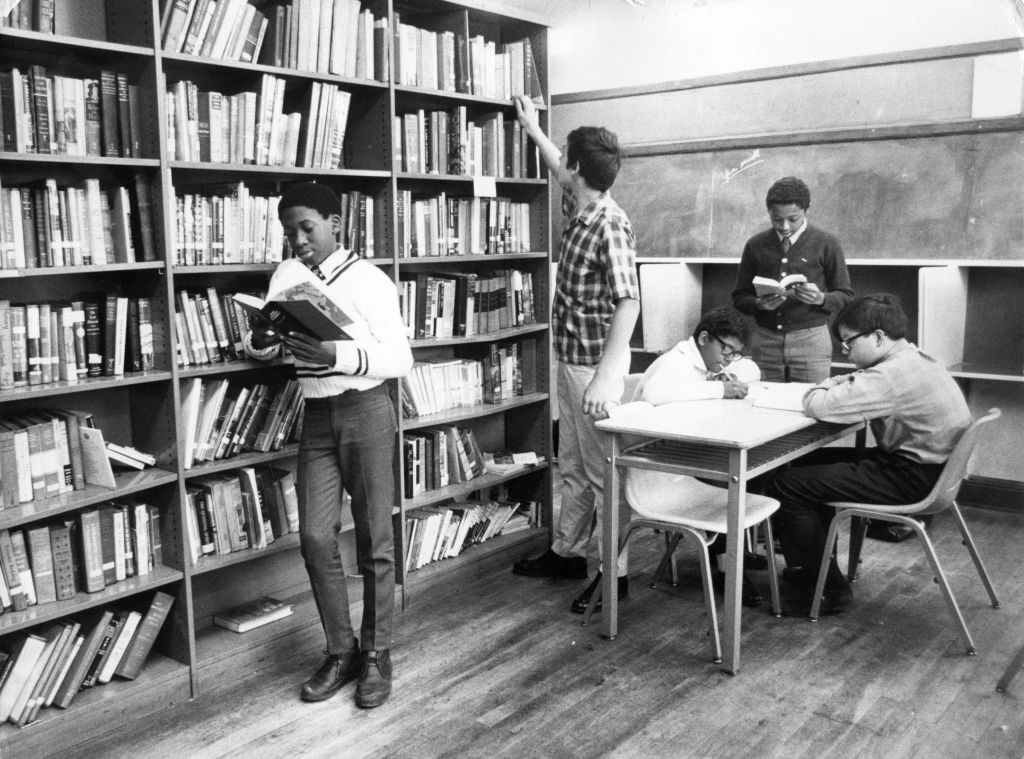
Teenage students work at a library, circa 1965.

Mass literacy was ultimately a by-product of the struggles for mass democracy that defined the 20th century. With elites once again in control of the public sphere, people have naturally grown uninterested in the hollow culture money and power have produced. (Hulton Archive via Getty Images)


Approximately two years ago, a bizarre new genre of AI-generated content began to emerge online. Suddenly social media was filled with short-form videos depicting hypersexual anthropomorphic fruit, embroiled in increasingly far-fetched and soapy plot lines. In one video, a voluptuous strawberry cheats on her watermelon husband, and gives birth to two wolf cubs. In another, an emasculated orange takes revenge on a womanizing banana who has stolen his girlfriend. In a particularly violent iteration, a young tangerine is bullied by his homophobic father and ends up juicing his whole family.

It is easy to dismiss these shlocky and incoherent narratives as mere “AI slop.” But they are also endemic to a broader culture. In 2026, the average American spends at least two hours a day doomscrolling — significantly more time than Asians and Europeans, whose social media use is in decline. On their phones, shirtless celebrities, videos of bears chasing cyclists, or children buried under the rubble of their family home are all part of an undifferentiated stream. Faced with this endless churn of content, the human attention span has become increasingly fragmented. Our ability to register nuance and complexity has also taken a hit. So it is that millions find themselves engaging with mindless dross from Baby Shark for toddlers to Fruit Love Island for adults.

What, one might ask, is the cost of this new form of consumption? The answer, argues British journalist James Marriott in The New Dark Ages, is human literacy. Marriott describes his book as an “impassioned attack on the trivial and meaningless culture of the screen and a defence of the written word.” There can be no doubt that Marriott has picked a hot-button topic. Evidence of declining literacy rates is stark. In 2004, almost 30 percent of Americans read for pleasure; by 2023, that figure had fallen to just 16 percent. Books are getting shorter, comprehension of long words is in decline, and many young people now source their politics from TikTok, YouTube, and Instagram.

Of course, warnings about mass media consumption are nothing new; experts have been issuing warnings since the dawn of television in the 1950s. To his credit, Marriott attempts to look beyond headline figures by situating the current crisis of literacy within a broader history and asking whether the rejection of printed media is a form of cultural evolution — a turn to what some have called “secondary literacy” — or a more concerning indication of civilizational decline. Too often, however, The New Dark Ages shies away from big ideas; Marriott himself seems more comfortable reproducing aggregate statistics than offering granular analysis. The result is a frustrating and often shortsighted work: a defense of elite culture that has very little to say about the economic or political forces that have produced the current crisis in literacy or those that might help to resolve it.

The Democratization of Literacy

The New Dark Ages starts by taking us back more than three thousand years to the first recorded instances of written language in ancient Mesopotamia. “Reading was by no means inevitable,” he observes. This is something of an understatement. Even today there remains no evidence to suggest that humans were ever cognitively programmed to understand the patterns of signs and symbols that we have come to call language. To develop these advanced linguistic abilities, we had to retrain our brains: an immensely difficult and time-consuming process that ensured that reading and writing remained the preserve of a specialized elite for over three millennia.

There is evidence to suggest that literacy rates increased during the more prosperous centuries of the Roman Empire. By some measures, approximately 10 to 15 percent of the population could read. However, these numbers would stagnate for much of the Middle Ages. In Europe, it was not until the invention of the modern movable-type printing press by Johannes Gutenberg in 1440 that mass literacy was even remotely conceivable, although even then its growth was gradual. In the words of the sixteenth-century essayist Francis Bacon, Gutenberg’s invention (alongside gunpowder and the compass) had “changed the appearance and state of the world” by disseminating print culture throughout Europe. No doubt this process was helped by the spread of Lutheran Protestant ideas that offered a cultural argument for literacy as a tool of social emancipation.

So began an era of mass “democratization.” Marriott — a self-described “Enlightenment bro” — pays particularly close attention to the eighteenth century, an era in which the growth of literacy helped many to challenge existing forms of religious and political authority, remaking the world according to new modes of rationalism. Books, journals, newspapers, and pamphlets spread information that might previously have been accessible only by the elite but that could now be turned against them. Marriott has little patience for the strand of Enlightenment skepticism one finds among the likes of Theodor Adorno and Max Horkheimer. For those thinkers, the rationalistic quantification and measurement of social reality allowed humans to dominate one another in ways previously unimaginable. Marriott contents himself with cheering Voltaire — a man who “dared to know” — and the democratic energy, as opposed to economic and social forces, that led to the first French Revolution.

The cult of the written word continued to grow until the middle of the twentieth century, when television challenged the novel’s place as the main means of imagining a shared cultural community. In 1985, Neil Postman’s Amusing Ourselves to Death sought to explain this drastic cultural shift. For him, TV’s tendency toward triviality, spectacle, and celebrity had hijacked the attention of its consumers and eroded the calmer and more rational forms of thought that reading promoted. Postman was particularly dismissive of the phrase “Now. . . .  this,” which in TV-speak tied one form of entertainment to another. This uniquely modern idiom, he remarked, served to highlight how disjointed and banal TV programming had become; the new medium encouraged viewers to passively absorb the diffuse fragments of information that were being beamed into their households.

Postman’s analysis of the “Now. . . .  this” paradigm seems particularly relevant today. If TV crowded out the time needed to pick up a book, the invention of the desktop computer and, later, the smartphone has dealt a near-fatal blow to the culture of reading. Suddenly the options for entertainment are infinite, and all accessible literally at our fingertips. On TikTok, users are able to skip through 260 videos in under thirty-five minutes. Meanwhile the latest developments in phone software encourage “dual screening” or “in-picture watching” — marketing jargon for being able to text, call, or browse while watching films on devices. Producers at Netflix have even encouraged their filmmakers to insert plot refreshers into dialogue throughout any production, better for those not paying attention to catch up easily.

A Cultural Crisis?

The New Dark Ages is at its best when describing the dangerous effects that these new behaviors might have on our ability to think critically. When we read, Marriott observes, we can engage in a number of sophisticated cognitive processes: drawing inferences, assessing truth value, considering multiple perspectives, and integrating everything into a broader analysis that allows us to interpret meaning and make judgements of aesthetic quality. Unlike short-form videos, books exercise the human attention span. They challenge us to follow a line of thought to its logical conclusions, for instance. This makes writing a particularly subtle form of expression, capable of holding nuance and contradiction unlike more visual media.

As greater numbers of people turn to digital entertainment, however, these cognitive skills are under threat. Consider again the phenomenon of AI fruit videos. They pander to the shallowest human desires: providing an emotionally saturated spectacle, complete with bright colors, unexpected narrative twists, and thinly veiled forms of sexual taboo. A similar degeneration is evident in our politics. Data shows that political speeches given in parliaments across the West are getting shorter. However, they are also getting louder, using quasi-hysterical appeals to a public that is no longer able to process or participate in any other form of rational debate. As Marriott rightly observes, this highly affective politics is embodied by President Donald Trump who, by no coincidence, refuses to read memos or policy briefs on principle.

It is hard to disagree with Marriott, even if he at points seems to offer an unintended example of the declining literary culture he is mourning. His sentences are often clipped and written in simple journalistic prose, appropriate for a seven-hundred-word column but not a serious study of the decline in literacy. The New Dark Age is brisk, concise, and peppered with personal anecdotes — perfectly suited to our almost postliterate era. There is also a talking-you-off-the-cliff-edge reasonableness that pervades The New Dark Age. Constantly, we are told that its author has no desire to be “apocalyptic” or “virtuous”; every description of structural crises is followed by evenhanded qualification. “This is not to say” is a common refrain.

The this-but-also-that quality of The New Dark Age is attributable to the author’s political outlook. Marriott is a journalist at the right-wing Times newspaper, incapable of thinking seriously about class. One searches the book in vain for any discussion of the relationship between inequality and the crisis of literacy. Studies conducted by Ofcom, a UK media regulator, have shown that low-income families watch twice as much TV and spend significantly longer on social media each day than their wealthier counterparts. Why is this? As many parents have pointed out in response to social media bans in both the UK and Australia, screen time is a begrudged substitute for twenty-four-hour childcare. The growth of the screen-free childhood movement, adopted disproportionately by wealthier parents, has only worsened the disparities between children from different class backgrounds. Childhood is increasingly two-tiered. Some kids spend hours on social media every day, while others have parents who are happy to read them the classics, in some cases even while they are still in the womb.

Unsurprisingly, Marriott pulls his punches when it comes to apportioning responsibility for the current crisis in literacy. It is now widely understood that capturing users’ attention — and refusing to let go — is part of the business model of tech billionaires. The longer we spend looking at our phones, the more ads we are exposed to and the more metadata we hand over to internet companies. This means that there is a clear financial incentive to use the algorithm to keep us looking, liking, tapping, and scrolling. As the Google whistleblower Tristan Harris has ominously observed, “you can try having self-control, but there are a thousand engineers on the other side of the screen working against you.” Declining rates of literacy ultimately help Big Tech companies to continue exploiting their consumers without requiring their consent.

Instead of identifying and criticizing these trends, Marriott is keener to extol the virtues of Western literature. “We face the serious possibility that writers like Shakespeare, John Milton, and Jane Austen. . . .  are not going to reach the next generation of readers,” he writes with glib sanctimony. This seems unlikely. The elite culture that Marriott feels so protective of is not going anywhere; we will always live in a world in which there are places to read the classics — at least for some. What is at stake is the existence of the mass culture, a unique historical development that came into existence only within the last hundred years, when working class people, women, and non-Westerners shaped global politics collectively for the first time. From the Nobel Prize–winning poetry of Rabindranath Tagore to the revolutions that humiliated European imperialism in nations as distinct as Algeria and China, the culture to which mass literacy gave rise was always a by-product of the struggle for, and achievements of, mass democracy. It was and remains the only successful challenge to Western chauvinism and the navel-gazing court culture that has flourished everywhere in the absence of inspiration from the popular classes. Without a renewal of the fight for democracy, we are unlikely to see a return to the culture of informed engagement with the world. If this happens, the end of literacy may be the least of our worries.