AI Art Is Weird, Sad, and Ugly. Let’s Not Pretend Otherwise.

Because capitalism orients people toward profit rather than allowing us to pursue our interests freely, it inevitably separates humans from the creative act. AI art is just the slop frothing up from that gap.
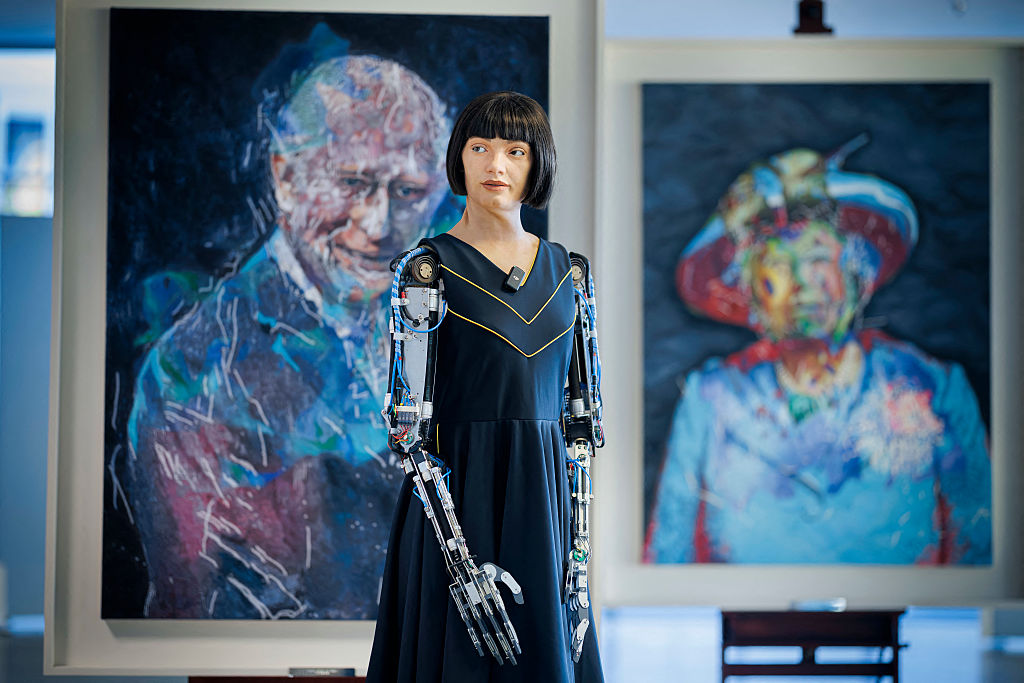
Humanoid "artist" robot Ai-Da looks on in front of paintings of Britain's King Charles III and Queen Elizabeth II, displayed on the sidelines of the AI for Good Global Summit organized by International Telecommunication Union (ITU) in Geneva, Switzerland, on July 9, 2025. (Valentin Flauraud / AFP via Getty Images)

There was a time when people imagined AI’s final form as a great metallic beast with malice in its mind — or, perhaps more realistically, as an unseen yet limitless network of accumulated knowledge that could render humanity obsolete simply by outperforming it. There’s something idealistic about those apocalyptic visions, some latent optimism in the belief that our destruction will emerge from a fair fight against a worthy foe created by the hubris of those with money and capital.

But reality is often disappointing. Generative AI is just as cruel as some had feared — it destroys workers’ livelihoods, swallows up tons of water, and spews pollution into the air. But its output is twisted, soulless gibberish — videos of a cat with suspiciously human-looking hands planting bombs on the heads of other animals, an X account gleefully announcing “her” latest recovery from cancer roughly once every six hours, an Israel-commissioned image of a reconstructed Gaza, sanitized of its Palestinian past and people, serrated with rows of gleaming glass towers. Whether it is made to manipulate emotions or justify a genocide, AI cannot hide its weird incompetence: an oily sheen draws out sickeningly vivid colors; appendages appear and disappear; scenes of simple joy are unintentionally rendered in grotesque, grimacing swirls of beaks, teeth, and fur.

Nevertheless, some remain enamored with generative AI. What they lack in taste, they make up for in power. While Israeli government employees were testing out image- and text-generation prompts, so too were their counterparts in the Trump administration, Andrew Cuomo’s shamelessly vindictive mayoral campaign, right-wing content farmers on YouTube, and the UK Labour Party headquarters, steered by its AI-boosting leader Keir Starmer.

To them, relying on cheap and wholly obedient machine tools over human artists and experts is the obvious choice. Corporate leaders chafe at their dependency on the workers they disdain as inferiors and fear might one day fight back. Workers are only valuable for as long as no other recourse exists. To maximize profit, labor costs and dependencies must be reduced as far as possible. Now, at long last, AI promises to liberate the capitalist from his workers. The inferior product is a low price to pay, if indeed it is considered a sacrifice at all.

What Is Art? Not… This.

While some debate whether AI-produced content is good or bad art, critics question whether it can be considered art at all. If art by definition must emerge from a process of human imagination, reflection, and labor — the “innate mental aptitude through which nature gives the rule to art,” in Immanuel Kant’s phrasing — then it would be a stretch to include dictating a few strategically picked words to a machine that can only see the world with eyes stitched together by code. There’s comparatively less discussion on how to define art based on motive, but suffice it to say that art produced from a position of creative agency, uncompromised by the specific demands of production companies and corporate firms, possesses qualities that reflect the artist’s purest intent.

Capitalism routinely subordinates creative agency to financial and political imperatives. And so the artist, like any other worker, becomes both a tool for someone else’s ends — and an annoying inconvenience until they can be replaced with something better. “The bourgeoisie has stripped of its halo every occupation hitherto honoured and looked up to with reverent awe,” wrote Karl Marx. “It has converted the physician, the lawyer, the priest, the poet, the man of science, into its paid wage labourers.”

But even under the thumb of a higher power, a human artist can attempt to dispute unreasonable executive demands, gently stretch the boundaries, or slip through subtle marks of dissent. More existentially, art as political expression questions and challenges hegemonic social values, provoking the ire of the reactionary right, which in modern times has designated the humanities as an enemy that must be brought to heel. The separation of humans from the creative act, and the slop that froths up from the gap, is exactly the point. It does not matter whether AI generates good or bad art, or whether it is art in the first place, only that it reaps easy profit and gives the user a sense of total control.

The capitalist obsession with control and its theoretical byproduct, efficiency, is everywhere to be found — in hedge fund billionaire Charlie Munger’s design for a college dorm that would have packed 4,500 students into identical units consisting of a conference table surrounded by windowless cubicles; in corporate offices and rich people’s houses painted in sterile grey-black-white palettes that preclude any possible sense of aesthetic discord; in the extreme measures companies take to dictate workers’ behavior and threaten them into compliance. Generative AI represents the inevitable endpoint of this pathology — or perhaps just another point that prefaces something worse. Every aspect of a picture, video, or audio track can be stretched to fit the user’s purpose without any need for effort, skill, and most crucially, the kind of thoughtful contemplation that ripens with process.

For all that our culture seems to extol diligence as the surest guarantor of success and fulfillment, its embrace of AI technology exposes the fact that laziness at the top level is its true cardinal virtue. People like failed mayoral candidate Whitney Tilson, who in another era would have had to wait for their opponents (in this case, Zohran Mamdani) to step out of line on camera, can now conjure up their own alternate, politically convenient realities. If the result looks like Claymation trapped in a 2-D canvas, that’s a small price to pay for total narrative control.

Crap for the Masses

Tilson’s AI-generated anti-Mamdani “musical” certainly drew some attention to his desperate campaign, most of it scathing. “I’m not convinced that Whitney Tilson himself isn’t AI generated by Andrew Cuomo,” wrote one commenter. Nevertheless, for all the ugliness it produces, AI generation apps continue to attract customers who are far less rich and powerful than Tilson — just tired workers and bored retirees in need of some low-energy, thoughtless fun.

Some have taken this as grounds for defending the medium. The popularization of AI doesn’t have to be a bad thing, they suggest. Once taken out of the hands of capitalists, the argument goes, normal people can use AI generation tools to break free from elite, bourgeois frameworks of aesthetic value.

People, of course, are welcome to believe that my third-grade scribble of an Allosaurus eating my school is more beautiful or interesting than Benozzo Gozzoli’s frescoes in the Medici chapel (or, for a more apt comparison, Hieronymus Bosch’s Christ in Limbo). Both possess materiality and tactile process. Both reflect an individual’s imagination and vision. The same can’t be said of AI-generated art, even when ordinary people commission it for pleasure. The apparent joy that some people might find in ordering ChatGPT to produce fake Studio Ghibli animations comes not from defying elite definitions of art, but from imitating and validating it through an alienated, mass-produced shortcut.

Surely, a notebook doodle or melodramatic fan fiction piece written from the heart does a better job of redefining aesthetic value than a knockoff of someone else’s highly popular work. Then again, it’s easy to repetitively switch words around and click “generate” in the same way that it’s easy to doomscroll on social media or cycle through TikTok brain rot, all feeding an addiction for immediate gratification that overpowers the addict’s desire for meaning and makes them ultimately feel utterly hollow.

Marvel at Its Splendor

Naturally, those who stand to profit from the generative AI bubble are happy to encourage its use among the wider population. They are certainly putting their money where their mouths are — according to a Goldman Sachs analysis, mega tech firms, corporations, and utilities are projected to invest around $1 trillion in the next couple of years on supporting AI development. “The biggest question in the marketplace right now is: Are we getting a return on the investment? I’m reasonably comfortable that we are seeing that return,” said Brook Dane, a portfolio manager at Goldman Sachs Asset Management.

Even as AI technology optimizes writers, artists, researchers, and countless other kinds of professionals out of work, its benefactors still manage to reap what other people sow. Generative AI content is, in essence, a distorted collage of resources that the generator found on the internet — resources produced with the sweat of real people who likely have no idea that their work is being used for someone else’s benefit, and little recourse to fight back.

AI models, flush with money, are constantly upgrading, and many have reached a point now where their content isn’t so obviously distorted or shockingly hideous in the sense of, say, characters with two irises in each eye or a short story that reads like the most shamelessly grasping LinkedIn post. But even free from those kinds of errors, there remains a mechanized, false quality that separates it from honest work.

For those who do not easily recognize the explicit distinction, a limited conscious perception does not preclude an unconscious sense of alienation and dread. My third-grade self might see an AI-generated picture of an Allosaurus eating my school, and not knowing its origins, still consider it properly inferior to the picture I made with my own hands, complete with human randomness like a crooked door and colors seeping over penciled boundaries. As long as we can still see, the world really doesn’t have to be so ugly.