France Needs a President Who Isn’t for the Bosses
France’s first presidential debate on Thursday was hosted by employers’ group Medef. Entrepreneurs laughed when left-wing candidate Jean-Luc Mélenchon called for wage raises, but he was deadly serious.
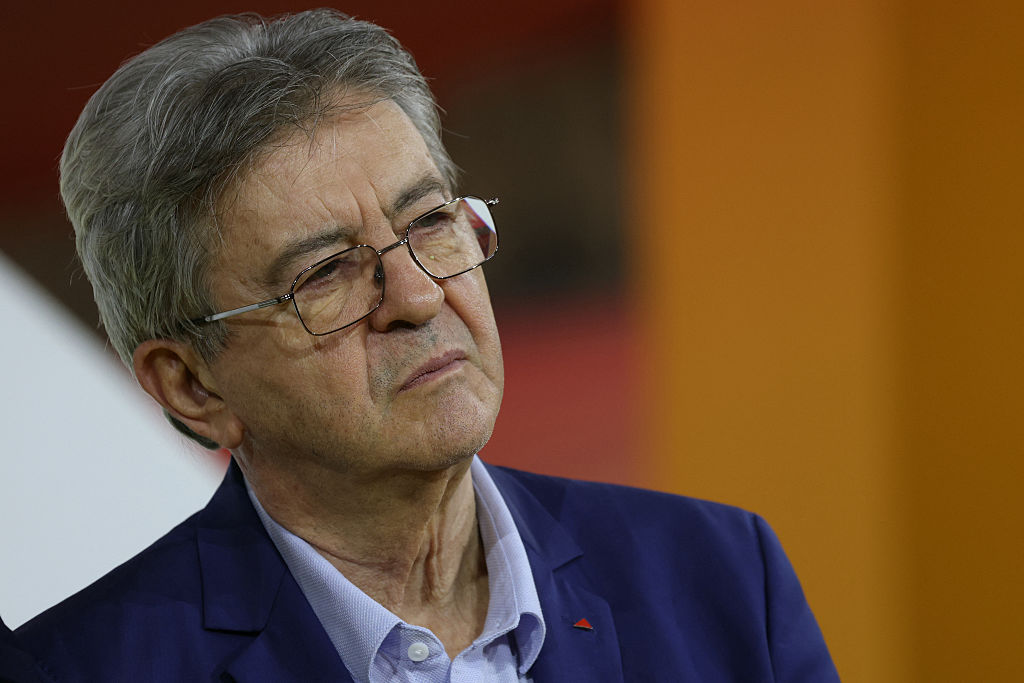
“We will die politically, socially, and economically” if the EU continues its commitment to the free market, Mélenchon said at Thursday night’s presidential debate. (Thomas Samson / AFP via Getty Images)
Heavy rain pummeled the canopy over the covered stage in Paris’s Roland-Garros stadium on Thursday night, midway through the first debate for next spring’s French presidential election.
The seven candidates present, who included Jean-Luc Mélenchon, Marine Le Pen, Édouard Philippe, Gabriel Attal, Raphaël Glucksmann, and Marine Tondelier, volleyed competing economic visions in front of a buttoned-up crowd of entrepreneurs and business leaders attending the Movement of French Businesses’ (Medef) summer conference.
There was plenty on stage for Medef corporate chiefs to cheer for. The pro-business, deregulation-happy employers’ union has already enjoyed a long string of political wins since its founding in 1998. Whoever the president has been, Medef’s priorities have consistently been carried out, as France’s postwar social democratic compromise has been worn down by decades of austerity and capitalist logic.
In the past twenty years, Medef backed and won initiatives that loosened contract termination negotiations for employers, then firmly shifted the balance of power from workers to employers after an unprecedented overhaul of the labor code. Medef also beat back countervailing winds like initiatives to limit CEO pay and steadily and successfully introduced ideas like capitalized pensions and raising the retirement age to reduce budget deficits into national discourse.
That was even before Emmanuel Macron’s decade in the Élysée Palace, where Medef’s agenda has been carried out at a drumbeat pace.
With less than a year left in Macron’s term, the fruits of Medef’s efforts were clear up on the debate stage. All four candidates of the Right and the center supported ending or substantially modifying France’s redistributive retirement system by introducing capitalization, raising the pension age, and drastically cutting spending and regulations. As Medef’s president in 2018 put it in an interview with Le Figaro, “Medef has won the battle of ideas.”
Cutbacks
One leading presidential contender, Édouard Philippe — Macron’s first prime minister and now head of his own centrist party Horizons — said that before France can think of redistributing the country’s wealth, it has to put its accounts in order and “make space for industry to create wealth.” He added that to do so, France needs to “work longer,” something he claimed every other country in Europe but France has “had the courage to do.”
But when pressed about just how high he would push the retirement age, he dodged. “It won’t be popular to say this,” he conceded, but France needs to get out of debt.
One of the more recent prime ministers, Gabriel Attal, who now presides over Macron’s party Renaissance, echoed the same ideas but took them further. He promised Medef that he’d lower France’s debt-to-GDP ratio to under 3 percent by 2032 – and eliminate debt by 2037. Those dates would mark the end of his potential first and second terms.
Spending on expanding obligations for social programs is the problem, he said, not the government’s discretionary budget. Attal crowed about the €10 billion his government managed to cut in 2024 as a noble but inadequate effort as long as social spending is allowed to increase. When the Green candidate Marine Tondelier pointed out that some of those cuts included €50 million stripped from the firefighting budget that could have bought two additional Canadair firefighting planes the country will desperately need next fire season, he hardly bothered to defend himself.
Capitalized pensions, which in theory compound higher the longer you defer retirement, would encourage people to work longer. If you retire early, you get a little, Attal argued, but if you retire later you can get a lot more. Unmentioned was another potential outcome — a market downturn delaying your retirement by years. After the 2008 financial crisis, it took six years for an index of the market to recover to where it was before.
That could be all the more incentive to work longer — more time to top up your contributions.
In any event, there’s a social movement in France today with no spokesperson, Attal intoned gravely: “the middle class who works.”
Bruno Retailleau, running for traditional conservative party Les Républicains, took two turns as Macron’s interior minister in governments after the 2024 snap election. In that role, he cracked down with police sweeps on illegal immigrants and toughened up immigration visa requirements while claiming crime in France is out of control and driven by immigration and warning that the Left led by Mélenchon’s La France Insoumise is far more dangerous than Marine Le Pen’s Rassemblement National.
The only way to fix the economy, Retailleau said in this debate, is by adding more work to the equation. Aside from about fifty core principles in labor legislation, different provisions of the law should be negotiable between employers and workers, he said. He also called for cutting between two and three hundred thousand government employees, largely getting rid of the estate tax in the case of direct inheritances, and linking the retirement age mathematically to rising life expectancy.
“More work, less public spending,” Retailleau summed up his thinking.
Marine Le Pen, the poll leader and would-be anti-system candidate went even further. She called for €125 billion in spending cuts, and said that there are thousands of regulations that need to be cut, not just the hundreds Retailleau says need to go on day one. Raphaël Glucksmann, a liberal Atlanticist running for the Parti Socialiste’s nomination, later accepted this same framing, saying that regulations are like cholesterol: there’s the good and the bad kind.
The Green contender Tondelier (she hasn’t yet officially launched her candidacy), argued in favor of social spending particularly on ecological initiatives. She called the eleven million poor people in France representative of Macron’s actual record, and proposed raising the gross minimum wage to €2,000 a month.
Glucksmann also defended heavy ecological spending, calling out tens of billions of euros paid to subsidize fossil fuels under Macron and saying that his presidency represented a lost decade for the environment. Glucksmann said that what would actually be expensive would be to not invest in ecology.
At the same time, he has campaigned on uncompromising opposition to Chinese trade, and in favor of military spending to rearm against Russia.
“[A]ll European countries need us,” Glucksmann said, calling France the continent’s shield. He proposed that the country take advantage of that by conditioning military aid on a country’s willingness to orient itself against China.
Europe is like the Ottoman Empire, Glucksmann said: in the midst of a long slow decline. The only way out is to make the choice to reindustrialize. And to launch an “AI Manhattan Project.”
Sunshine Soon
The only candidate who presented a coherent political alternative was La France Insoumise’s Mélenchon. In response to Retailleau and Philippe’s diagnosis that France needs to work more to right the ship, Mélenchon disputed the idea that the hours that people don’t work are wasted. Instead, this is all time that people can spend in their community or with family, Mélenchon said.
“It’s time that you want to capture,” Mélenchon lamented. “[B]ut we’re talking about human beings.”
Speaking against the constant prescriptions of spending cuts, Mélenchon said that social spending is a value and a way to “develop a people.”
After hearing Mélenchon lay out this vision, former Prime Minister Philippe, sitting to his right, quipped that Mélenchon was to his left in two senses, and called Mélenchon’s arguments a “vocal explosion” paired with a “deluge” from above, referencing last night’s rainfall.
“Just wait, I’m here. There’ll be sunshine soon,” Mélenchon quipped back.
Mélenchon also argued against the idea that regulations are what make business difficult in the European Union.
“We will die politically, socially, and economically” if the EU continues its commitment to the free market, Mélenchon said.
Pushing back on an argument from Attal that the United States has succeeded in the digital revolution and pays far higher salaries than France as a result, Mélenchon declared that “the United States has no lessons to teach us.”
“Their social system is pitiful,” he continued, “with millions of people outside of the normal functioning of society. Surely the French people can’t want this.”
Mélenchon then drew the ire of the Medef crowd when pushing back in response to a question where an entrepreneur asked what commitments the candidates would make to reducing taxes and social contributions by employers.
If employers are going to favor capitalized pensions, he argued, they’d have to raise salaries and contributions. Matching current pension returns, he said, would require doubling contributions in a capitalized system.
“[S]alaries must be raised. The minimum wage must be raised!” Mélenchon insisted, drawing a disapproving gust of laughter from the entrepreneurial crowd.
“If you don’t raise salaries,” Mélenchon shot back as a warning, “you won’t be laughing much longer!”
Mélenchon predicted that if salaries weren’t raised France would face a recession. That cut the laughter short, but the Medef crowd never got on his side (Attal was the crowd’s favorite, his proposals drawing frequent rounds of applause).
Mélenchon hardly tried appealing to them. Instead he often rejected the premise of the questions posed to him: no, taxation isn’t onerous in France; no, regulations aren’t unnecessary; no, the French people aren’t lazy and they don’t need to work more.
Nobody in the stadium bought it, but Mélenchon wasn’t really talking to them anyway.