After France’s Elections, the Left Remains Deeply Divided
France’s local elections again showed Emmanuel Macron’s weakness. With both the Socialists and France Insoumise making gains, neither party will likely recognize the other as the Left’s standard-bearer for the 2027 presidential election.
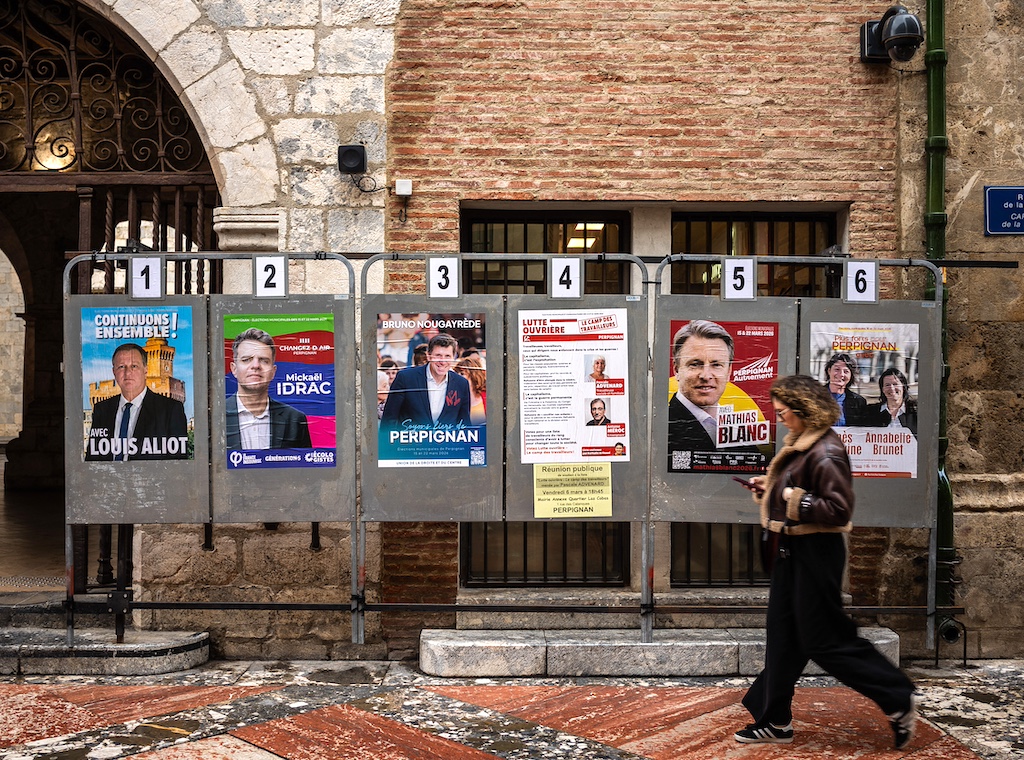
The French municipal elections reveal an uncomfortable lesson for the leaders of both the PS and LFI: it will be difficult for either party to win the presidential election without collaboration between them and with other left-wing parties. (JC Milhet / Hans Lucas / AFP via Getty Images)
Nearly all parties celebrated the results of France’s municipal elections, held on March 15 and 22. Above all, the contests confirmed just how muddled the country’s political situation is ahead of the 2027 presidential elections.
The conservative party Les Républicains (LR) will govern the most city halls, while the Parti Socialiste (PS) celebrated retaining Paris and Marseille, among other big cities. Marine Le Pen and Jordan Bardella’s Rassemblement National (RN) boasted its best-ever local-election scores, while left-wing France Insoumise (LFI) cheered its own arrival in city halls across France.
Even clear losers celebrated. The Écologistes, suffering a decline after their growth spurt in 2020, found reasons for comfort as they held on to the Lyon mayoralty; Emmanuel Macron’s camp, reduced to an even smaller minority, could at least say it won Le Havre and Bordeaux. None of them are really out of the running.
Still, these elections do confirm some wider trends. First, the collapse of Macronism and the growth of RN and LFI — two parties that could face each other in the second round of the presidential elections for the first time in history. The resilience of traditional parties (especially the PS and LR) is neither surprising nor necessarily significant for predicting the presidential elections, given that these dominant postwar forces have traditionally been strongest at the local level. Yet the municipal elections also reveal an uncomfortable lesson for the leaders of both the PS and LFI. It will be very difficult for either party to win the presidential election without collaboration between them and with other left-wing parties. This scenario, however, seems increasingly distant.
The Demonization of France Insoumise
Recent months in French political life were colored by a media-political offensive aimed at solving this dilemma by destroying the reputation of Jean-Luc Mélenchon’s France Insoumise and sinking its local-election prospects. It was an offensive with two main axes, premised on claims over antisemitism and political violence. Spokespeople across the political spectrum, from the PS to far-right parties, accused Mélenchon of antisemitism over an ill-advised joke about the pronunciation of Jeffrey Epstein’s name, a topic that has flooded television studios and radio debates for weeks.
The other angle of attack was LFI’s relationship with the Jeune Garde, an anti-fascist collective in Lyon, after some of its members participated in a brawl with far-right activists that ended in the death of one of the latter. An LFI parliamentary assistant has been accused of “complicity with a homicide by instigation,” a charge that has been used to assign political responsibility to Mélenchon’s party, which has always explicitly opposed political violence even while still defending its alliance with the Jeune Garde.
One protagonist of the offensive against LFI has been Bruno Retailleau, the leader of Les Républicains and former interior minister under Macron. He describes Mélenchon’s party as “the worst. It’s a party that spreads antisemitism, makes deals with Islamists, and justifies violence.” While making many concessions to Le Pen’s far right, Retailleau has called pacts between other left-wing parties and LFI “the agreements of shame.”
Yet the PS has itself partly echoed the anti-LFI rhetoric: its secretary rejected a national agreement for the municipal elections because of “the intolerable antisemitic statements of Jean-Luc Mélenchon.” In the past, LFI had already faced accusations of antisemitism for its defense of the Palestinian cause and its use of the term “genocide” to describe Israel’s crimes in Gaza. The establishment’s desire to destroy the only big party that poses a threat to the economic elites feeds back into Mélenchon’s tendency to stir up pointless controversies.
War Within the Left
The unity among left-wing parties built for the 2024 parliamentary elections, which led to the victory of the Nouveau Front Populaire (NFP) alliance, is now history. France Insoumise MPs — the largest left-wing group in the National Assembly — are mounting a frontal opposition to Macron’s successive governments, filing censure motions to sabotage the president’s austerity policies.
In contrast, the Socialists steered toward conciliation and, in defiance of the NFP’s own program, ended up accepting a watered-down version of Macron’s budget cuts. The unity of action on the Left lasted only briefly, after Macron refused to appoint the candidate proposed by the NFP as prime minister following the summer 2024 snap elections.
The municipal election campaign was the scene of bitter confrontation between the PS and LFI. While the former ran in numerous cities in coalitions with the French Communist Party (PCF), Écologistes, and other minor forces, France Insoumise ran alone in municipal elections for the first time. In recent years, its strategists have concluded that to aspire to compete for victory in the 2027 presidential elections, it was necessary to improve its territorial foothold at the municipal level, a political terrain traditionally dominated by LR and the PS. The gamble was at least relatively successful: France Insoumise will govern Saint-Denis (a city on the outskirts of Paris) and the post-industrial city of Roubaix, and it will have hundreds of councillors across the country, especially in large cities.
For their part, the Socialists have oscillated between anti-LFI rhetoric and pragmatism to retain power, despite doing without any comprehensive agreement. In Paris, Socialist candidate Emmanuel Grégoire secured the mayoralty despite refusing to ally with the LFI candidate Sophia Chikirou, who also made it to the second round. In Marseille, France’s second-largest city, the LFI candidate decided to withdraw after the first round given the risk of a far-right victory; the Socialist candidate eventually won.
Elsewhere, both parties merged their lists in the second round, with mixed results: in Toulouse, the main city that LFI aimed to govern, the joint ticket was defeated. Conversely, the Socialist mayor of Nantes was reelected with LFI’s support, as was the Écologistes’ mayor of Lyon. Thanks to the merging of lists in some cities, some LFI councillors will hold municipal government positions for the first time, though in most cities the winner will have a monopoly on city management due to the majoritarian logic of the French electoral system.
Both parties accuse each other of undermining the other’s results. The reality of such claims, however, owes a lot to divergent local dynamics. The clearest conclusion is that the Socialists remain the largest left-wing force at the municipal level, but in the future, they will have to reckon with France Insoumise if they want to maintain power locally. Extrapolating this to the presidential elections is surely a trickier job. Yet these results reinforce the position of those to consider that only a united left, like the one seen in the 2024 parliamentary elections, can defeat Le Pen’s Rassemblement National in the second round.
“New France” Strategy
The Parti Socialiste and France Insoumise agree on one thing: they want nothing to do with each other. The PS is counting on maintaining for the presidential elections its alliance with the PCF, the Écologistes, and some small parties, such as Raphaël Glucksmann’s centrist Place Publique. For his part, Mélenchon (whose candidacy is taken for granted) aims to build on the previous presidential elections, in which he came within just 420,000 votes of the second round, to reach the final duel for the presidency—predictably against Le Pen or, if the courts confirm her disqualification from running, Bardella.
France Insoumise strategists hope that republican common sense will prevail and that the majority will choose Mélenchon, if only to avoid handing the country over to the far right. And yet, this is not what current polls say. They unanimously predict a large victory for any of the possible far-right candidates against Mélenchon. It may be admitted that polls were wrong ahead of the 2024 parliamentary election, but the national RN lead is a significant one.
LFI calls its strategy to expand its electoral base a matter of mobilizing the “new France,” attracting young voters and those from working-class neighborhood — many of them of migrant descent — who typically abstain at much higher rates than the rest of the population, and particularly the wealthier groups. Electoral success in areas like Paris’s red belt or the election of the LFI candidate as mayor of Saint Denis with more than 50 percent of the vote suggests the strategy is yielding results in some cities.
But the limits are also evident: there will be few LFI councillors in peripheral and rural areas where the far right and traditional right dominate, which hampers Mélenchon’s prospects for the presidential election.
In his previous campaigns, Mélenchon has demonstrated a great ability to soften his image, win voters from other left-wing parties, and activate voters who usually do not participate in other elections. It is worth reminding that he scored 22 percent of the votes in the 2022 election, while the PCF’s Fabien Roussel got 2.3 percent and the Socialist Anne Hidalgo only 1.75 percent.
However, the only election the Left has won in the last decade was the 2024 legislative election, in which France Insoumise, Socialists, Communists, Greens, and even small anti-capitalist parties ran together as the Nouveau Front Populaire, which also had the explicit support of the country’s Confédération Générale du Travail labor union.
The municipal elections have highlighted the resilient strength of France Insoumise, which will add to its powerful electoral machinery (it has more than a hundred thousand members) hundreds of local councilors across the country. However, the March 22 results also confirm that the other left-wing parties remain forces to be reckoned with. And, while they will have difficulty fielding a candidate capable of competing with Mélenchon, it is also difficult to imagine a France Insoumise victory against the Rassemblement National without the help of the rest of the Left. Such comradeship still seems distant.