According to Polls, Americans Like Socialism a Lot

A crop of recent polls shows that socialism’s appeal is surprisingly broad. They also reflect a transformed US political landscape that is ripe for a socialist politician to capitalize on — if they’re willing to step up.
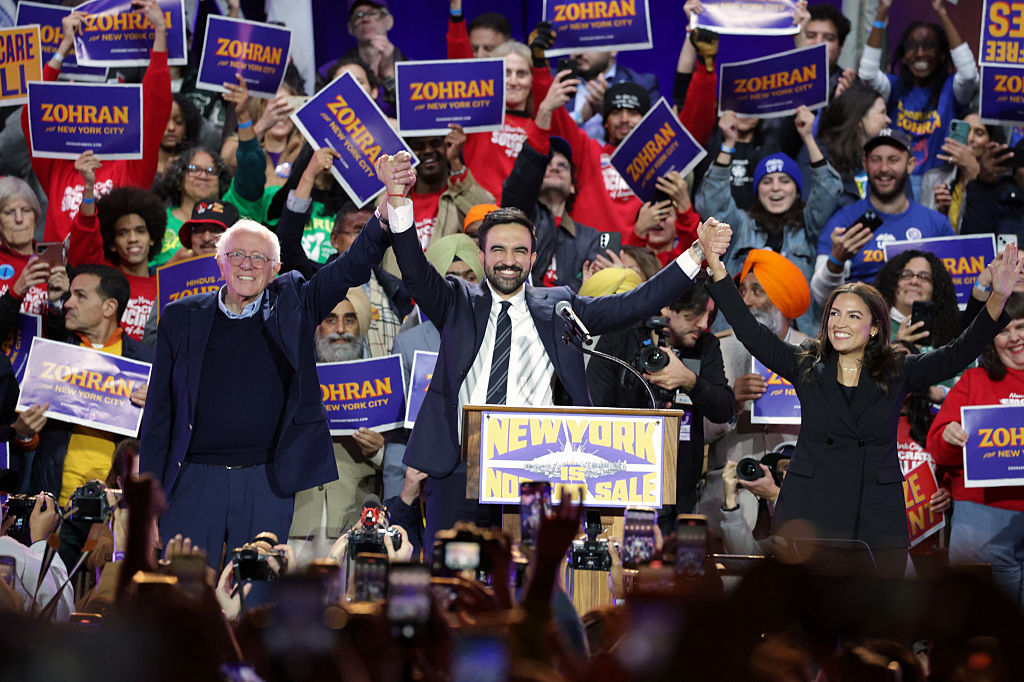
Then New York City mayoral candidate Zohran Mamdani holds hands with US Senator Bernie Sanders (I-VT) and US Representative Alexandria Ocasio-Cortez (D-NY) at the end of a campaign rally at Forest Hills Stadium in the Queens borough of New York City on October 26, 2025.

You wouldn’t know it from listening to mainstream media, but socialism is more popular than it’s been for a long time, and both socialism and its most well-known leaders appeal to a diverse voter base. (Angela Weiss / AFP via Getty Images)


Socialism is more popular than it’s been for a long time, both socialism and its most well-known adherents appeal to a surprisingly diverse voter base, and most people still have no idea who Hasan Piker is.

Those are just a few of the takeaways from a crop of polls conducted over the past month or so, which together suggest the radicalized, antiestablishment zeal that’s taken over the Democratic electorate and opened the door for a rising socialist insurgency is still going strong, with a few surprises in tow. And they come at a potentially crucial time, as socialist Rep. Alexandria Ocasio-Cortez weighs whether to make a run for president in 2028, a campaign that many socialists view as pivotal to the future prospects of their movement as a whole.

We should obviously be careful with polls, which are not actual elections and only give us an imperfect snapshot of public opinion at any point in time. Still, while they may not exactly reflect hard numbers, they do often reflect real trends, especially when put alongside other poll results. And as such, these recent ones offer several takeaways.

Socialism Is Surprisingly Popular . . . 

A new Gallup poll conducted over the month of August puts socialism at its highest positive rating, 43 percent, since the polling firm started asking Americans in 2010. Socialism has hovered just under the 40 point mark every year since, until experiencing a pronounced uptick since last year.

Maybe more significant is the reason for this uptick, which according to Gallup isn’t to do with the attitudes of Democrats — their roughly two-thirds positive view has effectively stayed flat since last year — but thanks to independents, whose positive views of socialism have gone 8 points up to 45 percent.

To be clear, socialism still has a way to go. The same Gallup poll found that capitalism is viewed significantly more positively at 55 percent, effectively unchanged from last year, as is “free enterprise” at 77 percent — which, somewhat confusingly, fell 4 points since last year, part of a more gradual downward slide it’s experienced since 2019. On the other hand, “big business” is in the doldrums, hitting a new low of 35 percent this year.

And socialism’s appeal remains geographically specific. According to a recent New York Times/Siena University poll of likely voters nationwide, socialism’s favorability is underwater in all four regions polled but is strongest in the West (-8), and weakest in the South (-27). In a Times/Siena poll of Michigan specifically later this month, Detroit was the only region where it was close to breaking even (-1).

Nevertheless, though 43 percent isn’t a majority, recent history shows that may not matter. Less than a quarter (24 percent) of Americans viewed the MAGA movement positively in April 2023, a year and a half before Donald Trump and MAGA routed the Democrats and took total control of the federal government. The Gallup results here track with several other recent polls that show voters are significantly more open to voting for a socialist candidate than a MAGA politician.

 . . .  and Popular With a Surprising Coalition

The general narrative is that socialism is mostly popular with young, well-off, and highly educated white progressives. This recent wave of survey results does continue to show there’s a marked generational divide in socialist support. But other than that, this narrative about socialism being confined to a particular demographic slice isn’t really supported by the data.

In the Gallup poll, socialism has more support from people of color and those earning less than $100,000 than from white adults and those earning more than that figure. And its support is about the same whether someone went to college or not. In fact, other than adults aged thirty-four and younger, people of color are the only group that views socialism more positively than capitalism.

We saw a similar result in the Times/Siena nationwide poll, in which white voters had the least favorable view of socialism (-26), followed by the “other non-white” category (-18), while black and Latino voters viewed it most favorably (+4 for each).

Interestingly, that poll does show an educational divide, but one that breaks down along race: while white voters of any educational level hold a very dim view of socialism (a net negative in the double digits), non-white voters both with college degrees (-4) and without (0) hold much more positive views. Bear in mind that only 18 percent of the voters surveyed in that poll self-identified as democratic socialists, with the highest proportion of those that did (33 percent) being non-white, non-college-educated voters.

AOC and Zohran Have Different Coalitions

The data is particularly interesting when we move away from socialism writ large and look at specific socialists, especially two of the most high-profile socialist politicians: possible 2028 presidential contender Rep. Ocasio-Cortez and New York City Mayor Zohran Mamdani.

Both are wildly popular with what have come to be termed “normie” Democrats. The Liberal Currents survey found that the pair, as well as fellow socialist Sen. Bernie Sanders, officially an independent, are three of the most popular figures in the Democratic Party, behind names like Barack Obama, Kamala Harris, Pete Buttigieg, and Gavin Newsom. Meanwhile, the Democratic Socialists of America (DSA), the organization that counts both Ocasio-Cortez and Mamdani as members and that has been involved in many of the left-insurgent victories this past year — holds a net +53 positive rating, with its strongest favorability (+45) coming from black voters.

But when it comes to views of Ocasio-Cortez and Mamdani, there seems to be a divide between Democratic and all other voters. Comparing the Liberal Currents and Times/Siena poll, we can summarize some of the takeaways as follows:

  • Ocasio-Cortez is viewed slightly more favorably than Mamdani by Democratic voters, while Mamdani is viewed substantially more favorably than Ocasio-Cortez by all likely voters (Ocasio-Cortez has an overall -11 rating from the latter).

  • In both cases, Ocasio-Cortez substantially lags Mamdani in terms of her support from younger voters, meaning those aged under forty-five.

  • Mamdani has a stronger favorability with independents and nonvoters (+14 with each), raising the question of whether the New York mayor’s rise helps explain independents’ growing friendliness to socialism since last year.

  • As with socialism more generally, when it comes to all likely voters, both get their strongest support from voters of color and especially black voters, college-educated and not. Ocasio-Cortez is significantly stronger with Latino voters, while Mamdani is stronger with the “other, non-white” category, maybe related to his campaign’s unprecedented mobilization of South Asian voters.

  • These demographic coalitions look very different when it comes to just Democratic voters: there Ocasio-Cortez has her highest favorability with white voters and also beats Mamdani with black voters, but significantly lags him among Latino voters. (By contrast, Sanders registers a stronger rating than the pair among all three voter groups.)

Put aside these details, and the broader takeaway is that the country’s most well-known socialists derive their strongest support from non-white voters and have significant appeal to those among them without a college education. By contrast, DSA, the nation’s largest socialist organization, is according to its most recent internal polling 60 percent white — down from 85 percent five years ago — as well as 9 percent black and 14 percent Latino. In older surveys, a substantial share of its members had or worked in fields that required higher education degrees, though like the racial demographics, that has likely changed in the years since.

Still, these poll results suggest the organization’s struggle to diversify its membership is not due to some inherent aversion to socialism by non-white and non-college-educated Americans. It suggests these efforts may bear further fruit — but that it may also require changes within its own recruitment practices and internal culture.

The Democratic Party Has Been Ideologically Transformed

We are a long way away from the pre-2016 era, when Democrats largely didn’t think about politics in ideological terms. These poll results show that not only have Sanders’s two presidential runs and the Democratic establishment’s series of failures transformed and radicalized the Democratic electorate, but that they’ve done so in a way that leaves a socialist candidate with the strongest pitch to make them.

The Liberal Currents survey confirms what countless polls have told us over the past nearly two years, namely that Democratic voters have had it with their own leadership. Senate leader Chuck Schumer has only a +3 net positive rating from Democrats, while possible future House Speaker Hakeem Jeffries is disliked by 22 percent of them. These voters agree with the statement that “criticizing the Democratic Party establishment makes you more likely to support a candidate” by a +19 margin.

On a policy level, the survey shows Democratic voters are strongly in favor of positions that socialist politicians have long taken: expanding the Supreme Court, abolishing the filibuster, zoning reform to build more housing (an issue socialists have long led on), holding the line on trans rights, and taxing billionaires out of existence, with Democratic voters believing billionaires shouldn’t exist by a 6 point margin.

Note that not all of this newly radicalized electorate’s views necessarily line up with what might be socialist priorities: these voters are overwhelmingly friendly toward the idea of a military coup against Trump and double the share of self-described liberal voters want Trump officials prosecuted by the next administration as socialist or progressive ones do.

In any case, whether or not she decides to run, Ocasio-Cortez is the socialist politician best positioned to capitalize on this transformation and not just because numerous polls show she’s now one of the party’s leading figures. Not only does the Liberal Currents survey show she has strong support from young voters when matched up head-to-head with the rest of the potential field, but crucially, she retains high favorables (+52) with voters over forty-five and white voters (+54) — a demographic that votes heavily in primaries, and whose skepticism of Sanders sunk both of his presidential campaigns. The next most progressive likely 2028 contender, California Democrat Ro Khanna, lags behind her with all these demographics and has far lower name recognition.

To deflect against the inevitable electability arguments, Ocasio-Cortez will be able to point out that her positions are broadly popular with the electorate. Voters nationwide, in Michigan, and in other battleground states all prefer candidates who oppose military aid to Israel. In Michigan, voters prefer a pro–Medicare for All candidate by 29 points. These voters also hate data centers and want them limited and heavily regulated. Other polls show even self-described moderate voters holding stridently anti-billionaire views, and swing voters being more likely to back a candidate who wants to tax the rich, pass Medicare for All, and raise the minimum wage.

Especially significant is that more than 81 percent of Democratic voters believe a candidate’s foreign policy views are important. This doesn’t just mean the matter of Israel-Palestine, which socialists have led on. The same poll found these voters oppose a US war with China over Taiwan by a 16 point margin, part of a wider trend in US public opinion that views China less negatively and is less predisposed to conflict with the country.

“The Discourse” Is Not (Always) Real Life

Finally, there’s long been a lot of talk about how the pet obsessions of the press and social media commentators don’t really reflect what most average people are thinking about. This has always veered into overstatement — there is every sign that people are thinking and worrying about artificial intelligence to a similar degree as pundits and online chatterers, for instance. But it is definitely true when it comes to some of the leading controversies of this election season.

Take Twitch streamer Hasan Piker, who, despite holding no elected office or any formal power at all, has become a media fixation. One aggregator found that news outlets had published 327 stories about Piker over the last three months, or more than three stories per day, the vast majority of it in national coverage.

Yet polls show most voters still have no idea who he is. Fifty-one percent of Democratic voters have never heard of him, even though centrist Democrats have worked to put him at the center of both primary and now general election contests. More astoundingly, 54 percent of specifically Michigan voters haven’t heard of him, even though you would assume from media coverage he’s the most important issue in that race. For that matter, 69 percent of Democratic voters have never heard of DSA national Cochair Megan Romer, whose recent interview missteps were a big story among the commentariat last month but don’t appear to have resonated elsewhere.

It’s hard to know exactly what to make of this, but one explanation could be that it signals the waning power of traditional news. Cable news networks saw their ratings nosedive last year, and things haven’t been much better a year later, part of a longer-term decline that ticked up after Trump’s 2025 win. It goes beyond viewership: trust in traditional forms of media fell last year to an all-time low. Given the role corporate and legacy news outlets have played in tilting previous election results, including presidential ones, this could prove advantageous for left insurgents and other outsider candidates.

An Altered Landscape

So, to recap: socialism and socialists are slowly but surely growing in mainstream approval, that approval is often strongest among people of color and isn’t limited to college graduates, and the Democratic and general voter electorate have been transformed in ways that have flung the doors open to socialist ideas and organizing wider than they’ve been in a very long time.

Oh, and constantly bringing up Hasan Piker does not seem to be the political silver bullet that Republicans and corporate Democrats want it to be.

There’s a long way to go before 2028, and all of this could look different in the wake of whatever happens in November, not to mention after whatever potential wild card a Trump who no longer cares about elections ends up playing. Still, it’s clear the past ten years of socialist organizing have slowly, unevenly reshaped the US political landscape — and that landscape in turn is changing the fortunes for socialist organizing.