What If Socialism Takes Over the Democratic Party?
Could democratic socialism become the brand of a new generation of political actors — not just on the fringe, not just in New York City, but across the country?
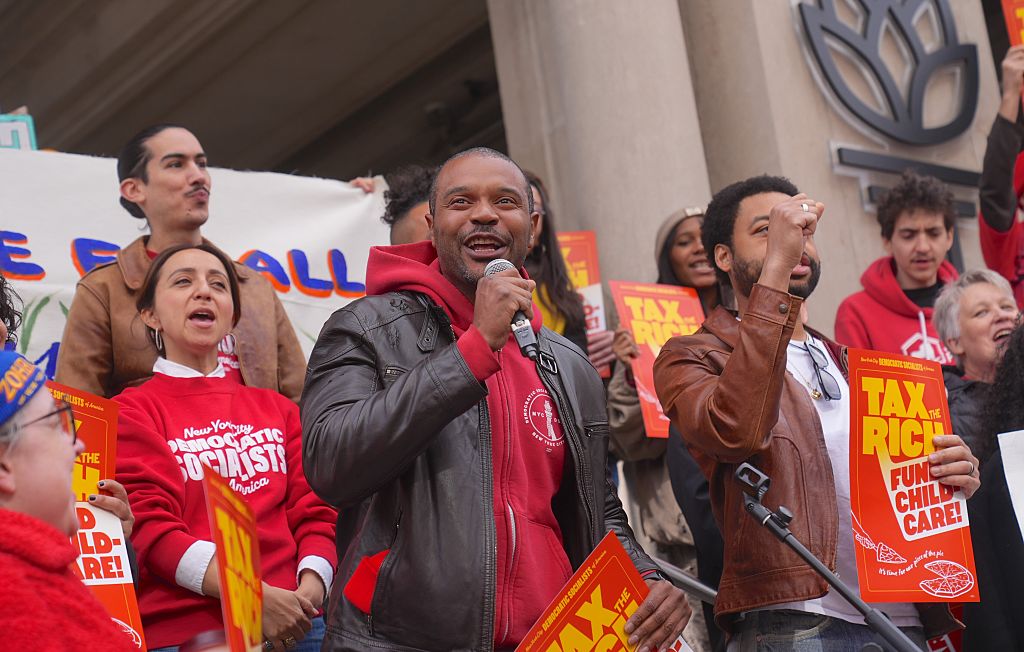
For younger people, liberalism means nothing but a corrupt bargain with power and capitalism. Which is probably why they’re searching for a new political brand and ideology to associate with — and seem to have found it in socialism. (Selcuk Acar / Anadolu via Getty Images)
In a probing Substack, John Judis writes, “In ten or fifteen years, it is very possible that the Democratic Party will be known as ‘democratic socialist’ in the same way it is now known widely as ‘liberal.’” Before you dismiss this as ideological patter from a political adventurer, you should know that Judis is a relentlessly unenthusiastic realist, who’s been watching and commenting on the American political scene longer than I’ve been alive.
I’d like to take up his thought, with two tweaks. First, I’m less certain if the Democratic Party is going to be the vessel of this transformation. Though it may be at this point the oldest political party in the world — and, as Kevin Phillips famously called it, the second most enthusiastic capitalist political party in the world — the Democratic Party needn’t survive forever. Let’s use “Democratic Party” as a stand-in for whatever left-of-center party there is or may be in the decades to come. Second, I don’t know that the Democratic Party is widely known today as liberal. Let’s say instead that “liberal” has been the term for the dominant left-of-center ideology in America for about a century now.
With those tweaks in mind, I think Judis poses an interesting scenario worth discussing here.
But first, some intellectual housekeeping. In my experience, there is nothing more difficult to talk about on the internet than “liberalism.” There are the obvious reasons: People disagree about its desirability; people disagree about its definition. We’re already set up for confusion. More than that, people don’t readily understand why they disagree about liberalism’s definition, much less its desirability. There are so many deep and unacknowledged sources of misunderstanding between the people who argue about liberalism on the internet, it’s a wonder we can carry on a conversation at all. Most times, we don’t.
So before we talk about whether democratic socialism will one day replace liberalism as the lingua franca of left-of-center political culture and discourse in this country, we have to understand what we talk about when we talk about liberalism — that is, what we disagree about when we disagree about liberalism.
For starters, liberalism in the United States means something different from liberalism in Europe and Latin America (I’m less certain about Africa and Asia). On these other continents, liberalism has long been identified with free markets and constitutionalism, and with a less-than-minimal appreciation of democracy. While hardly the same as conservatism, liberalism has a fairly conservative — and certainly counterrevolutionary — valence in Europe and Latin America, which goes way back in Europe, at least to the nineteenth century. In the United States, by contrast, particularly during the New Deal era, liberalism was the tradition that voiced skepticism, if not outright opposition to, free markets, sought to turn the Constitution from a limiting constraint on the state into an expansive charter of state control over markets, and pushed for an extension of democracy.
Beyond this geographical divide between the United States and other parts of the world, we have a historical cleavage within the United States. For older generations, by which I mean my generation of elder Gen Xers and above, liberalism was essentially the American version of social democracy. You can find all sorts of evidence for that, but two sources I’d flag are Arthur Schlesinger Jr’s The Vital Center and Philip Roth’s The Plot Against America (or any of Roth’s other historical novels, really). Schlesinger’s is the more surprising text because we think of that text as the anti-communist manifesto, which in many ways it is. But it’s also firmly committed to social democracy and even dedicates a chapter to a positive account of class struggle. As much as liberals like Schlesinger were opposed to communism, so were they opposed to unregulated capitalism and conservatism.
But for younger people — millennials and Gen Z and beyond — liberalism means nothing but a corrupt bargain with power and capitalism, the worst sorts of neoliberalism that we associate with the Clintons, compromise that produces only confusion and concessions. (Eleanor Roosevelt, by contrast, said, by all means compromise, but when you do, make you sure you compromise up.) As an elder Gen Xer, I’ve often been surprised by the vehemence about liberalism among younger generations. Not because I disagree with them — I don’t — but because for my generation, liberalism was a more complicated antagonist. I’m not used to this kind of uniform hostility. But for younger generations, liberalism is, without a question, the shittiest ideology. Except for Trumpism, of course, which at least has the virtue of not pretending to be anything other than what it is (except to addled mainstream journalists).
Beyond geography and generation, we have a divide, among academics, between political theorists and, well, everyone else. Ironically, it’s political theorists (and some of our allies in English literature departments) who probably have the longest historical view of liberalism, whereas most historians, social scientists, comparative literature scholars, and some philosophers tend to think of liberalism in strictly twentieth-century terms. Political theorists, by contrast, trace liberalism back, first and foremost, to the early years of the nineteenth century in France and Spain, and sometimes, though we disagree on this one, back to the eighteenth and seventeenth centuries in England and France. We take seriously liberalism’s commitments to freedom of religion, freedom of speech, constitutionalism, and, even, on occasion, democracy, because we’ve seen how the ideology has played out on a longer time scale and continental expanse. Most other scholars, I’ve found, particularly in history, American studies, and the social sciences, are like the younger generations I’ve described above: implacably hostile to liberalism and therefore less vexed in their accountings of it.
And last, of course, we have the political divide in this country between Republicans and Democrats, between right and left, conservatives and liberals, which has led to all kinds of confusion about what liberalism really is, with liberals in recent decades basically abandoning the term in the hopes of rebranding themselves as progressives (that was the Clinton move) or something else.
Okay, back to Judis’s prediction that in the next ten to fifteen years, “democratic socialism” will become the dominant term of self-understanding on the broad swath of the left-of-center spectrum that extends from mainstream Democrats further to the left, much in the way that liberalism once was.
John has his reasons for why he thinks this is possible, but I want to focus on the consequence of this development, should it occur — the consequences, in particular, for political culture, both among intellectuals and in the common sense of political life.
It’s hard to overestimate how important it was that, within the United States, New Dealers embraced the language of “liberalism” to describe what it was that they were doing. Within a short period of time, starting in 1933 or so, liberalism became the moniker or “brand,” as we now say, of the Democratic Party. With that branding came the cleavages and common culture that I’ve described above. With New Dealers, from the most mainstream to the more left union types, taking up the term liberalism to include policies and programs that ranged from the welfare state to social democracy, from state planning to military Keynesianism and beyond, liberalism became the dominant term of agreement and disagreement on the left of center.
Liberalism set the pace for our national conversation, such that we got books like Louis Hartz’s Liberal Tradition in America, which treated liberalism as the only ideology in America, or Richard Hofstadter saying that America (by which he means liberalism) has the unfortunate destiny of being an ideology rather than having one. In much the same way that we get scholars today claiming that the United States was always conservative, always Trumpist, always fascist, or what have you — generalizing from a movement to a moment to a national way of life — so did scholars claim, once upon a time, that America was always liberal. (Not true, but that doesn’t matter here.) That was the effect of the New Deal: it imprinted itself on a generation, which then imprinted itself upon subsequent generations, creating liberalism as the way we understand ourselves.
None of this, it should be stressed, was preordained. The New Dealers could have chosen a different self-description, and indeed, one of the reasons that free-market opponents of the New Deal took on the label “neoliberal” in the late 1930s was that they were furious that the New Dealers had claimed the term liberalism for themselves, effectively stealing it from the free-market tradition of the nineteenth century that anti–New Dealers looked back to. Liberalism is a complicated ideology, and it can be pushed in different directions. In the United States, it got pushed in the left direction it got pushed, and because the United States was the hegemon that it became, the term became a term of global contestation.
But what if democratic socialism, for all the reasons of contingency and circumstance that went into the production of “liberalism” in the twentieth century, becomes the moniker, or brand, or whatever, of a new generation of political actors, not just on the fringe, not just in New York City, but across the country? What if these democratic socialists come to speak for an entire generation, and are able to put their imprint on generations to come, the way that Roth was imprinted during the New Deal, and then continued the imprint long after the New Deal was over?
I’m not talking, again, policy or politics or program. I’m talking political culture.
Insofar as language and words have power — a big if, about which I’m often dubious — things might get interesting.