DSA Is Eyeing a 2028 AOC Presidential Run
Members of the Democratic Socialists of America are thinking seriously about a national presidential campaign for Alexandria Ocasio-Cortez in 2028 that would reach millions of working people and have the potential to transform American politics.
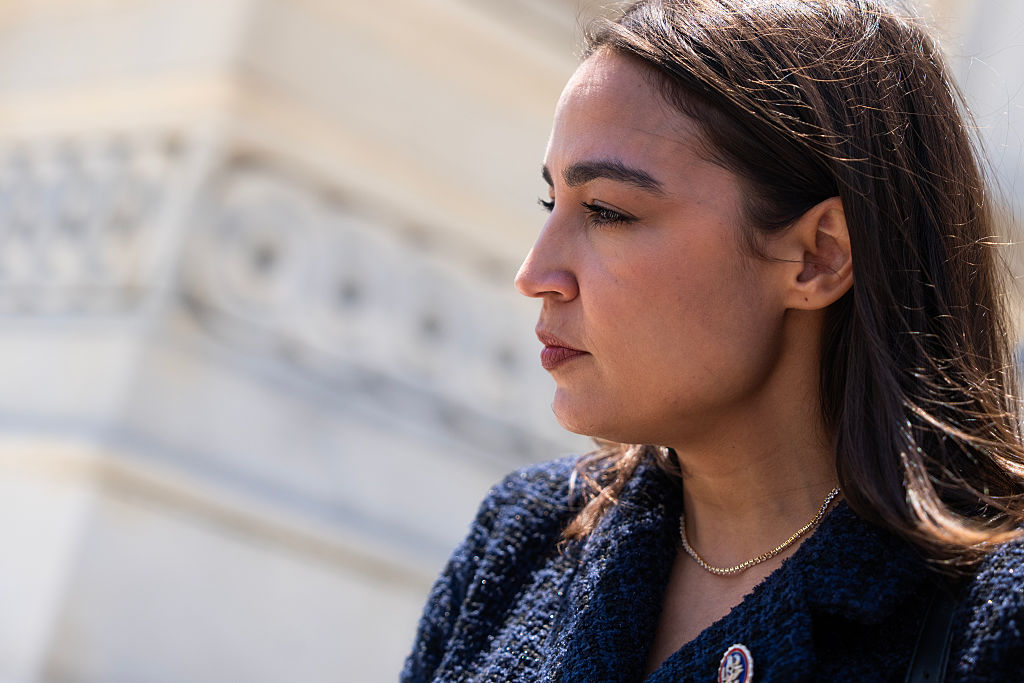
A growing chorus from Democratic Socialists of America members and chapters around the country are indicating their support for an Alexandria Ocasio-Cortez 2028 presidential run. (Tom Williams / CQ Roll Call via Getty Images)
The Democratic Socialists of America (DSA) is entering a new phase. After decades on the political margins, DSA has helped elect a socialist mayor of New York City, won a string of congressional primaries, and grown to over 130,000 members. Now, as chapters across the country call for Alexandria Ocasio-Cortez to run for president in 2028, the organization faces a crucial test of how to turn its growing popularity into national political power.
There are encouraging signs that DSA is rising to the occasion. From Los Angeles and Chicago to smaller communities like Ithaca and Wichita, chapters have passed resolutions urging AOC to run. Last weekend, Bread and Roses — a caucus I am a member of and that within DSA’s national leadership often holds the balance of power between the organization’s different political wings — voted overwhelmingly to join the effort to draft her.
DSA’s national leadership has also approved a process that could allow an endorsement early in 2027, rather than waiting until its summer convention. None of this means the organization is united, or that its remaining disagreements are trivial. But the trend is clear: more socialists are coming around to the possibility of a national campaign capable of reaching millions of working people.
The Growing Coalition for AOC
At its 2025 national convention, held before Zohran Mamdani’s mayoral victory reenergized the organization, DSA committed to helping unite labor and the Left behind a socialist presidential candidate in 2028. That decision did not settle whom to support. But as members have organized for an AOC candidacy this year, the case for rallying around her has gained force.
Over recent months, with support from caucuses on what’s sometimes referred to as the right wing of DSA’s political spectrum such as Socialist Majority and Groundwork, chapters from Los Angeles, Chicago, and Boston to smaller chapters like Ithaca, Wichita, and Sonoma County have passed resolutions encouraging AOC to run for president.
These resolutions argue that an AOC campaign could upend American politics. Atlanta DSA’s resolution highlights her support for Medicare for All, the Green New Deal, and an arms embargo on Israel. Unlike establishment Democrats such as Gavin Newsom and Kamala Harris, AOC could offer working-class Americans a clear alternative to the status quo, championing an agenda that puts “people over profits.” Rather than simply defending existing institutions against the far right, the resolution argues, her campaign could rally millions around an ambitious vision for improving their lives.
The precedent of Bernie Sanders’s presidential campaigns looms large. His runs helped turn democratic socialism into a recognizable political force and gave millions of Americans a language for challenging billionaire power. In supporters’ view, an AOC campaign could build on that legacy, bringing demands for economic redistribution, universal public services, and a more democratic political system to an even wider audience. And unlike Sanders in 2016, she would begin with a much larger socialist organizational base from which to build.
The resolutions also reflect an urgency about the country’s political direction. In California, Sonoma County DSA warned that both major parties have been moving rightward for decades and declared that “it is time to stop that slide.” Its September statement argues that a socialist presidential campaign could rally voters around alternatives to growing inequality, authoritarianism, and war, while advancing struggles for health care, housing, immigrant rights, and Palestinian freedom. Similar sentiments have emerged in smaller communities. Announcing its overwhelming vote to support AOC, Mid-Hudson Valley DSA declared that “we cannot cede ground to a politics of yesterday.”
The growing support for AOC also reflects the influence of Zohran Mamdani’s breakthrough in New York. His victory demonstrated the appeal of campaigning on concrete improvements to working people’s lives, including rent freezes, universal childcare, and taxing the rich. Just as importantly, it showed that socialists could reach far beyond their existing base by combining popular demands with ambitious grassroots organizing. Supporters of an AOC candidacy see the possibility of taking that approach nationwide.
For these chapters, a presidential campaign also presents an opportunity to strengthen socialist organizing well beyond Washington. As one Atlanta DSA member put it, “We need a DSA of millions, one that’s strong enough to contest state power, fuse with a strong labor movement, and energetic enough to get bystanders to come out to support us.”
Chicago DSA offers perhaps the clearest case for how an AOC campaign could strengthen socialist organizing beyond the presidential race. Noting that presidential elections are “how most Americans engage with politics,” its recently adopted resolution proposes pairing an AOC campaign with a slate of candidates for the Illinois legislature and Congress, who would run on demands including rent control, fully funded public schools, immigrant protections, and higher wages.
Just as importantly, the chapter lays out a plan to turn electoral enthusiasm into lasting organization: building relationships with unions, recruiting and training socialist candidates, and converting campaign volunteers into DSA members. For its part, Los Angeles DSA has made “Run, AOC, Run!” one of its three main priorities for the coming year.
The breadth of these resolutions suggests that DSA’s electoral victories and influx of new members are encouraging greater ambitions. Bread and Roses’ decision to join the draft effort is especially notable, suggesting that the emerging coalition is extending well beyond the Socialist Majority and Groundwork caucuses. Increasingly, socialists with different strategic traditions are seeing an opportunity to translate diffuse popular support into organized power.
Why Some Socialists Remain Skeptical
Not everyone is on board. Over the summer, several caucuses from the organization’s far left, who generally espouse some version of revolutionary socialism, raised objections to an AOC campaign, though the intensity of their opposition has varied, and they have been less vocal about the issue over the past two months.
Red Star, whose member Megan Romer is one of DSA’s two national cochairs, has expressed “serious doubts” about throwing its weight behind her, citing a lack of “political and practical alignment with DSA.” Marxist Unity Group and Springs of Revolution have questioned moves toward an early endorsement and stressed the importance of holding socialist elected officials accountable. Liberation, a much smaller Maoist caucus, has rejected the idea of making her the standard-bearer of the socialist movement.
In 2024, disagreements over Palestine led national DSA to withdraw its national endorsement of AOC, even as NYC-DSA continued to back her. Critics have pointed to her statements at the Democratic National Convention about Kamala Harris “working tirelessly” for a ceasefire, her past views on Israel’s Iron Dome, and her sometimes conciliatory approach to Democratic Party leaders. Although she has pledged to oppose military funding to Israel, some DSAers worry that such commitments might not hold under the pressures of a national campaign or once in office.
There is a deeper strategic concern, too. Over the past century, popular left-wing politicians around the world have frequently won office only to be hemmed in by party leaders, wealthy donors, and the institutions of the state. Socialists are right to avoid subordinating their independent organization to the fortunes of any single politician, and they’re right to worry about the potentially demobilizing effects of holding executive office. But those concerns are ultimately an argument for shaping an AOC campaign, not standing aside from it. And their specific criticisms are often overstated. Whatever DSA members might think of some of her past rhetoric on Palestine, AOC has never voted for military aid to Israel. And without justifying all of her tactical approaches, much of what those on the DSA left see as AOC’s excessively accommodationist approach to Democratic leaders reflects a sober and appropriate understanding of the need for some degree of unity in action to stop Trumpism.
AOC combines a national audience, an identification with democratic socialism, and a plausible path to mobilizing working people on a scale few others could match. Refusing to engage out of the perception that she falls short on certain questions would not, by itself, make DSA and the broader movement more independent or more powerful. It could instead mean forfeiting a rare opportunity to build both.
The Bigger Test Ahead
Of course, the biggest remaining question is whether AOC herself decides to run. That decision will likely depend in significant part on November’s midterm results, including the performance of socialist and progressive candidates and the balance of power within the Democratic Party.
But whatever AOC decides, the growing push for her candidacy signals an important shift within DSA. Increasing numbers of its members seem determined to move beyond the margins and make democratic socialism a major force in American life. Whether that momentum turns into lasting organization — and whether skeptics and supporters alike can help shape it — will determine how far America’s socialist revival can go.