Can Britain’s Greens Become a Working-Class Party?
In Britain, left-populist Green leader Zack Polanski has emphasized cost-of-living issues. While his party has won over parts of the working class alienated by Labour, broadening this base remains an uphill challenge.
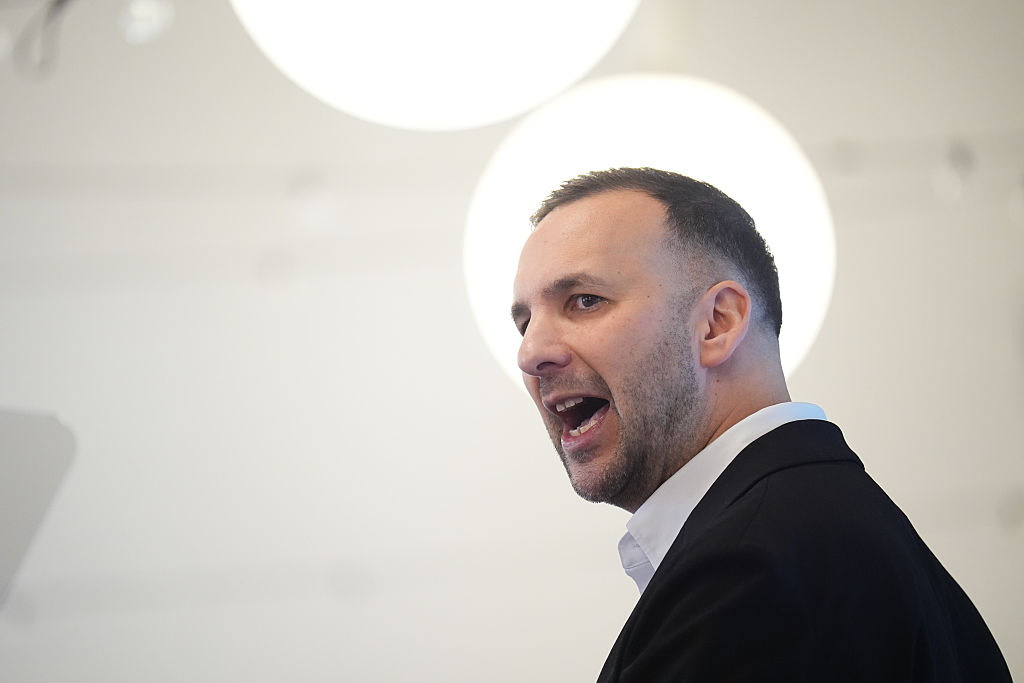
Recent research shows that even Reform UK–voting parts of the working class are receptive to left-wing economic policies. Green leader Zack Polanski’s hopes of changing British politics demand a focus on these voters, too. (James Manning / PA Images via Getty Images)
Britain’s local elections in May offered the Left much reason for anxiety. Nigel Farage’s far-right Reform UK swept up over 1,400 new council seats and won outright control of fourteen councils, leapfrogging Keir Starmer’s Labour Party, which is now in free fall. It’s a wearily familiar story across Europe: neoliberal decline, and establishment parties’ meager proposals to manage it, has produced fertile ground for the continued rise of nationalist-conservative forces.
Yet Britain is perhaps something of a distinct case. These elections were also lauded as a victory for the Green Party, consolidating its growth trend over the past year. The Greens won 441 new seats and outright control of four councils. Set against Reform UK’s gains, these are modest numbers. Yet read alongside the Greens’ recent membership growth and parliamentary breakthroughs, they suggest that something is stirring on the British left. This demands reflection on the changes that have recently taken place in the Green Party and how far they can go.
Filling Labour’s Vacuum
The Greens’ approach has shifted massively since Zack Polanski took over as party leader last September. Once perceived as a niche, middle-class environmentalist outfit, the party under Polanski has begun to look like something closer to a left-populist formation. He has railed against “Rip-Off Britain” and entrenched wealth inequality, called for an end to UK arms exports to Israel, demanded nationwide rent controls, and pushed for a substantial rise in the minimum wage. The party has begun advancing a political platform that the Economist has described, with evident alarm, as “Corbynism on steroids.”
As trade union leaders have voiced their frustration with Labour’s milquetoast reforms, Polanski has promised to overturn the anti-union legislation built up under successive Conservative governments and left untouched during Labour’s tenures in between. He’s even described the Greens as “the new workers’ party.”
This has also fueled a change in the party’s base. Last July, during discussions surrounding the launch of Jeremy Corbyn’s Your Party, Momentum cofounder and former Corbyn adviser James Schneider sketched the task of any new socialist party in Britain. It must, he said, reconstitute itself through “the asset-poor working class, downwardly mobile graduates, and racialized communities.” The Greens, under Polanski, appear to be doing precisely this — retaining their existing support among urban graduates, expanding within Muslim and ethnic-minority communities, while making inroads among lower-income voters. According to a More in Common study, there are now only two parties whose voting intention figures rise linearly as individuals’ financial situation worsens: Reform UK and the Greens.
It’s not just about the money in people’s wallets. The Palestine solidarity movement has played no small part in helping along this transformation, catalyzing a rejection of a Labour leadership unwilling to abandon its fervent military, financial, and political support for Israel. Together with a vocal rejection of austerity and a new communication style capable of reaching beyond the already politicized, the Greens’ stance on Gaza has helped drive a tripling of the party’s membership since Polanski’s election. Membership rose another 10 percent after plumber-turned–Green MP Hannah Spencer defeated both Labour and Reform UK in February’s parliamentary by-election in Gorton and Denton.
The Architect
How much of this is Polanski’s own doing? A former Lib Dem who joined the Greens only in 2017 and won the leadership last fall, Polanski does not come with a traditional left-wing pedigree. Yet he has rapidly pushed the party’s messaging in a left-populist direction, fueling growth in both membership and electoral scores.
Polanski is a talented orator and handles the spotlight well, but he is no extraordinary tribune. The importance of his leadership for the party’s growth seems to lie less in his rhetorical gifts than in his ability to redirect its strategy. This points to a more general truth: leadership matters in contemporary politics, including on the Left, but “leadership” can mean very different things. There is a purely external version of leadership, in which the party is reduced to the leader’s personal electoral machine. And there is an internal version, in which the leader guides some wider body in society. Polanski’s role is central because he is the architect of a strategic shift inside the Greens. For that shift to consolidate, however, it must eventually spread throughout the party’s structure. Otherwise, the project risks meeting the same fate as Corbyn’s Labour, which, despite the influx of new members he brought in, never transformed the party deeply enough.
Polanski’s personal profile is also worth dwelling on. He is Jewish and gay, vegan and teetotal, and refuses to fly in order to avoid carbon emissions — declining even to meet Zohran Mamdani in New York, for that reason. At first glance, this might not look like the profile of a leader capable of pushing the Green Party toward economic populism and a lower-income electorate. And yet that is exactly what is happening. It is a useful reminder that so-called identity politics issues are not, in themselves, necessarily a liability for class politics, as left-conservatives have insisted. What matters is how these themes are embedded in broader political profiles and aims, not the themes themselves. It is the perennial problem of how to construct a collective “we” capable of transcending identitarian particularisms without denying their existence.
Beyond the Urban Core
The Greens’ transformation surely has not yet made them the “new workers’ party” Polanski proclaims them to be. A large share of Green voters are still primarily concerned with environmental issues, more than the cost of living. That makes many of them outliers in a country that overwhelmingly cites high costs among the key issues shaping its vote. Critics have also highlighted the party’s inability to overcome its geographical limits, with its appeal still largely confined to urban areas. Mobilizing the Greens’ active membership to overcome those limits is important but fraught with difficulties: local campaigns are often shaped by voluntaristic middle-class activism that lacks training and clear direction, and is not always fully aligned with Polanski’s new economic populism.
Tough though it may be, the key to making the Greens’ rise something more than a passing windfall from Labour’s temporary collapse lies in the need to root the party in working-class mobilization and to build a working-class presence in its ranks. Polanski’s populist turn has certainly opened prospects in this direction, but the road ahead is long. Here it is worth looking at the experience of post–2008 crisis European left populism, which Polanski’s new course at times recalls. Those left-populist parties were better than the radical-left formations that immediately preceded them at fostering a common identity around clear, shared goals during election campaigns. But their leaderships — media-driven, personalized, and often drawn from culturally elite backgrounds — proved rather weak at the slower work of building on-the-ground organizations solid enough to hold working-class voters over time.
Comparing Reform’s base with the Greens’ offers some insight into the challenges ahead and where attention should be concentrated. Both parties have a cross-class base but draw differing levels of support from distinct fractions of the working class. The Green Party does well in areas with larger Muslim communities and high numbers of renters. In one YouGov poll, Reform UK has more support than other parties from routine workers doing repetitive, often low-income jobs — except among those aged between 18–34, who massively favor the Greens. Reform UK also does well in the areas of organized abandonment where such routine work is more common. Recent research by Sacha Hilhorst has shown that there is a concrete appetite for progressive politics and economic populism among large sections of Reform’s voter base.
In 2018, the Labour Party under Jeremy Corbyn launched a community organizing unit meant to help extra-parliamentary struggles around local issues. Arguably, such a program could be understood as a form of base building — a strategy which has garnered interest among socialist organizers in recent years. This seeks to develop support for socialism among broader sections of the working class through initiating and participating in localized campaigns. In this sense, Peter Mertens — leader of the rising Belgian Workers’ Party (PTB) — has highlighted the importance of building campaigns around the demands that local residents themselves raise. By listening first, rather than imposing a program from above, the PTB has won support through creative actions such as organizing to protest the closure of local swimming pools. While the logic of elections can create its own priorities and pace, the Greens should explore revitalizing projects such as the community organizing unit, and a similar strategy. This could offer the possibility of surpassing their current geographic limitations and attracting a broader stratum of current Reform voters or abstainers.
Moreover, to successfully challenge Reform’s advance among working-class voters, the Greens will also need to draw upon some of the deeper sentiments and emotional registers that resonate with that electorate — sentiments Reform has been able to tap into — while reframing them in solidaristic terms, in contrast to Farage’s politics. For instance, the global right today excels at weaponizing nostalgia for reactionary ends. But that should not mean abandoning this sentiment altogether. It is thus important that Polanski continues, as he is already doing, to articulate a form of nostalgia that bends toward left-wing ends. His recurring slogan “Make Hope Normal Again” is exemplary of this. Hannah Spencer’s victory speech offered another: “Working hard used to get you something — it got you a house, a nice life, holidays. It got you somewhere. Now, working hard — what does that get you?”
Finally, to become a party that represents broader sections of the working class and create what Antonio Gramsci called a “national-popular” force, the Greens shouldn’t be squeamish about foregrounding their attachment to specifically British traditions. This doesn’t mean echoing Farage’s anti-immigration rhetoric, nor, like one dismal recent Labour leadership contender, pretending you’ve never had a cappuccino for fear of being deemed “metropolitan.” It means, for instance, mobilizing the deep affection most people feel for the National Health Service into a demand for its revival and constructing a vision of place-based pride that bends toward an inclusive, welfarist politics. Doing so counterposes the visions of Britain offered by Reform with something more expansive and aspirational: that is, a story of the country that working-class people, of any background, can recognize as their own.
The Storm Ahead
Britain’s media establishment has already given a foretaste of what awaits Polanski in the run-up to a general election: an attempted character assassination of the kind it ran against Corbyn. They appear to be using almost exactly the same playbook, with figures like Sky News’ Trevor Phillips desperately attempting to tie Polanski and the Palestine solidarity movement to violent antisemitism.
In this respect, the Greens must learn from Corbyn’s experience, not least to avoid repeating the same tactical mistakes in the face of a coordinated media assault. Going on the defensive — or offering apologies and retreats on terms dictated by hostile media — may feel safer in the moment than facing the uncertainty of open confrontation. But it is the path to defeat. Here, Jean-Luc Mélenchon’s record in France offers a lesson: he has consistently refused to be dragged onto the defensive by bad-faith media controversies or to apologize in response to dishonest, whipped-up accusations.
For now, Polanski appears to be moving in this direction. He has, for instance, been willing to use his Jewish identity to push back against the antisemitic narratives being constructed around him and the party. Remaining forthright in his positions will not only help retain those members drawn to the Greens by their vocal stance against the ongoing destruction of Gaza; it will also help Polanski withstand the media storm that awaits him.
But facing that storm will require more than Polanski himself standing firm. A Left without support among economic and media elites can only rely on the mass backing of ordinary people. It must count on the one vehicle that, despite the fluidity of contemporary society, can still turn that support into sustained political force, namely a mass party. That is why building a party that is more structured, and more capable of sinking deep roots in working-class communities, matters so much: it is not simply a recipe for electoral growth but the precondition for weathering a hostile media environment and a volatile political landscape.
The British left has spent the years since Corbyn’s defeat in a kind of wandering exile. And Your Party, the new Corbyn–Sultana left formation, after initially raising great hopes, ended up imploding. Could Polanski’s Greens become the vehicle for the kind of left-wing political reorganization among the working class that, for now, we are seeing only in fits and starts — from the PTB in Belgium to La France Insoumise in France, or Mamdani in New York? The current opening is thin but real, and it might not stay open for long. What the Greens do with it is now the most important question on the British left.