Francis Fukuyama: The American Right Has Gone Off the Deep End

Francis Fukuyama

Francis Fukuyama tells Jacobin that decades of suspicion of the state, from both the Left and the Right, helped produce America’s current crisis.
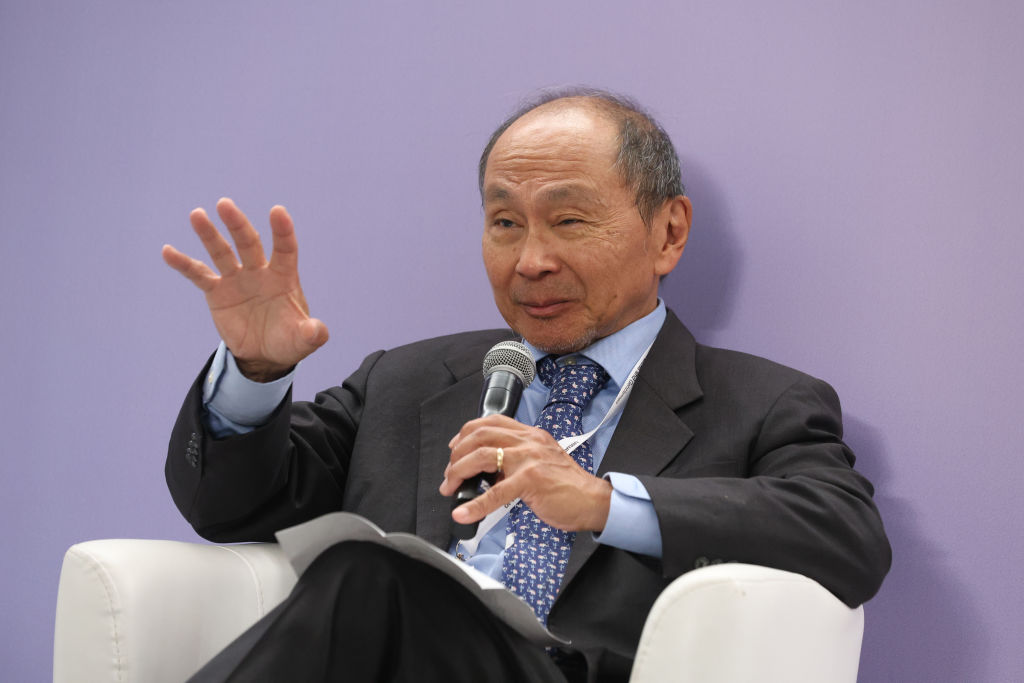
Francis Fukuyama at the Summit of Ladies and Gentlemen on September 12, 2024, in Kyiv, Ukraine.

Francis Fukuyama: Zohran Mamdani is “politically pretty smart.” (Viktor Kovalchuk / Global Images Ukraine via Getty Images)


Interview by
John-Baptiste Oduor

In 1989, Francis Fukuyama wrote a sweeping philosophical polemic in which he argued that liberal democratic capitalism was the only viable economic and political system. Countries would either converge on its model or drift into dysfunction. What prevented states and individuals from accepting this fate was a fear of being the Last Man, a Nietzschean term for the individual living without ideas worth dying for. A world in which liberal democracy was triumphant was, Fukuyama argued in “The End of History?,” one without the tragedy and pathos of the era of great ideologies — safe but boring.f

When he expanded this essay three years later into The End of History and the Last Man, Fukuyama gave voice to a worry that this condition of placid stability may not be able to satisfy the drives of all individuals. Here he echoed G. W. F. Hegel, the philosopher from whom he took the idea of a universal history, who wrote that “within the state, heroes are no longer possible: they occur only in the absence of civilization.” In his upcoming memoir, In the Realm of the Last Man, Fukuyama makes clear that he views figures like Vladimir Putin and Donald Trump as unwilling to pay the cost of progress. They instead hearken back to a time of heroic conflict, refusing to accept the constraints of liberal democratic capitalism.

Jacobin spoke to Fukuyama about his own intellectual development from a former Republican policy adviser to the Ronald Reagan administration and member of the RAND Corporation to a Democrat who now describes himself as, with some qualifications, a social democrat. In this interview, Fukuyama also discusses the transformations of the American right, what the Democratic left could learn from Trump, and from Zohran Mamdani’s successes in New York.


John-Baptiste Oduor

You were about sixteen in 1968 and became a conservative a few years later at Cornell. How did you think about yourself in relationship to the progressive and leftist politics of that period? Did you think you were reacting against them?

Francis Fukuyama

It was really my teachers at Cornell, particularly Allan Bloom — they were all students of Leo Strauss — who influenced me during that period. Strauss made a complex set of arguments, but basically he argued that the Western philosophical tradition had gotten itself into a dead end with the rise of the relativism that was the core of the teaching of people like Friedrich Nietzsche and Martin Heidegger. That was a problem because people still had moral commitments, which were necessary for society.

Strauss argued that it was still possible to use human reason to come to an understanding of basic issues of good and bad that progressive thought had, in a certain way, rejected. I spent a lot of time as an undergraduate going back to Plato and Aristotle because that’s the core of the Western project to use reason to answer big questions about the nature of justice, the nature of human happiness, and so forth.

That was really what I was doing when I was an undergraduate. And it wasn’t in reaction to progressivism in particular. I mean, it was a very turbulent time in American politics because the Vietnam War was raging. There was a lot of student activism. And I participated in some of that. Probably my sophomore or junior year, I went to an anti–Vietnam War protest in Washington, DC.

John-Baptiste Oduor

What in your view was the political content of Straussian conservatism then? Figures like Patrick Deneen and Michael Anton who are close to the current administration take it to imply an ethnonationalist view of Western cultural traditions.

Francis Fukuyama

I think they have taken a really ridiculous position. I have debated Deneen in the past few years a couple of times. Many people who consider themselves in some way students of Leo Strauss split into different factions. One of the big divisions is between so-called West Coast traditions associated with the Claremont Institute and East Coast students who were more likely to be students of Allan Bloom or possibly Harvey Mansfield. The West Coast traditions, in my view, have just gone off the deep end.

A lot of [thinkers associated with them], like Michael Anton, have become die-hard Trump supporters. They’ve forgotten a lot of the basic teachings of people who were students of Strauss like Harry Jaffa, who was really the founder of that whole West Coast school. Patrick Deneen, I think, has discovered a certain celebrity by arguing that we ought to go back before the Enlightenment, to a period when Western countries were united by a single conservative Catholic doctrine. It’s totally absurd that anyone could think this was remotely possible in the year 2026.

I don’t associate myself with any of those particular schools. I remain what I regard as a classical liberal, meaning that I believe that liberal democracy is the only practical way to govern a modern society.

John-Baptiste Oduor

American conservatism has taken an anti-humanist turn over the past ten to fifteen years, particularly under the influence of the tech right. How do you think this happened?

Francis Fukuyama

I think it’s a complicated story. The person who has written the most intelligently about this is Laura Field. She published a book last year called Furious Minds, where she traces the origins of a lot of this. I believe her account that a lot of this is people who are American nationalists, in some sense, who have dressed up their politics in a theoretical language to defend something that’s just basically American chauvinism. That is part of it.

The other part is the opportunism of people who saw Trump rising. They saw that this was a powerful real-world political force that they wanted to attach themselves to. And so, for the last ten years they’ve been tying themselves in knots trying to come up with a highbrow philosophical justification for Trumpism.

It just doesn’t work, because I don’t think Trumpism is a coherent doctrine. It’s just the psychopathology of this one individual. All of these theoretical attempts to put him into some a structured framework are bound to fail. People like Peter Thiel and J. D. Vance are good examples. Thiel has started to use this theological language about the Antichrist to explain what Trumpism is about. I think that’s all silly. It’s not serious political theory.

John-Baptiste Oduor

Speaking of J. D. Vance, figures like him and Tucker Carlson have at points tried to present Trumpism as part of a redistributive pro-worker conservatism. In practice, the politics of the Republican Party has been the same as it has always been: tax cuts and war. Do you have an explanation of why this pro-worker conservatism has so little foothold in reality?

Francis Fukuyama

In many ways, it was displaced workers in depressed, postindustrial parts of the country that formed part of the original Trump coalition. And I think it’s true that the Democrats and a lot of liberals didn’t do a whole lot for them. Democrats were the ones who were pushing the North American Free Trade Agreement and these different trade liberalization deals that led to the elimination of their jobs. When China was let into the World Trade Organization, it cost a couple million manufacturing jobs. The Democrats did little to combat this. Trump’s voter base was motivated partly by resentment against this.

Culturally, also, the Democratic Party moved into a very different space than these voters. Previously, it had been made up of a coalition in which working-class people were a major component. This was true from the 1930s on. But gradually, as you got closer to the twenty-first century, elites within the Democratic Party became college-educated professionals. Culturally, I think they speak a different language from most working-class Americans. I think a lot of those working-class people began to perceive that, culturally, they didn’t have anything to do with the leadership of the Democratic Party. And this came to a head particularly on issues like immigration, where the elites in the party were just taking a very different attitude from a lot of working-class people who weren’t in favor of open borders.

John-Baptiste Oduor

How did this coalition that mobilized around issues like open borders and police abolition that — bracketing their soundness — were quite unpopular among working-class Americans become so prominent within the Democratic Party? This variant of progressivism has always existed but has never become as dominant as it became in the 2010s.

Francis Fukuyama

I don’t have a good explanation for this other than a general failure of leadership. Nancy Pelosi, when she was speaker, used to talk about “the groups” in the Democratic Party, meaning that there were just several dozen different small factions within the party representing environmentalists, African Americans, immigrants, disabled people, and others. No Democratic politician could survive going against any one of these groups. They would have to go around basically affirming their agenda. I think that this speaks to a lack of leadership, because what was needed was a leader on the Left to say: we have to prioritize, and we’re not going to satisfy the interests of all these different little factions within the Democratic Party. But you never really had that leadership emerge. I think maybe it’s beginning to happen.

One of the big divisions in the party was between those who were focused, like Bernie Sanders, on economic-equality issues, and others that were more interested in identity politics. Those two wings have been contesting ever since. And it may now be the case that more of the progressive left is shifting more toward an economic focus, which, by the way, I think would be a good thing.

John-Baptiste Oduor

In a recent essay, you discussed Trump’s attempts to consolidate executive power, motivated by a theory of a unified executive. One of the potential consequences of the success of this project would, you write, be the emergence of a “spoils” system. What would this look like?

Francis Fukuyama

I’m not sure Trump himself has a coherent understanding of this, but certainly people like Russell Vought, who’s now the head of the Office of Management and Budget, has ideas. It’s all based on an irrational hatred of government. Vought believes the permanent bureaucracy is full of left-wing ideologues who really don’t respond to a democratic choice. This is complete nonsense.

If you look at the history of the American bureaucracy in the nineteenth century, you had the spoils system, or the patronage system, where virtually every federal employee was there because of a political favor from a politician. This was changed only beginning in 1883, with the passage of the Pendleton Act, which created a civil service commission. This made it so that you needed to take a civil service exam or have some credentials in order to work for the US government. This didn’t suit the interests of the politicians at the time. It took the assassination of President James Garfield in 1881 by an office seeker to shame Congress into passing the Pendleton Act. But slowly, we developed a professional civil service that operated according to the principle that a civil servant is not a partisan. They exist to implement the wishes of democratically elected leaders, and they do so no matter which party is in power.

As the federal government expanded in the 1930s and became much more complex, the expertise of these bureaucrats became much more important. The Centers for Disease Control and Prevention, the Federal Aviation Administration, the National Aeronautics and Space Administration — you have all these new agencies that really can’t be run by political partisans. The staff of the Federal Reserve is full of PhD economists and people with long experience in financial markets. This expansion of expertise is inevitable in a modern economy. You cannot run a government without this expertise, but there’s been this huge populist revolt against the very idea of expertise.

There’s very little appreciation on the Right for the fact that you actually do need medical professionals to run a public health service, this sort of thing. The rise of the internet has promoted all of these really wild conspiracy theories. The number of Americans that think that the COVID-19 vaccine was causing more death than COVID itself . . . it’s shocking.

But I should say, before I go further, that there was something to the unhappiness with the existing bureaucracy, because it did actually become very difficult to control a lot of bureaucrats. Public sector unions that wanted to protect jobs were really powerful. Compared to the private sector, if you wanted to discipline an employee in a federal agency, it was much harder to do that than in a private company. This created an excessive rigidity, but that does not justify this wholesale attack on expertise and on the idea of a neutral public service, which is really core to the way any modern government has to operate.

John-Baptiste Oduor

The critique of state bureaucracy is a long-running one. A version of it can be found in the Mancur Olson’s book The Rise and Decline of Nations. He was concerned with rent-seeking coalitions, but a version of this critique has recently resurfaced in the so-called abundance movement. Do you think some of the strength of the MAGA project has come from the Left’s unwillingness to take seriously concerns about the calcified nature of bureaucracies under democracies?

Francis Fukuyama

I think that’s right. The problem is not that the bureaucrats themselves are calcified. They’re simply responding to the incentives created by the system and to the rules that have been established as a result of pressure or actual state capture by a lot of very powerful interest groups. That’s what’s made it very difficult to do things like build sufficient affordable housing or to build infrastructure in a timely, inexpensive way.

The history here is complicated, but there’s a very insightful book by Mark Dunkelman called Why Nothing Works that places a certain amount of the blame for this on the Left — the progressive left, because in the Progressive era and through to the 1950s, many progressives felt that government was the main engine for social progress. The Tennessee Valley Authority, the Hoover Dam, and the Works Progress Administration: these are all federal-government-led efforts to get the economy going again. But beginning in the 1960s, with the rise of the public interest movement led by people like Ralph Nader, a lot of progressives began to argue that actually the government was the problem, that the government had been captured by corporations and was no longer representing the people but was actually defending these entrenched corporate interests.

And honestly, that was true in a lot of sectors, but I think that this skepticism toward the state led to a convergence of the Left and the Right. The Right always hated government, and the Left began to be very suspicious of big government as well.

Fundamentally, what the abundance movement wants to do is to try to change that cultural mindset, to say, no, actually, government can be a force for change. If you’re going to decarbonize the American economy, it can’t be driven by grassroots movements. It really does require much stronger action to build transmission lines and to incentivize alternative energy.

John-Baptiste Oduor

But doesn’t capital also need to be disciplined? The discussion around abundance has been couched in terms of removing bureaucratic hurdles and getting rid of rent-seeking mediators. But that on its own is not enough.

Francis Fukuyama

I think you need a middle position where you can admit that many things, particularly the way that bureaucrats are forced to operate, are overregulated and yet say that the Department of Government Efficiency (DOGE) and the Republican solution is not a solution. You need rules. There are good reasons why you’ve got worker-safety and environmental protections and all sort of limits on what the government can do and how it needs to operate.

But you can also make them more flexible and easier to implement. I’ll just give you a concrete example. If a federal agency wants to buy an office computer or a desk, it has to comply with something called the federal acquisitions regulations, which are literally hundreds of pages of detailed rules about how you buy stuff in the federal government. No private corporation has to deal with that volume of rules, which were originally put in place to prevent corruption. But you don’t need hundreds and hundreds of pages of regulations in order to get to that objective.

Something similar is true, I think, with environmental law. The National Environmental Policy Act was very important. It set the model for environmental protection by mandating the need for environmental reviews. And that was necessary. But over time, the length of these reviews has grown so that today they are thousands of pages long and take five or even ten years to write. That adds dramatically to the cost of building infrastructure.

John-Baptiste Oduor

During Trump’s first term, the tariffs he imposed on China were treated as extreme policies at the time, but they have now become part of the center ground of American politics, for better or worse. In his second term, Trump has now expanded the power of the executive. Do you envision this new view of executive power as becoming a new norm for both parties? Could the progressive wing of the Democratic Party use these powers to enact policies that its base wants?

Francis Fukuyama

This is something that progressives need to think about very carefully, because checks and balances work in both directions. They are a protection against a would-be authoritarian like Trump, but they also limit what a good progressive administration would like to achieve. You actually saw this under both Barack Obama and Joe Biden, where a lot of the things they wanted to do, like Deferred Action for Childhood Arrivals, had to be done by executive order. The cancellation of student debt under Biden was done by an executive order because they could not get this stuff through Congress.

There is a temptation to simply do things unilaterally using the executive. If there’s a progressive president elected in 2028, there will be a strong temptation to continue to exercise the executive powers that Trump has been using. That’s a danger. It’s easy to get frustrated with checks and balances and then say, we’re just going to cut through all this bullshit and get stuff done. I think that mindset is helpful in certain instances, because there is a lot of unnecessary bureaucratic constraint on governments, but fundamentally you need a rule of law.

John-Baptiste Oduor

In The End of History and the Last Man, you offered a psychological explanation of the drive to break with liberal capitalism. The term you used was a Greek one, thumos, which you interpreted to be a drive for recognition. It lay, you argued there and also in your new book, in a refusal to accept our posthistorical condition — a refusal to be the Last Man. Is it fair to say that in your view, both the Left and the Right, insofar as they reject the essential role of an apolitical bureaucracy, checks on executive power, and the rule of law are regressing to a preliberal form of politics that is inherently unsustainable?

Francis Fukuyama

I don’t want to psychologize people on the Left at the present moment, because first of all, I think that there’s a very diverse set of interests represented there. And I’m not sure that resorting to psychology as opposed to discussing policy and this sort of thing is really helpful. But it’s certainly true about the Right.

Right now, it is very hard to discern any consistent set of ideas or ideology that defines what Trump is trying to do. You have to resort to individual psychology. You know that this is a guy that has grown up with all these resentments and prejudices. He felt that he was grievously persecuted after he left office, and he wants to get revenge.

He also doesn’t know very much about foreign policy. After he captured Nicolás Maduro, he suddenly realized he had this great power to act militarily on the world stage. Now he’s gotten us into this unnecessary war with Iran a result. You can’t explain that through theories like isolationism or realism or any of the terms that are used by international relations experts to characterize these underlying trends. You need to look to the weird psychology of this one individual.

That is completely a matter of thumos. Thumos is the feeling of being disrespected and desperately trying to gain that respect, oftentimes by claiming power and dominance. I think that’s really what’s going on. There are two individuals who suffered this when Obama was president. One was Trump, at this White House Correspondents’ Dinner, where Obama made fun of him and he had to slink off with his tail between his legs.

The other was Vladimir Putin. Obama at one point characterized Russia as a regional power, not a global great power. Now, this is an exaggeration, but I think that both of these individuals after those episodes bore this incredible resentment that they were not being taken seriously by the world’s leading democracy. A lot of their subsequent behavior has to be explained in terms of their wanting to prove their detractors wrong.

John-Baptiste Oduor

Aren’t there longer-term trends at work driving the behavior of Russia and the United States? Under the Obama administration, there was talk of a “pivot to Asia,” which is in part a justification for Trump’s hawkishness. And the Republican Party has long been frustrated with what it saw as the incoherence of Obama’s Iran deal. Many rightly saw the partial rapprochement as incompatible with maintaining healthy relations with Israel.

Francis Fukuyama

At a certain level, all of these policies could be justified in terms of a hyperrealist view of the world as full of dangerous enemies. But I think that the particular way that Trump has engaged in these arenas speaks to something different that isn’t coming out of the realm of ideas.

For example, one of the remarkable things about the Iran war is that he discarded all of the process that usually guides American foreign policy. Now, you may say that in the past that process produced bad results like the Iraq War. And that’s true. But at least there was some effort to systematically think about second- and third-order consequences. Questions like, how did this affect the economy? How did this affect our allies? And so forth. Even if that did not prevent the Iraq War from happening, it certainly prepared the United States in certain ways for what was to come.

There are plenty of people in the US national security establishment who would have told Trump that if you attack Iran in that direct manner, it’s going to try to close the Strait of Hormuz because that’s their big trump card. Plenty of people could have told the Trump administration that. Trump simply was listening to Steve Witkoff, his son-in-law Jared Kushner, and his very small group of people that agreed with him.

John-Baptiste Oduor

One of our frequent contributors, Paul Heideman, recently wrote a book, Rogue Elephant, in which he argued that the extreme turn of the Republican Party is a consequence of their success: Having defeated organized labor, they no longer had a need to organize businesses into a coherent coalition. This disorganization of the Right allowed minoritarian interests to take hold of the Republican Party. Do you find this plausible?

Francis Fukuyama

Yes. It’s plausible in the sense that in most liberal democracies in the 1950s and ’60s up through the ’70s, there was a social contract that said organized labor does have to be incorporated into public decision-making. In Germany, still to this day, wages are set by nationally coordinated bargaining between the big German companies and the labor unions. That’s also true in Scandinavia. It’s true in a lot of European countries. And we in the Unted States had an informal understanding — as a result of all the labor strife in the 1930s — by the 1950s that major firms, like big car companies, had to work with the United Auto Workers and that sort of thing. Ronald Reagan really undermined the position of organized labor. I would say to that extent, what you’ve said is probably an accurate reading of what has happened.

John-Baptiste Oduor

You’ve moved to the left in the past few two decades. But the Republican Party has also moved very far in the opposite direction. Do you still think about yourself as a conservative?

Francis Fukuyama

I don’t think of myself as a conservative, really. I think of myself as a classic social democrat. You have to have a market economy. It needs to be carefully regulated, and you need a certain amount of redistribution because otherwise you’re not going to have a stable political system. I think that was the winning formula for much of the post–World War II period. Getting away from that is one of the reasons that things have become so unstable in our politics.

On certain cultural issues, I find myself more on the conservative side. I wrote a whole book about identity politics, which I believe is very problematic. But certainly, on the economic issues, I wouldn’t say that I’m a conservative.

John-Baptiste Oduor

Finally, what do you make of Zohran Mamdani and the prospect of Alexandria Ocasio-Cortez potentially running for president?

Francis Fukuyama

I think Mamdani has been very careful and politically pretty smart. He’s embraced part of the abundance movement because he realizes that you do need to deliver these sorts of concrete results. If politicians like him or AOC are able to break free of some of the existing constraints that they currently face, what their agenda would be remains an open question. There I don’t know what the answer is. You’ll have to tell me. There are certainly people on the left wing of the Democratic Party who, I think, are just out to lunch and dangerous, like Hasan Piker. But if you tell me that he’s not going to have any real policy influence, then ok.