Twenty Years After Invading Iraq, American Liberalism Is Discredited Yet Still Dominant
US imperialists’ post–Cold War directionlessness was solved by 9/11 and the invasion of Iraq — only for Iraq and the entire “war on terror” to lead to disaster. The imperialist liberal vision has been thoroughly discredited. So how is it still staggering on?
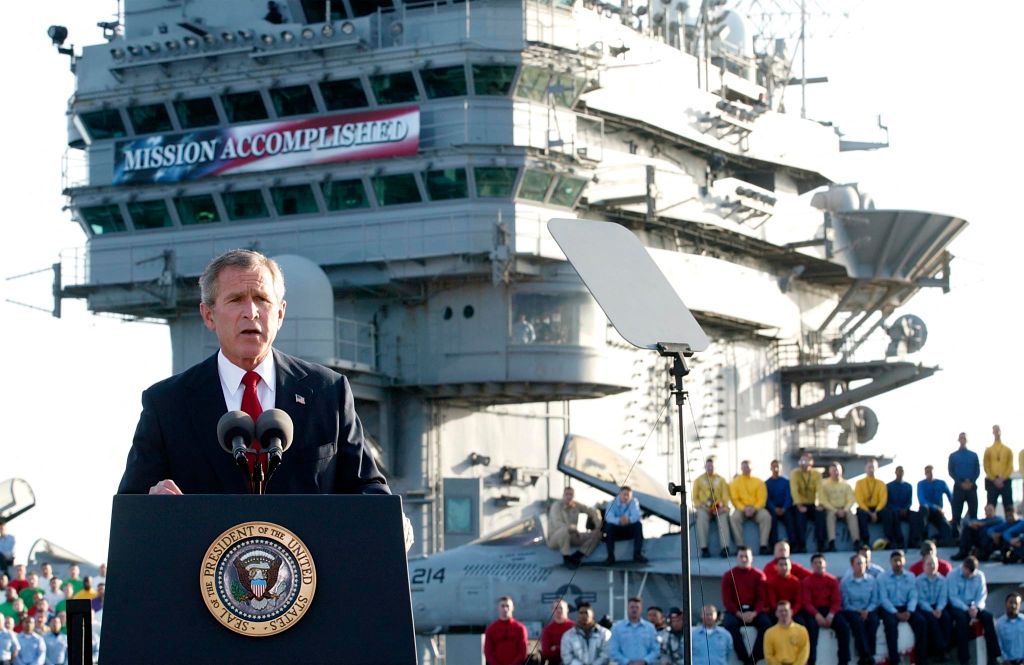
US president George W. Bush gives an address aboard the nuclear aircraft carrier USS Abraham Lincoln on May 1, 2003. Behind him a banner reads “Mission Accomplished.” (Stephen Jaffe / AFP via Getty Images)
In 1989, Francis Fukuyama predicted that the human species had reached “the end of history.” Throughout the world, elites had recognized that liberalism, characterized by political democracy and free markets, was the only ideology capable of addressing humanity’s problems. To Fukuyama, this suggested that eventually, whether it took a year, a decade, or a century, at some point in the future, all of humankind would embrace technocratic liberalism.
It was unclear, though, what the end of history would mean for US foreign policy. Since liberalism’s advent in the era of the French Revolution, the ideology was connected with empire. Throughout the nineteenth and early twentieth centuries, liberalism served as a primary justification of empire, as states from the British to the French to the American insisted that it was right and good to “promote” liberal values at the barrel of a gun. The word “liberal” itself was spread across Europe by Ur-liberal imperialist Napoleon Bonaparte.
The modern American empire was part of this proud tradition. During the Cold War, the United States became the global hegemon, and like previous hegemons, it constantly undertook military interventions abroad. To justify their nation’s wars, US elites claimed that they were defending liberalism against communists who wanted to destroy it.