To Unionize Amazon, Disrupt the Flow
Organizing logistics behemoths like Amazon and Walmart will require the labor movement to figure out how to disrupt the flow of goods across the supply chain rather than simply organizing individual workplaces — and that requires a major rethinking of organizing strategy.
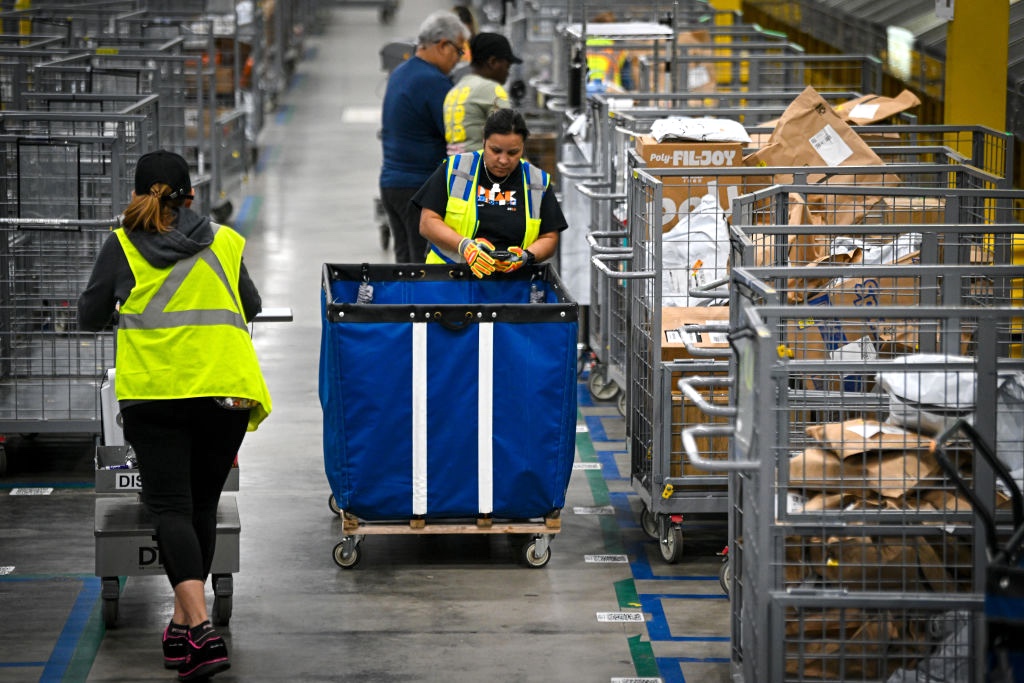
Amazon employees work to fulfill same-day orders at an Amazon fulfillment center on December 2, 2024, in Orlando, Florida. (Miguel J. Rodriguez Carrillo / Getty Images)
In the popular imaginary, Ford’s River Rouge complex has come to represent an industrial age long gone. Completed in 1928, the Rouge complex comprised ninety-three separate buildings in Dearborn, Michigan, occupying about 1.5 square miles in total. About 80,000 workers were employed there at its peak.
In addition to its vast assembly plants, the Rouge complex had its own docks, railroad tracks, electricity plant, and steel mill. All of this was surveilled and guarded by some 8,000 “service men,” the private army of thugs hired by Ford and run by the infamous Harry Bennett. A sprawling manufacturing facility with a mammoth workforce, the Rouge complex embodied everything we supposedly lost with deindustrialization: centralization, vertical integration, manufacturing, workforce, and working-class community concentration.
The Rouge was a particularly gargantuan example of mid-century industrial geography, but similar organizing targets existed around the Northeast and Midwest: Goodyear in Akron, General Motors (GM) in Flint, stockyards in Chicago, steel mills in Pittsburgh, General Electric plants in Schenectady, New York, and Lynn, Massachusetts. These were the key targets in the 1930s, the strategic chokepoints of the industrial society of the period, and in a remarkably short amount of time, between 1937 and 1941, the Congress of Industrial Organizations (CIO) conquered them all. Where that particular spatial dynamic was absent, the CIO either struggled (as in the West) or largely failed (as in the South).