Is There a Way Out of AI Doomerism?
Artificial intelligence poses existential risks, from extreme labor market disruption to security dangers. Managing those risks will mean taking on the concentrated power of the AI industry.
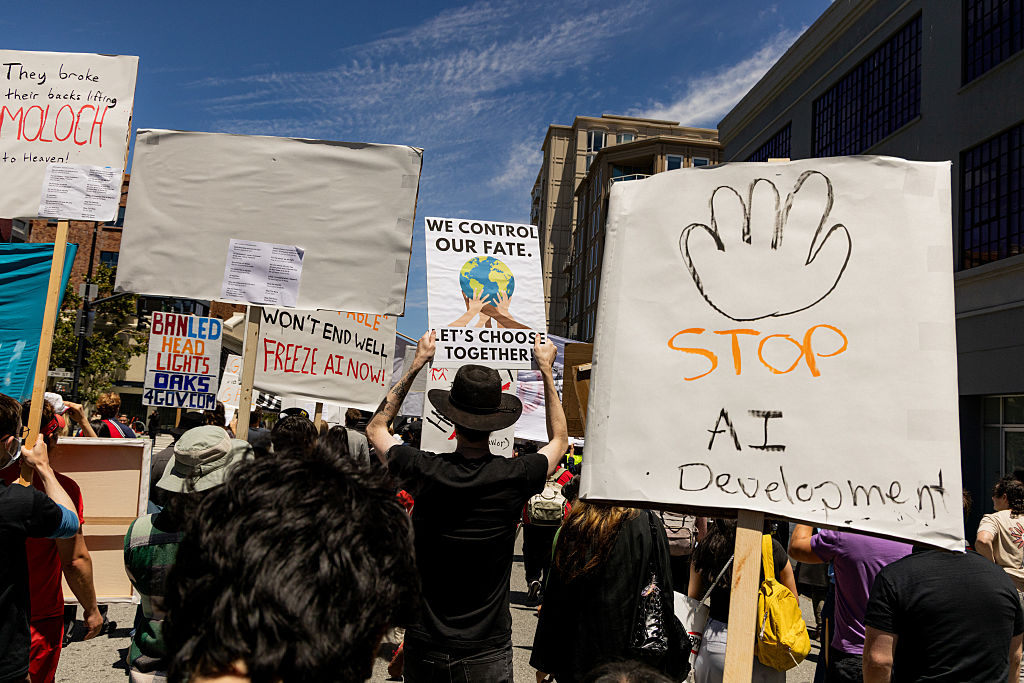
The AI debate is often presented as a choice between utopianism and apocalypse. A new book offers an alternative, but it will require constraining the power of tech to realize. (Jason Henry / Bloomberg)
Not long ago, a close friend of mine, a software engineer, was discussing how his job role had changed in recent months as his company had moved to adopt an “AI-first approach.” He explained that this approach had altered his team’s dynamics. He told me how he now dreads one question more than any other, one that has become a refrain around the office: “Why don’t you just give it to Claude?” ‘It’ is usually a difficult engineering problem to solve, one that has stumped the team for a little while, or longer than a few minutes at least, often during a technical discussion that only a few years ago might have lasted well over an hour. Invariably, he will give the problem to Claude who, invariably, will produce an impressive solution within a few minutes. He doesn’t mind that Claude has provided him with a solution. He minds that those around him no longer understand him as an authority, as they once did. He minds that he now feels more or less fungible. Or perhaps, worse still, obsolete.
The concept of human obsolescence is one that Garrison Lovely takes seriously in his study Obsolete: The AI Industry’s Trillion-Dollar Race to Replace Us — and How to Stop It. Rather than approaching the subject through the eyes of workers on the ground (like other recent books on this topic, perhaps most notably Sarah O’Connor’s We Are Not Machines), Lovely approaches it from above, with a bird’s-eye view, and as a problem of political economy. Obsolescence, redundancy, fungibility: these are political problems for Lovely. And yet those tuned into the noisy and ever-evolving discourse surrounding artificial intelligence know that most of the issues being discussed today do not run neatly along the usual political fault lines. Indeed, as Lovely acknowledges early on in his book, on what other subject do we find Elon Musk siding with the Service Employees International Union against Nancy Pelosi and far-right billionaire Marc Andreessen? Or Steve Bannon agreeing with Barack Obama’s national security advisor, Susan Rice, while openly criticizing Donald Trump’s policies?
Lovely claims there is one matter everyone should be able to agree on, though: the fact that “a tiny group of people, backed by the most well-resourced organizations in the world, is attempting to render us obsolete.” Put like that, you might think the claim sounds tendentious at best (and, at worst, a sign of political paranoia). You might think that most of the artificial intelligence labs would recoil from such a description. But as Lovely is quick to point out, these companies have been remarkably candid about their ambition to do away with human labor.
OpenAI, for instance, informs us in its charter that it has from day one been pursuing Artificial General Intelligence (AGI), which it defines as a “highly autonomous system that outperforms humans at most economically valuable work.” No matter how the company phrases it, its mission to build AGI is precisely an attempt to turn capital into labor and remove one of the last remaining constraints on capital: the dependence on human workers. This leads Lovely to argue that AGI ought to be reframed “not as a new type of brain but rather a new type of machine, one that doesn’t make products or services, but produces labor itself.” He calls this machine “the Obsoleting Machine.”
The first part of Obsolete, “What You’ve Heard,” succinctly catalogs the dominant positions on AI today. Lovely writes that “the roiling debate over AGI has roughly three competing camps: worriers, accelerationists, and critics.” The worriers, who include the AI-safety movement and those often pejoratively described as “doomers,” agree that AGI is possible but believe its development will likely have catastrophic effects on our future. The critics, who include figures such as Emily Bender (who famously cowrote a paper dismissing large language models as “stochastic parrots”), remain deeply skeptical that AGI is even possible (let alone imminent) and tend to dismiss the discourse around it as mere hype. Finally, Lovely speaks of the accelerationists (or “boosters”) who share the worriers’ belief in the technology’s remarkable potential but insist we should build out AGI as rapidly as possible. (Andreessen, for example, has gone on record to make the dubious claim that the longer we wait to build AGI, the more lives we lose that could have been prevented by breakthroughs in medicine.)
The resulting alliances between these groups are often surprising. Critics and worriers, for instance, both want the industry restrained, although often on very different terms and for very different reasons; critics and accelerationists, meanwhile, can find themselves in agreement on the idea that hypothetical existential threats ought not to determine present-day policy and distract us from the here and now.
Lovely devotes a considerable portion of his book to dismantling many of the concerns and arguments put forward by these camps (doing so very successfully in most cases) before proposing a fourth position with which he aligns himself, the “reformer.” AI reformers, he writes, “recognize that AI’s present harms and its potential catastrophes aren’t separate problems requiring separate approaches — they’re symptoms of the same underlying dynamics: competitive pressure, concentrated power, and a staggering lack of accountability.” Here he takes the well-reported examples of chatbots encouraging teenage suicides and the possibility of AGI posing a serious security risk if it were to slip from human control. Both emerge from organizations rushing to deploy systems they don’t fully comprehend.
What might stop us from hurtling into the technological polycrisis Lovely fears? His prescriptions as outlined in the final section (“What to Do”) are commendable, but, geopolitically speaking, a lot would have to change before some of his demands could be met. Perhaps most ambitiously, he wants the United States and China to agree not to develop AI systems “designed to fully automate labour” until there is both public support behind them and broad scientific agreement about their safety. But for anyone who has heard the Trump administration’s repeated pledges to “do whatever it takes” to secure “America’s global AI dominance” and “win the AI race,” the likelihood of this happening might seem almost comically remote. (It’s worth adding that the Biden administration also treated AI as a race to be won against the Chinese.) There are other hopeful and more modest suggestions that might ameliorate the current situation. For example, the idea that we ought to build publicly owned compute infrastructure while establishing collective “data unions” to bargain over material to train the models. But if China was perceived as ramping up its AI operations, is there really a realistic world in which the United States wouldn’t follow suit and thereby abandon these fairer, more democratic ideas?
There are times when Lovely’s book is frustrating to read. The overly unbuttoned style can grate or, worse still, undermine an argument (“neither side wants to create a rogue superintelligence or let any rando kill billions”). There’s occasionally a glibness to the prose (“Altman, like his chatbot, knows what to say to keep the conversation going — and your hands firmly away from the power cord”). And the structure of the book, with its many chapters, which are broken down further into sections and subsections, makes the experience feel like we’re barrelling through a textbook (one with some peculiarly cramped and sometimes unnecessary graphs and charts). And of course, there’s the rather sensationalist subtitle. But these are mostly minor (and editorial) criticisms.
Obsolete does something both useful and challenging. It provides an illuminating snapshot of the current state of the debate on AI while proposing some sensible ideas on how to handle a technology that threatens to cause a lot of harm and entrench even greater inequality across the globe if left unchecked. But it’s unlikely to provide much cheer to those already feeling distant and alienated from their work, as they are asked one more time, “Why don’t you just give it to Claude?”