Socialists Can Lead in the Fight Against AI Data Centers
Americans across the political spectrum are coming together to fight against AI data centers and for solutions like public power. Beholden to big donors, mainstream politicians won’t meet the moment — but the Left can.
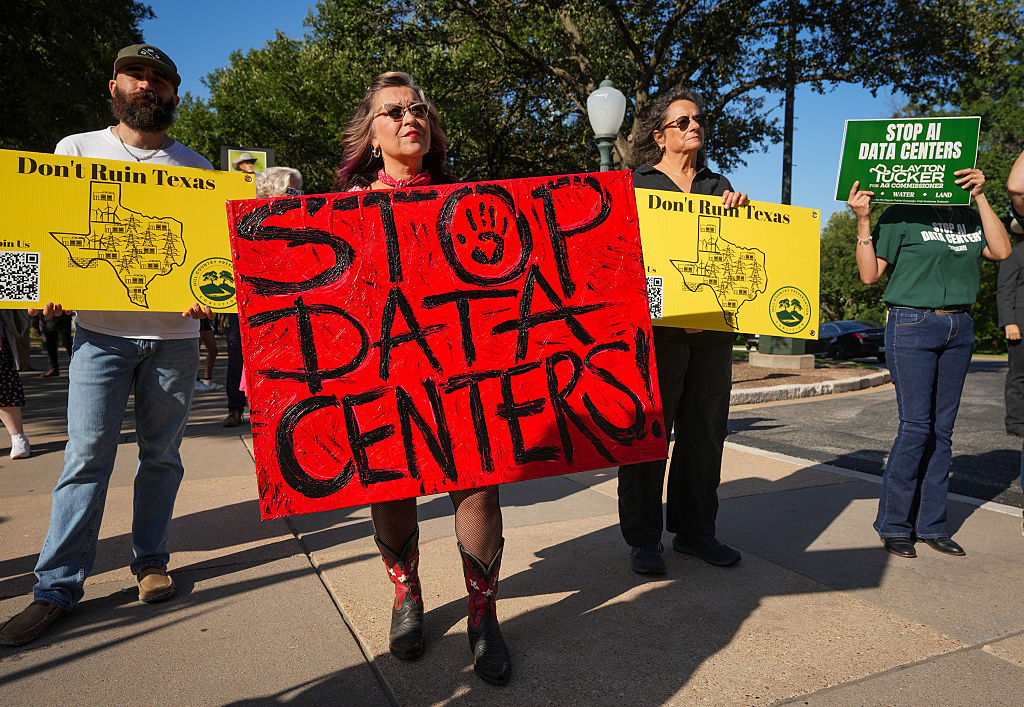
Seven in ten Americans oppose having an AI data center in their own community. But both parties take Big Tech money, and neither is capable of meeting the moment. (Jay Janner / The Austin American-Statesman via Getty Images)
“We really thought we had won,” says Lee Ziesche, a cochair of the Tucson Democratic Socialists of America (DSA) in Arizona, ruefully recalling August 2025. Along with other groups and thousands of community members, DSA had been battling the developer Beale Infrastructure over a massive artificial intelligence data center called Project Blue.
In this desert city, water is precious and also a public utility. (Excessive water usage is a much-criticized aspect of the data center boom.) The developers had said they would not build Project Blue unless the City of Tucson annexed the land; that way, the data center would be served by Tucson water. “There was massive opposition to [the data center] for a lot of reasons,” Ziesche explains, “but the number-one thing is, conserving water is just part of the culture here. Everyone learns about it in school.” Moreover, Ziesche says, “It reached 100 degrees here last March, so we are obviously very aware of the climate crisis.”
“I’ve seen a lot of opposition to major infrastructure projects,” says Ziesche, who also fought pipelines in New York City, “and I have never seen anything like the resistance [to Project Blue] in Tucson. It’s pretty dead here in the summer; the snowbirds leave, and it’s really hot.” But that summer, a thousand people showed up to a public meeting. The city council decided unanimously not to annex the land for the data center, which meant the city wouldn’t be providing the water. A win!
The massive opposition prevailed in the arena of democratic decision-making: the municipality. But that turned out not to be the decisive arena. In an about-face, the developer decided to proceed with Project Blue anyway, using air instead of water as a coolant. That’s a big shift — and one entirely due to the resistance — but it doesn’t resolve the residents’ concerns. With weather that hot and a data center driving up already sky-high electric bills for households, Ziesche says, “It’s going to be impossible to survive.”
“These tech billionaires, as we’ve always known about capitalists,” says Ziesche, “are willing to sacrifice entire communities to make a profit.” Even worse, the defeat showed the fragility of the city’s democratic institutions: the people, united, can easily be defeated when they don’t have the final say.
Construction crews have broken ground on Project Blue. Protests continue, but it appears to be a defeat. Nevertheless, Ziesche says that Tucson socialists are taking the lesson about the community’s investment in energy and infrastructure issues and moving forward with a new campaign demanding public power. The data center fight, says Ziesche, “has really broadened the base of people who believe in public power and potentially socialist solutions.”
Seven in ten Americans oppose the construction of a large AI data center in their own community. In fact, there are few issues that unite Americans across the political spectrum like this one does. Even among Republicans, more say that new data center construction is bad than good. Yet most mainstream politicians, Democratic and Republican alike, are failing to meet the moment.
That leaves socialists, who are unbeholden to large donors with vested interests in the AI boom, in a unique position. Democratic socialists are better positioned than either major party to stand up to oligarchy, a twenty-first-century American gangrene that every data center fight seems to reveal anew.
Data Centers Are a Class Issue
There are good reasons for the popular opposition to data centers: most of all anger over corporate greed and a sense of popular helplessness at being left out of important decisions at the local level. Both Republicans and Democrats are funded by Big Tech, the fossil fuel industry, and the superrich, while socialists argue that these corporations and billionaires need to get out of politics and ideally not even exist.
In recent primaries, where data centers have become an issue, democratic socialists have won or come close. In Michigan, where the state has given data centers incentives to build and the energy they demand is being used to exploit loopholes in the state’s clean energy laws and build new fossil fuel infrastructure, Detroit’s Chris Gilmer-Hill won his state house primary. Gilmer-Hill is an environmental justice activist and made data centers a central issue.
He wasn’t alone: in a state where the issue has been raging, other anti-data-center socialists and progressives won big, with congressional primary victories by Will Lawrence and Donavan McKinney, not to mention Senate nominee Abdul El-Sayed. In Denver, democratic socialist Melat Kiros won her congressional primary in June, also calling for a moratorium on data centers. And while Francesca Hong did not prevail in her recent gubernatorial primary in Wisconsin, the data center issue certainly helped make her a strong contender in what turned out to be a painfully close loss.
The reasons people hate data centers — and generative AI in its current, extractive, billionaire-piloted form — are deeply aligned with democratic socialists’ broader political agenda. Sarahana Shrestha, a democratic socialist assemblymember in New York’s Hudson Valley fighting for a state moratorium on new data centers, says that the data center fight is less about Terminator-style scenarios where AI turns against us and really about grounded, immediate issues like affordability and inequality. While rural New Yorkers are struggling with the rising costs of electricity and threats to the grid, data centers will drive up their energy costs.
Data centers get ridiculous special treatment in the form of lavish tax subsidies, which is in itself a broad class issue. Plus, says Gilmer-Hill, “Even if we were to make data centers pay their fair share, pay the same rate as everybody else, you’re still not capturing the fact that they’re making it more expensive for everybody.”
Data centers also delay the needed transition to renewables by requiring more fossil fuels, worsening the climate crisis. Indeed, the energy needs of data centers are being used by fossil fuel companies to justify more oil and gas infrastructure — even in the face of record heat, storms, and wildfire pollution connected to the climate crisis. In Tucson, for example, the utility companies claim they need gas generation to power these data centers and are pushing a multimillion-dollar pipeline.
People are “understanding that the data centers aren’t really to serve us,” says Ziesche. As Gilmer-Hill points out, in the best-case scenario data centers create very few jobs, and in the worst, they may put many Americans out of work. Although President Donald Trump said last week — with the characteristic charming respect that he always shows to his rural voters — that communities resisting data centers were choosing to be “backwards and poor,” the truth is the economic benefits are greatly exaggerated. As Shrestha says about the promises tech billionaires are making to communities, “It’s not just the machines that are hallucinating.”
Fight Data Centers, Save Democracy
Beyond the specific threats posed by data centers, nationwide fights against them are awakening people to their disempowerment in the face of billionaires’ wishes — that is, the weakness of their democratic institutions. “We really are recognizing how important it is to be able to make those decisions for ourselves as a community,” says Ziesche, “and not have these massive projects shoved on us by Big Tech.”
Democratic socialists are deeply committed to expanding democratic control and ownership, which makes them well-positioned to speak to this anger and channel it toward political solutions. “What socialists are fighting for is public goods for the public,” Shrestha says, and these fights build the case for publicly owned and controlled energy.
In Tucson, DSA already had a public power campaign underway, but the data center defeat greatly strengthened it by highlighting the need for energy to be controlled by the people of Tucson, just as water is already. Now, Ziesche says, socialists are making the data center fight into a referendum on the private utility. After the outrage of Project Blue, she says, “I’m seeing many people who are definitely not socialists supporting our public power campaign.”
In New York state, DSA and its elected officials — including Shrestha and State Senator Kristen Gonzalez — are pushing for a statewide moratorium on new data center construction. In a compromise, Governor Kathy Hochul issued an executive order establishing a watered-down version, which pauses new construction for one year. Socialists in New York State are further along in the fight for publicly owned renewable energy, having passed the Build Public Renewables Act in 2023 (although implementation of that law remains an ongoing struggle). But in the Hudson Valley, as in Tucson, one of the next big campaigns is to socialize the electric utility, as many small towns and cities in America already do.
Gonzalez is also working on legislation to end tax subsidies to data centers. In Rockland County alone, state and local agencies have committed at least $321 million in power and tax subsidies to data centers. In a recent executive order, Hochul expressed an intention to work with the legislature to end such subsidies. But that intention has not yet become law, and given her record on climate and her history of coziness with polluters, there’s ample reason to believe it will take a big fight to make it so. If it weren’t for socialist legislators like Gonzalez, ending subsidies for data centers wouldn’t even be part of the Democratic policy conversation.
At the grassroots, it’s rare that we as Americans agree on something so fervently. Looking at the polling, as well as the thousands of people across the political spectrum thronging public meetings, talking to their neighbors, and signing petitions for public power, it seems clear that mainstream Democrats and Republicans would be electorally wise to become socialists at least on this one issue.
Shrestha reflects that in Wisconsin, Francesca Hong’s opponent, a Democrat who opposed a statewide moratorium, might now lose the governorship to a Republican. “Even from just a purely political point of view,” she says, Democratic support for data centers “seems so reckless. If the Democratic Party is even remotely interested in fighting the climate crisis, in making democracy functional, in winning elections, they need to take a hard stance against these data centers.”
But even absent the participation of mainstream Democrats, the democratic socialist movement will likely continue to lead on this issue. “Everyday people are waking up to how this system has been rigged against us,” says Gonzalez. She adds that if socialists can “model good governance on this issue, I think we can prove that our positive vision for the future, for working people, is popular.”