Centrists Are Still Defending California Billionaires
California Democrats just defied Gavin Newsom to endorse a billionaire wealth tax. The fight previews a national battle in which centrists push “pragmatic” alternatives that would barely make a dent in ultra-elites’ wealth or power.
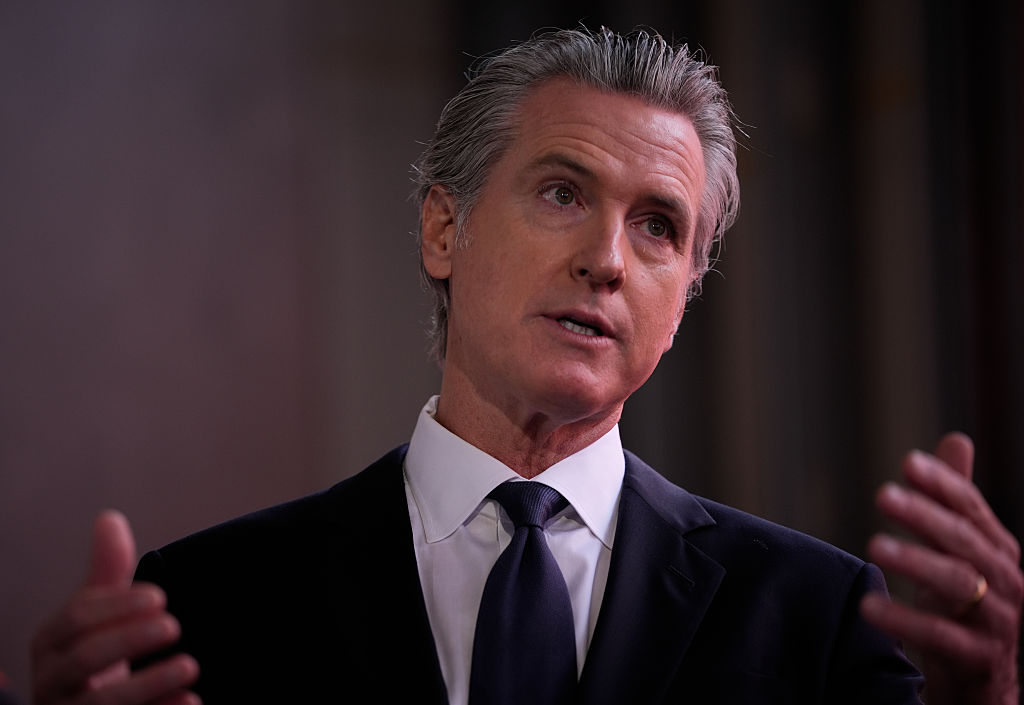
Gavin Newsom fought to kill California’s billionaire wealth tax, despite branding himself as a populist. His alternative proposals would barely touch billionaire fortunes — a preview of how centrist Democrats will dodge the tax fight ahead of 2028. (Tayfun Coskun / Anadolu via Getty Images)
When California Democrats met last week for the party’s executive board meeting, the question on everyone’s mind was whether they would back Proposition 40, the onetime billionaire wealth tax that has split the party in recent months. With some of the most powerful Democrats in the state opposing the measure — including Gov. Gavin Newsom and his likely successor, Xavier Becerra — it was far from certain whether the board would support it. When it came to the floor for a vote, it fell just short of the 60 percent threshold required for endorsement. It was only after a second vote, along with a decisive show of support from veteran Rep. Maxine Waters, that the board narrowly endorsed the measure with 61.7 percent backing.
The party’s endorsement gave Prop 40 a much-needed boost in the face of a billionaire-backed opposition that has already raised nearly $120 million and recently launched an $87 million ad blitz. It also defied the wishes of top California Democrats and underscored a widening rift between the party’s centrist leadership and its rank-and-file members. By endorsing the measure, the California Democratic Party aligned itself with the party’s base, which overwhelmingly backs the proposal in the polls.
“Individual Democratic leaders may or may not have their own opinions but Voting Yes on Prop 40 is the official Democratic Party position,” said Will Rodriguez-Kennedy, chair of the San Diego County Democratic Party. This vote, he added, “indicates that the Democratic Party will take on the most powerful people out there to save Californian lives from the cruel healthcare cuts enacted by the Trump administration.”
The endorsement of the billionaire wealth tax marks the latest sign of populism’s growing force inside the Democratic Party, which even the most vocal opponents of the proposal now seem to recognize. Governor Newsom, who mounted a sustained effort to kill the initiative before it got on the ballot, has since sought to qualify his stance ahead of a likely presidential campaign, framing his opposition as a disagreement over how to tax the ultrarich.
In a video and Substack post published the day after the wealth tax officially made it onto the state’s ballot in late June, the outgoing California governor reiterated his opposition, criticizing the proposal’s spending priorities and warning that billionaires would flee the state if it passed. At the same time, Newsom insisted that he supports reining in the billionaire class, but that it must be done at the federal level. The “fight against concentrated wealth is a national fight,” declared the governor, before laying out an alternative set of proposals under the banner of a “national billionaires’ tax.”
Contrary to some reporting in the press, Newsom did not propose a national wealth tax, which progressives also support. Instead, he offered a set of reforms aimed at closing loopholes in the tax code, raising the top rates on current taxes, and creating what he calls a “minimum tax on billionaires.” Importantly, these proposals would not target wealth but income, thus capturing only a fraction of the annual gains that make up billionaires’ true earnings. As tax expert Gabriel Zucman, who helped craft the California wealth tax, observed in a post on X, Newsom’s proposals would “do almost nothing to curb the explosion of the wealth and power of America’s oligarchs.”
The “Pragmatic Populist” Playbook
The dispute over the billionaire wealth tax in California foreshadows a broader debate that Democrats will have in the years ahead. As pressure mounts to tax America’s oligarchs, bold proposals like the wealth tax will likely continue to grow in popularity. This presents a conundrum for the party’s centrists, especially those with higher political ambitions. Newsom’s effort to repackage himself as a kind of pragmatic populist ahead of a likely presidential run offers a preview of how establishment Democrats will attempt to appease the party’s increasingly populist base without alienating the big donors who still finance their campaigns.
If the debate in California is any guide, centrist Democrats will frame their opposition to proposals like the wealth tax in strictly pragmatic terms, focusing on unintended economic consequences or the institutional challenges of enacting such policies. In the Golden State, Newsom and other Democratic critics have mostly argued that the proposal would drive wealthy residents out of the state and thus erode its tax base and long-term revenue. Nationally, the “pragmatic” critique will likely center on the constitutional challenges that a federal wealth tax would inevitably face.
These criticisms are not entirely groundless. It is true, for example, that a state wealth tax would be difficult to administer and that the wealthy are highly mobile, especially at the state level. While narratives about wealthy residents fleeing states due to high taxes are greatly exaggerated — often built on anecdotes rather than hard data, which shows relatively little tax-related migration — the California wealth tax lacks any real historical precedent. Though structured as a onetime retroactive tax to curb avoidance and limit economic fallout, it’s not unreasonable to assume that some of the state’s wealthiest residents will leave if the measure passes (whether that’s such a bad thing is a different question).
While a national wealth tax would be far more difficult for the wealthy to escape by simply packing up and moving, it faces its own serious obstacles. Indeed, a straightforward tax on wealth would almost certainly be struck down by today’s Supreme Court, where conservative justices have indicated they would rule against any “direct tax” that isn’t narrowly construed as an income tax.
These challenges are real and shouldn’t be casually dismissed by wealth tax proponents. At the same time, the ostensibly more “practical” alternatives sold by centrists like Newsom would do little to confront the very problems that proposals like a wealth tax are designed to remedy, from extreme inequality and outsize billionaire power to persistent tax avoidance at the top.
Take the proposal to eliminate the “buy, borrow, die” loophole, which first gained notoriety in 2021 when a ProPublica report revealed how some of the country’s wealthiest men routinely avoided taxable income by taking out low-interest loans backed by their assets. While simply taxing wealth or unrealized gains would automatically render this strategy obsolete, centrist Democrats have rallied around a more technocratic fix that would avoid dramatic changes to the current tax code. The most popular proposal is to simply tax loans as if they were capital gains. In June, another presidential hopeful aiming to occupy the “pragmatic populist” lane, Arizona senator Ruben Gallego, introduced a bill that would treat such loans as “realization events” for those with assets over $1 billion. In theory, this would eliminate the tax incentive to take out loans in the first place.
There are a few issues with this approach. For one, it’s unclear how much better it would actually fare in the courts. According to Brian Galle, a professor of tax law at Berkeley, proposals to tax borrowing would “face constitutional challenges that are not especially different from those facing wealth taxes more generally.” Though Galle argues that it would be constitutional “on the best reading of the existing law,” this wouldn’t prevent the Supreme Court from trying “very hard to find ways to strike it down.”
The bigger problem is that a tax on loans simply wouldn’t raise much revenue from billionaires. Recent research has found that annual borrowing from the wealthiest American households represents just a fraction of their total income when untaxed (i.e., unrealized) earnings are included. “[It] turns out that when you are super-rich you already have enough cash flow to fund most of your private jet and megayacht purchases, even if that is a tiny share of your overall wealth,” noted Galle.
In practical terms, this means that eliminating the loophole would hardly touch the real income of the ultrarich. In a column, Rep. Ro Khanna claimed that a tax on loans would generate just one forty-fourth of what his and Bernie Sanders’s proposed 5 percent wealth tax on billionaires would raise.
Taxing Wealth Without Calling It That
If centrist proposals fail because they don’t target the true source of billionaire wealth and power, progressive plans like Sanders and Khanna’s national wealth tax would likely fail for the opposite reason: they target it so directly that the conservative majority on the Supreme Court would rule it unconstitutional.
A truly pragmatic approach would avoid the legal pitfalls of a direct wealth tax while still finding a way to tax the wealth of the ultrarich. For a time, taxing unrealized gains was seen as a somewhat more viable option, since it could be plausibly framed as an income tax. That idea sat at the heart of the Biden administration’s “billionaire minimum income tax,” which applied to households with more than $100 million in assets. Since then, the constitutional prospects of this approach have also dimmed considerably. Galle, who helped craft the Biden proposal, noted that it was developed before a Supreme Court ruling in 2024 where conservative justices signaled they would deem a tax on unrealized gains unconstitutional as well.
In a monograph published earlier this year, Galle outlined a new plan that he argues could sidestep these constitutional hurdles while still meaningfully taxing the ultrarich. Galle’s framework, the Fair Share Tax (FAST), offers a sophisticated work-around to the Supreme Court’s strict interpretation of the “realization rule,” under which only realized gains qualify as taxable income. Rather than taxing wealth or unrealized gains, FAST would tax gains only at realization but impose an additional interest charge equal to the asset’s annual return, making it far more expensive to hold assets indefinitely. As Galle explained to me, FAST would “tax investment assets when they are sold, but [also] adjust the tax rate that individuals pay so that after paying the tax they are left with the same amount they would have held if they had been taxed annually.”
In his telling, this would generate the “revenue and economic effects of a wealth-type tax with the administrative ease and constitutional compatibility of a traditional income tax.”
Under the current tax code, any investment gains that aren’t officially realized during the owner’s life are effectively wiped out at death for tax purposes, leaving heirs with a mostly tax-free inheritance (hence the final step of the “buy, borrow, die” strategy). To eliminate this loophole, known as the “step-up basis” rule, tax experts have suggested treating death itself as a realization event. This could be paired with the replacement of the estate tax with an inheritance tax to be paid by heirs. Galle’s plan would eliminate the step-up basis loophole and pass all the gains made during the life of the investment onto the inheritors, accumulating even more interest over time. He also proposes an additional tax on heirs when they sell their inherited property that would kick in at $15 million in property gains.
Ahead of the 2028 election, a real debate is needed on how to tax the top 0.1 percent in a way that is both effective and workable. With a judicial branch openly hostile to such efforts, the more creative solutions there are on the table, the better. But despite recent proclamations about the dangers of concentrated wealth and spiraling inequality, centrist Democrats like Newsom seem largely committed to symbolic gestures that would do little to curb the power or fortunes of the billionaire class. It falls to the Left to articulate a genuinely pragmatic brand of populism instead.