His Rivals Wrote Him Off, but Jean-Luc Mélenchon Is Back

Critics of French left-winger Jean-Luc Mélenchon have repeatedly claimed that he’s finished. But as he launches his latest presidential campaign, his popularity among working-class and minority voters is again making him a real contender.
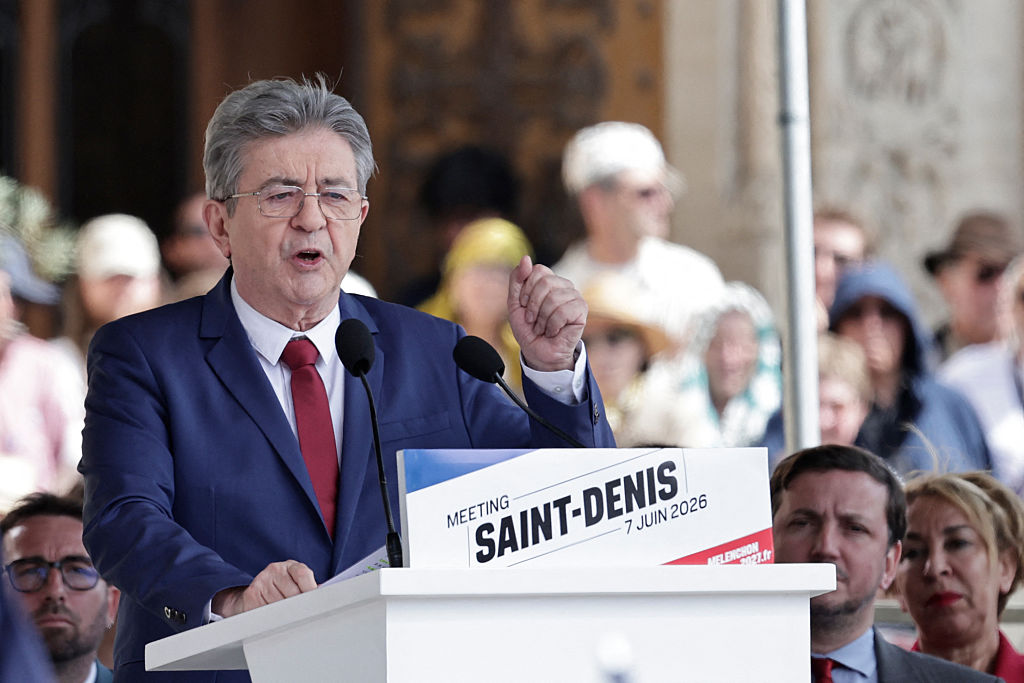
Jean-Luc Mélenchon speaks at a rally in the northern suburb of Paris, Saint-Denis.

On Sunday, 26,000 people came to see Jean-Luc Mélenchon launch his 2027 presidential bid. While liberal pundits call Mélenchon unelectable, their proposals for another left-wing candidate offer a milquetoast progressivism that inspires few voters. (Stéphane de Sakutin / AFP via Getty Images)


“Ladies and gentlemen, comrades, I give you your candidate for the 2027 presidential election, Jean-Luc Mélenchon!”

This past Sunday, tens of thousands of people filled the streets of Saint-Denis in Paris’s northern suburbs. Despite the sun beating down, they’d come to watch left-winger Mélenchon launch his campaign.

It was a powerful demonstration of the electoral war machine that Mélenchon has been building ever since his first run in 2012. Back then, he’d quit the Parti Socialiste to strike out on the Left. That year, the Parti Socialiste’s François Hollande took the presidency, but his former party colleague Mélenchon won 11 percent of the vote. Today the power balance has changed. In 2022, the Parti Socialiste couldn’t even win 2 percent support.

The reason: Hollande’s dismal presidency lasted just one term, and in 2016 his young Economy Minister Emmanuel Macron quit the Parti Socialiste to make his own successful bid for power, fracturing the political landscape. Over the past decade, while Macron has eroded the country’s social system from the center right, Mélenchon’s France Insoumise has slowly but surely come to dominate France’s left. In the first round in 2022, Mélenchon won 22 percent support, just four hundred thousand votes short of making the runoff. He hopes that in 2027, he’ll finally do it.

In recent years, there were many calls for unity on the French left. In both 2022 and 2024, alliances of left-wing parties performed creditably in parliamentary elections, denying majorities to either Macron or Marine Le Pen’s far-right Rassemblement National. However, this unity has always been fragile. Ahead of the 2027 presidential contest, it looks like Mélenchon is going it alone.

Your Candidate, Not Theirs

Over the last five years, the non-Mélenchon left has increasingly marked its distance from his presidential ambitions, as well as his politics. Initially rosy sentiments toward him after 2022 soon evaporated as it became clear that he wasn’t retiring to serve as a wise elder statesman, but wanted to stay involved.

The reasons for the break are varied but come down to real ideological disagreements and strategic differences. Mélenchon’s France Insoumise calls itself a Left of “rupture”: a break with the established order, with the government, and with capitalism and imperialism. The rest of the Left — including the majority factions of the Greens, the Parti Communiste Français (PCF), and social-liberal groupings like would-be candidate Raphaël Glucksmann’s Place Publique — presents itself as a governmental force: experienced, responsible, and capable of being trusted by France’s ruling class and international markets.

Still, one principal reason has been France Insoumise’s and Mélenchon’s firm stance against Israel during the genocide in Gaza. Media controversies on the subject have been multifarious, and include endless phony charges of antisemitism against Mélenchon.

“I dedicate this meeting to the undefeated Palestinian people,” Mélenchon said in a typical display at the start of Sunday’s speech: the Palestinians are “martyrs of an invasion and a genocide.” Such unequivocal support for Palestine isn’t to the taste of France’s center left. Instead, potential candidacies offering to represent a more respectable left have multiplied. Each wannabe contender claims to have the unique traits needed to dethrone Mélenchon in the first round then fend off the Rassemblement National in the second.

“He Just Can’t Win”

All these candidacies are justified by the conventional wisdom that Mélenchon’s fourth presidential bid is already dead in the water. The reasons — go the standard arguments — are the sky-high rejection of Mélenchon among the electorate, and the concomitant rise of the far-right Rassemblement National.

In the 2017 presidential race, when Mélenchon scored almost 20 percent, he was frequently forecast to crush Le Pen if they ever faced a runoff. Near the end of that campaign, Mélenchon’s popularity peaked: 68 percent of France had a favorable opinion of him.

Today, a series of splashy polls instead show Le Pen ally and Rassemblement National Party President Jordan Bardella steamrolling Mélenchon 70–30 percent in the runoff — or worse. Numbers like these have Mélenchon’s opponents from all quarters picking out headstones.

On the non-Mélenchon left, the battle cry is more dire. Putting Mélenchon into the 2027 runoff, they say, will lead automatically to a far-right presidency. Mélenchon’s rejection rating has now shot up to a seemingly calamitous 72 percent. Maybe they are even more concerned that none of these polls show any left-wing candidate except Mélenchon having any shot at reaching the runoff.

Key to the election dynamic is who people say they won’t vote for. Opinion polling shows many voters in the Macronite center saying they will refuse to back Mélenchon against the far-right candidate, whether that means Bardella or Le Pen (currently barred from running, pending a legal appeal). Left-wing voters also say they won’t vote for center or center-right candidates in a runoff. Gabriel Attal and Édouard Philippe, both Macron-era prime ministers, also lose head-to-heads with the Rassemblement National candidate. Attal’s numbers hardly look much better than Mélenchon’s.

It’s true that Mélenchon hovers near the bottom of the list of most-liked French politicians. But hardly any French politician is broadly admired.

Outside of Mélenchon, Bardella, and Le Pen, in fact, all other current potential second-round candidates were prime ministers for Macron. The scuttlebutt is that another former Macron-era premier, Jean Castex, may also join the race if he sees an opportunity. Castex is one of Macron’s few former allies who remains on good terms with the president, and Macron sees him as an ideal and pliable successor.

Prospects for replacing Mélenchon on the Left don’t look so strong, either.

“Send Jean-Luc Mélenchon to the second round, and you guarantee Jordan Bardella’s victory,” says Glucksmann, a consummate Atlanticist and EU-phile. He polls the best of Mélenchon’s rivals, in no small part because he pulls votes from the Macronite center. But put him into the second round and he also falls short. In a head-to-head with Bardella, he only takes 42 percent. That’s partly because he’s unwilling to pick a clear lane — is he a center-left candidate picking up the mantle Macron ran with in 2017, or is he a left-winger acceptable to the center? Either way, in an increasingly reactionary France, much of the conservative vote goes against him. His favorability numbers are hardly much stronger than Mélenchon’s.

In fact, even France’s top-rated politician, Bardella, only scrapes up 35 percent approval. It’s true that Mélenchon hovers near the bottom of the list of most-liked French politicians. But hardly any French politician is broadly admired.

Glucksmann (like Mélenchon) has rejected calls for a primary to pick a single presidential candidate for the Left, though he hasn’t officially announced his own bid, yet. Still, he has a good picture of who his electorate is, and knows that fundamentally it isn’t compatible with Mélenchon’s, given the latter’s broad support among younger and poorer voters from impoverished cities and suburbs. An internal report recently leaked from Glucksmann’s camp identified lower-income voters as “harder to mobilize” and concluded that they should “be avoided for now.”

Those who continue to call for a primary (including figures like the Parti Socialiste’s parliamentary leader Boris Vallaud, or the Greens’ president Marine Tondelier) increasingly fall upon deaf ears.

“The primary is finished,” Mélenchon insisted, as he looked out over the massive crowd in Saint-Denis on Sunday. “We’ve won the honor to march on the front line against the Rassemblement National.”

Will they be able to win that battle? A lot has changed in a decade. Where once a solid 60 percent of France would likely vote against the Rassemblement National come what may, now it seems that figure is closer to 40 percent. Still, the current dire polling probably doesn’t reflect what will happen on voting day. In matchups where Mélenchon runs against the far right, two-thirds of centrist voters currently say they’ll abstain. The same is true in reverse when left-wingers are asked about backing centrists. But will they really refuse to pick? That’s doubtful. It seems more like they are being coy now, in an attempt to influence who the second-round candidate will be.

A Team Built to Win

Still, parsing polls and trailing surveys isn’t the same thing as doing politics.

“Reality isn’t the only thing the world is made of,” Mélenchon said to close his speech, quoting the late philosopher Edgar Morin. “It’s our works, our desires, our will.”

This was like many other Mélenchon speeches — full of verbal pyrotechnics and a complete command of the crowd. Mélenchon roused the square to laugh at his enemies and thrill at the poetry of his oratory. The sheer scale was impressive. Mélenchon has a powerful voice even in a small room without amplification. The audio technicians pulled off a neat trick, booming him a little louder than the speakers who preceded him (including author Annie Ernaux, who told the appreciative crowd that her parents would be just as proud of her being here as for winning the Nobel Prize for Literature back in 2022). Mélenchon’s voice echoed off the buildings in the square and the basilica behind him. Under renovation, and with scaffolding framing its left side, the off-white gothic cathedral represents a millennium of French history, as well as the construction of a new future: an impressive backdrop for the candidate.

“We believe in the intelligence of the French people,” Mélenchon thundered. “We don’t believe that our country is racist. We don’t believe that our country is fascist.”

Saint-Denis mayor Bally Bagayoko, a France Insoumise candidate elected in March’s local elections, opened the rally with a similar slogan. “Saint-Denis is an anti-fascist city,” he declared, calling it not only a symbol, but “proof that our France exists.”

No matter how hard the non-Mélenchon left tries to cook up a viable alternative, he is the political leader of the day for a solid core of supporters.

“Ever since I started talking about the ‘New France,’ I incensed those who are obsessed by race,” Mélenchon later explained on this same theme. He denounced Bardella’s call to end birthright citizenship in France. “We don’t renounce, Mr and Mrs Fascist, the sacrifice of our grandparents who came here. . . . this is our home!”

Bagayoko also called on voters to “join together beyond the normal coalitions” — a nod to the fact that his own local success had been the fruit of a rare alliance between the Parti Communiste Français and France Insoumise.

Over the weekend, the PCF was holding its own fortieth party congress. There, it adopted a strategy of business as usual and continuity in its leadership, despite falling support for the current approach. PCF secretary Fabien Roussel is reportedly maneuvering for another presidential run, much to the chagrin of those on the Left who blame his 2022 election bid (scoring 2.5 percent) for taking votes from Mélenchon and denying him a shot at the runoff.

Stéphane Peu, a PCF deputy who represents a section of Saint-Denis and has appeared frequently at France Insoumise events, met with Mélenchon before Sunday’s rally. He posted smiling pictures, addressing him with “republican greetings.” On Tuesday, Peu told reporters that he “didn’t think it would be a good idea for the PCF to run a candidate.”

Candidate of the Left

How do you tell how real a campaign’s proclaimed “dynamic,” or “momentum” actually is?

Mélenchon’s speech was impressive. There were his declarations of solidarity with Iranians and Cubans resisting invasion, his warnings against a war economy and all-out conflict, his forceful declarations that “life is stronger than the fear of the other,” and his insistence that budget cuts increase crime and that “effective security in France will come from a radical change in our methods.” Does that mean people will vote for him at the end of the day?

Who can say?

Maël, a thirty-six-year-old who told me that he’d been voting for Mélenchon ever since he had the right to, said he didn’t see any other option. “I don’t always agree with him on everything 100 percent — but he’s the closest to my values.”

And Otmane, who moved to France from Morocco in 2019, says that in his home country Mélenchon is seen as a symbol of the global left. When Otmane arrived in France, it was only logical to support him. “Never the Socialists or Communists?” I asked. “Ehh . . . not really.” “So, you’re more France Insoumise?”

“But it isn’t even France Insoumise,” he lit up. “It’s Mélenchon.” For a lot of people on the French left, the story ends there. No matter how hard the non-Mélenchon left tries to cook up a viable alternative, he is the political leader of the day for a solid core of supporters.

In a critical opinion piece on Monday, the social democratic journalist Laurent Joffrin may just have summed up the reason why. “Mélenchon’s project is coherent,” we are warned, “but radically different from the rest of the Left.”