How Marine Le Pen Seduced Corporate France
Emmanuel Macron has been a president for the rich, but his faltering support has also left big business unsure if it can rely on his party. For many French capitalists, the answer is to build up ties with Marine Le Pen’s far-right Rassemblement National.
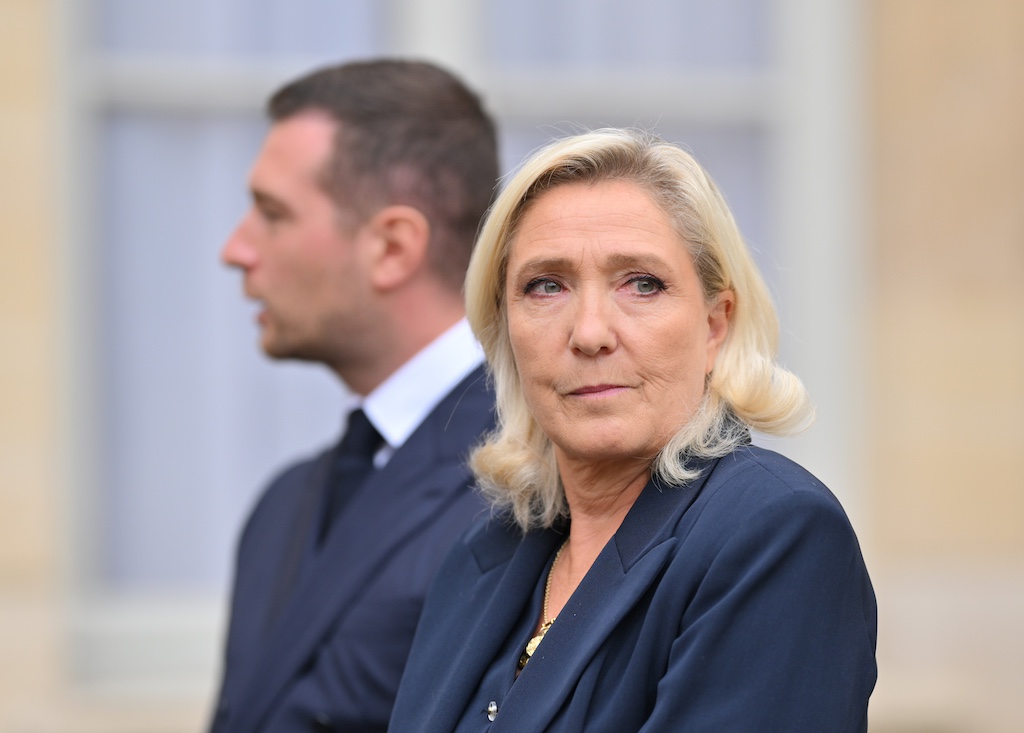
Key corporate leaders in France are coming to terms with the idea that Marine Le Pen, or another candidate from her Rassemblement National, could soon come to power. (Mustafa Yalcin / Anadolu via Getty Images)
In 2024, the blue-chip companies on France’s CAC 40 stock index issued a record-breaking €98.2 billion in dividends. Thanks to rising real estate valuations, France ranks third in the total number of dollar-millionaires, after the United States and China. Depending on the ticker price for luxury groups like LVMH or Hermès, the country can also claim to lead Europe in terms of aggregate billionaire wealth.
All this in a country that the business pages often deride as the sick man of Europe. Perhaps not in recent memory has there been a better time to be rich than in Emmanuel Macron’s France, where corporations and shareholders have won several major victories since his first election as president in 2017.
Yet not all is rosy for French capital. When Macron called snap parliamentary elections in June 2024, it was a blow to his own political allies, who won under one-third of seats in a divided National Assembly. More than that, he left France’s business lobby without a reliable political home, as it pines for major cuts to public spending and welfare. Eighteen months ahead of the 2027 presidential elections, it’s unclear if anyone in the centrist and conservative establishment can provide a revamped offering. To avoid another dissolution of parliament, the president’s allies seem ready to agree to modest concessions like light tax increases and a suspension of their hard-fought 2023 increase in the pension age.
In politics, too, it’s important to hedge bets. Frustrated by the fraying discipline in Macron’s camp, and wary of the lingering left-wing threat, key corporate leaders are coming to terms with the idea that Marine Le Pen, or another candidate from her Rassemblement National, could soon come to power. It’s a focus of rising speculation in France — and a new book by journalist Laurent Mauduit, Collaborations, which chronicles the ongoing rapprochement between the far right and big business.
This convergence is diverse and, in some cases, half-hearted. A small business owner up in arms over payroll charges or costly electricity bills has only so much in common with a board member of a multinational cosmetics firm. There are the genuine ideologues, old and new. The conservative from well-heeled western Paris, long intoxicated by the melodrama of French decline, is today giving way to the tech millionaire’s slavish fascination for Silicon Valley–style authoritarianism. Others would simply prefer someone of Le Pen’s ilk over a left-wing alternative — even if a recent embezzlement conviction has formally barred three-time presidential candidate Le Pen from running in 2027, pending an appeal slated for next year.
Yet the trajectory is clear. Mauduit writes that “for the first time since Vichy, the dominant mood in French business circles is that it’s once again possible to collaborate with [the far right].” By “collaboration,” one of the most charged terms in the French political lexicon, Mauduit hopes to draw a parallel not only with the most “extreme forms of cooperation with an authoritarian power,” but with the “support, habituation and convergence” that encompassed an entire swath of the French elite. Not afraid of mincing words, Mauduit argues that “with only a few exceptions, the biggest bosses are now completely indifferent to the question of democracy.”
“Dishonor and Ruin”
An economics reporter for Mediapart, Mauduit begins his story in the crack-up of June 2024. Minutes after the Rassemblement National won first place in France’s elections for the European Parliament, Macron announced the dissolution of the National Assembly. The snap parliamentary elections that followed seemed to offer an open path to power for the far-right force. When the Rassemblement National’s prime-ministerial hopeful Jordan Bardella, who is also the official party president, rolled out its platform in a grandiose press conference, it had all the trappings of a coronation. Appealing to businesses, he promised a “fiscal audit” and massive cuts on state spending, alongside measures “to loosen the reins that hold back economic growth.”
The seemingly imminent far-right victory caught big business off guard. Juggling internal factions, the Mouvement des entreprises de France, or MEDEF — France’s largest business lobby — offered neither an explicit endorsement in the race or a pointed rejection of the apparent front-runner.
What it most warned against was the threat of the left-wing Nouveau Front Populaire, the alliance that unexpectedly went on to win the largest share of seats among the various electoral blocs. In an interview with right-wing daily Le Figaro, MEDEF president Patrick Martin conceded that the economic platform of the Rassemblement National was “dangerous,” before decrying the Left’s as “even more” threatening. The minutes from a July 1 meeting at MEDEF headquarters, the day after first-round voting showed the Rassemblement National in a comfortable lead, were terse: “Point 2, parliamentary elections. Exchange between members of the bureau not followed with a report.”
“What we’re seeing is the emergence of a powerful and influential far left that raises a number of legitimate questions in our membership: What is worse for business?” MEDEF president Patrick Martin told the author in defense of his preelection stance. “If I said that, it’s also because today’s [Rassemblement National] is not [Jean-Marie Le Pen’s Front National] of yesteryear.”
The line from corporate mouthpieces like Le Figaro — owned by the Dassault family, who control the eponymous defense contractor — was even more direct. In its signed editorial published on June 30, the paper’s director, Alexis Brézet, concluded that the risks of the Rassemblement National were relatively marginal, instead lambasting the left-wing Nouveau Front Populaire as the “vehicle for an ideology that would consummate the country’s dishonor and ruin.”
This ground was laid long before summer 2024. Mauduit’s book profiles various business figures who’ve thrown their weight behind the far right. Some, like the billionaire media mogul Vincent Bolloré, are known even outside France. A staunch Catholic and self-proclaimed libertarian, the venture capitalist Pierre-Édouard Stérin has burst on to the scene in recent years, bankrolling the Fund for the Common Good, a civil-society network devoted to conservative causes like Christian education and “strengthening the links between the military and citizens.” Close with Le Pen and Bardella, he is more importantly the mastermind of the so-called Pericles plan, something of a French “Project 2025” that aims to build and finance an ecosystem of pressure groups and train down-ticket candidates for future electoral cycles.
The pundit Éric Zemmour’s failed presidential bid in 2022 was a coming-out for many economic conservatives. A Figaro columnist and frequent contributor on Bolloré’s television channels, Zemmour was ingratiated by the corporate elite in a way that was still quite rare for Le Pen, capped off in a 2021 dinner that had France’s most notorious reactionary pamphleteer meeting corporate top brass at the Paris home of Henri de Castries, the former CEO of insurance multinational AXA. Mauduit shows how certain bumper industries like defense and cybersecurity were particularly seduced, with Zemmour promising spending cuts and a rabid program of tax breaks for business that contrasted with Le Pen’s sporadic nods to defending the French social model.
Rather Le Pen Than the Left
The command centers of French capitalism have always been porous to the far right. Frightened by the Popular Front of the 1930s, business leaders funded opposition among far-right gangs and leaned on their powerful press holdings to vilify the Left. Perhaps nobody actually uttered the infamous slogan “Rather Hitler Than the Front Populaire.” But the sentiment was there, in the meltdown that overtook big business, reeling from a left-wing electoral victory and the pro-worker reforms won in the strikes of summer 1936. The years of social conflict following May ’68 present a lesser-known chapter. Mauduit traces the afterlives of several neofascist militants who went on to enjoy successful business careers after their youthful sparring with left-wing activists in Paris’s Latin Quarter.
But Le Pen and her allies have also put in the work to improve their image. Like just about every far-right force in the EU, Le Pen’s camp has abandoned talk of leaving the European Union, opting instead for mudslinging against the European Court of Human Rights or the regulatory burdens imposed by Brussels. The deregulation fervor dovetails with the growing libertarian mood in a French business world long dominated by dirigisme, or the state’s role in guiding private investment.
Donald Trump’s return to power has had billionaires like Bernard Arnault openly fawning for a similar bravado in France. This spring, Bardella, the Rassemblement National’s presumed presidential candidate if Le Pen’s ineligibility is confirmed upon appeal, called for a French version of Elon Musk’s Department of Government Efficiency (DOGE). The party’s 2026 counter-budget has it promising €36 billion more in cuts than the fiscal package defended by Macronist premier Sébastien Lecornu.
There are lingering points of tension. For all the fin de siècle talk of a “great replacement” of the “full-blooded French” by Africans and Muslims, many business owners simply don’t want to go without immigrant labor, documented or not. How would a President Le Pen or Bardella navigate the divisions within capital? The Rassemblement National leader’s father, Jean-Marie Le Pen, cofounder of the Front National in the 1970s, earned his first political stripes in Poujadism, a short-lived 1950s hard-right movement that enjoyed its strongest support among the small businesses marginalized by the postwar economy’s monopolist and statist shift. Up to the 1990s, this lingered on in the libertarian ethos of the Front National, which positioned itself as a Reaganite alternative to the crony capitalism of the Gaullist elite.
The far right’s strong position in the current parliament is already forcing it to arbitrate. In the ongoing wrangling over the 2026 budget, the Rassemblement National has rejected any comprehensive wealth tax but voted for a broader charge on “unproductive fortunes.” This is revealing: instead of a wealth tax targeting the 1,800 French fortunes valued at over €100 million, the party has agreed to pass more of the burden onto small millionaires and asset holders. It has voted for stricter minimum-taxation rules, but they have the benefit of being directed against the profits earned in France by multinationals.
As it warms to the far right, the bet in business is that the future is probably a continuation of existing trends. French immigration law has been progressively tightened for well over the past decade. Far from stemming the arrival of people to France, the effect has been to keep a swath of undocumented workers in a situation of chronic precarity, an outcome that suits businesses in low-wage sectors. Italian premier Giorgia Meloni has shown that a far-right government can earn the praises of the Financial Times and the favor of the German establishment.
Le Pen as Tragedy
In 2011, MEDEF’s then-president, Laurence Parisot, coauthored a short book warning against the normalization of Le Pen, who had just taken over the party leadership and was gearing up for her first presidential bid in 2012. Yet such interventions are increasingly rare in the business world, where little stock is still put in the old “republican front” against the far right. Mauduit takes the breakdown of any remaining taboo to be nigh-on inevitable. This is especially the case in a country like France, where the business elite is in thrall to a chronic fear of economic decline and where any left-wing advance awakens memories of François Mitterrand’s 1981 victory or the more distant traumas of 1936.
Contrary to their German counterparts, Mauduit contends, French business leaders don’t have a traumatic enough memory of the Vichy years to keep its contemporary acolytes at bay. The far right’s love affair with Marshal Philippe Pétain can meld into a more Whiggish telling of wartime collaboration: those working with Vichy were ultimately vying to preserve French industrial power, joining the war’s apparent victors in a Faustian bargain to allay a more humiliating defeat.
This is Vichy banalized as tragedy — a story that helped save much of the collaborationist elite from retribution after 1945. You can also hear it today, as business leaders rush to build ties with the Rassemblement National and ensure that it knows which numbers to call if — or when — it’s in a position to set economic policy. Henri Proglio, former CEO of energy giant EDF and utilities multinational Veolia, raised eyebrows when he lunched with Le Pen at a swanky Paris restaurant in October 2023. Speaking to Mauduit, Proglio brushed aside the scandal: “All the best-known CEOs, and I mean all of them, have had contacts with Marine Le Pen just like me, but without saying so. On this subject, there is nothing but hypocrisy.”