FIFA’s Gianni Infantino Must Resign

Ever more footballers are pressuring FIFA chief Gianni Infantino to resign after he plotted to sell off the World Cup. Removing him should be the first step in a root-and-branch reform to put the game back in the hands of players and ordinary fans.
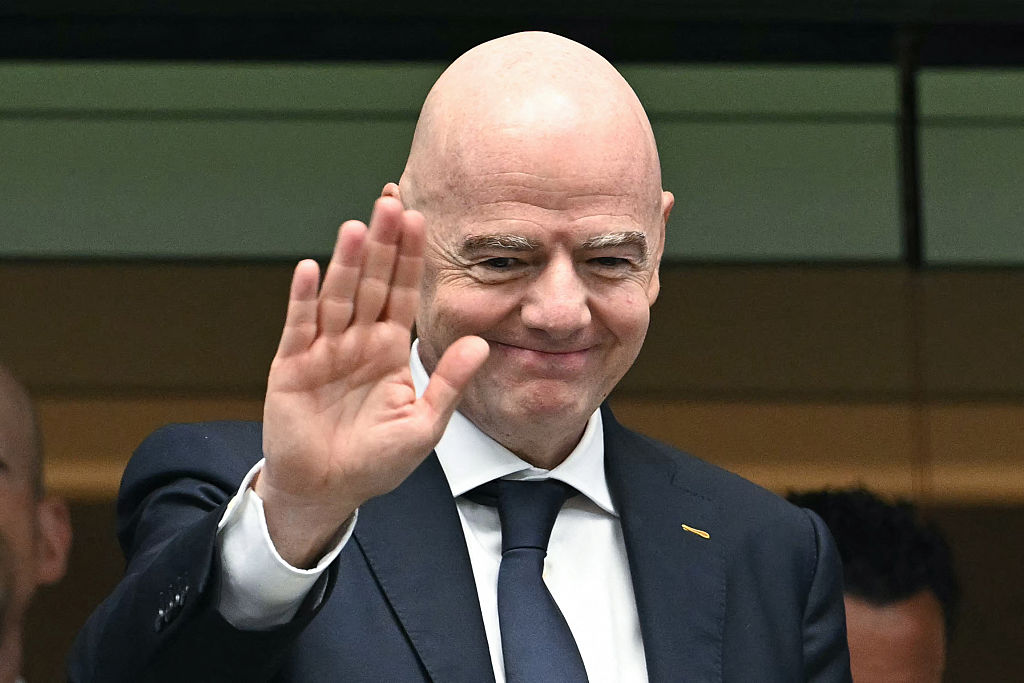
FIFA President Gianni Infantino gestures from the stands ahead of the World Cup semifinal match between France and Spain in Arlington, Texas, on July 14, 2026.

FIFA’s leadership have consistently tried to distort the game in order to chase money. Players’ unions and fan groups should decide the sport’s future, not bureaucrats trying to appeal to investors. (Ronaldo Schemidt / AFP via Getty Images)


Gianni Infantino must be shocked. He’s spent his near-decade-long tenure as FIFA president squeezing football for every cent possible. Now he’s weathering a global revolt against his leadership just for doing what he’s always done, after he quite literally tried to sell the World Cup to the highest bidder.

Popular criticism toward Infantino has long been brewing, reaching fever pitch during the rip-off convention that was the 2026 World Cup. But secretly developing a scheme to open the world’s most popular (and already extremely profitable) sporting event to private equity has proven too much even for some of his closest cronies.

Previously impressively indestructible, Infantino now genuinely seems to be in trouble, as one national football federation after another withdraws support for his reelection. The end of his reign would be cause for worldwide celebration. His ability to degrade an already corrupt and broken institution, and deeply harm football in the process, cannot be overstated.

But merely deposing FIFA’s beleaguered head isn’t enough. Football’s stewardship needs to be reimagined to become befitting, and more reflective, of the people’s game.

FIFA’s Folly

Using FIFA to print money at fans’ expense has long been Infantino’s modus operandi. Still, his latest move crossed a line for even some of football’s most corrupt and moneygrubbing actors. His proposed “FIFA Forward Enterprise” (FFE) plan would spin off a significant element of the global football governing body’s operations, including commercial rights for broadcast, sponsorship, and ticketing as well as “operational delivery of FIFA tournaments.” The newly minted division was meant to be controlled by FIFA, though 20 percent would be sold to private investors for $4.2 billion.

That might seem like an odd move considering FIFA is ostensibly a nonprofit; Infantino argued the scheme was about “the democratization of football worldwide.” The billions in revenue were surely just a fluke by-product. Anyone concerned that this was merely about lining Infantino’s pockets could rest assured, as there’d be plenty in it for FIFA’s 211 member associations too. Infantino promised an immediate $20 million windfall to each member for supporting the plan.

If exposing the World Cup to direct investment from private equity sounds shortsighted, or a deal that values FIFA’s commercial and operational assets at $20 billion seems undervalued when the 2026 World Cup alone raked in $15 billion in revenue, fear not: the best financial minds were on the case. JPMorgan Chase, which helped cook up the last big financial failure in football, the aborted 2021 breakaway Super League, spent a year fleshing out the plan in secret. Joshua Kushner, brother of Donald Trump’s son-in-law Jared Kushner, was primed to be to be a lead investor. When the deal fell apart, Kushner immediately moved on to trying to buy the Los Angeles Lakers, perhaps showing that his heart wasn’t really in football after all.

Infantino’s FFE proposal only survived, publicly, at least, for a lamentable three days. It was scrapped shortly after it was leaked by The Times, soon prompting overwhelming criticism. Even typical Infantino sycophants, like regional confederations CONCACAF (North and Central America and the Caribbean) and AFC (Asia) were quick to reject the plan. Top Infantino adviser at FIFA and former investment banker Carlos Cordeiro quit in disgust.

Whether football’s top brass are truly upset about preserving the sanctity of the game or merely frustrated about being cut out of the wheeling and dealing, they’re upset. Led by European federation UEFA, which has long been critical of Infantino, power brokers have seen enough blood in the water to try to force a coup.

State of Play

A civil war over Infantino’s leadership has embroiled global football, with clear geographic fault lines. UEFA, CONCACAF, and AFC released a joint statement that, while not naming the FIFA boss, was clearly aimed at him. It argued that “When trust is broken through deception, when an individual places himself above the collective that entrusted him with authority,” the duty of service to the “football family” has “been abandoned.”

UEFA has pledged to boycott FIFA tournaments and is pushing for Infantino’s ousting even after the failure of FFE. Even with the widespread criticism, many of the individual nations in these regional confederations — such as Mexico in CONCACAF or Qatar in AFC — have still voiced support for Infantino. CAF (Africa) has also rejected calls to push Infantino out. Nearly a decade of greasing wheels and courting partisans is paying off in a crisis.

While some prominent players, like England star Lucy Bronze, and the Fédération Internationale des Associations de Footballeurs Professionnels (FIFPRO), the global players’ union, have also come out against FIFA’s beleaguered president, Infantino looks to have shrugged off immediate calls to step down. He’s up for reelection next year, and the glory days of waltzing through elections unopposed are certainly over.

The international onslaught killed the FFE proposal but did little to dampen Infantino’s Trumpian approach to leadership. If anything, he’s doubling down. His initial response to the sell-off being revealed to the public was to try to force through a vote as quickly as possible to undercut resistance. When that failed and it degraded into a fight for his own survival, he pulled out all the stops: pushing to further expand the World Cup from forty-eight teams to sixty-four in a bid to win over direct support from nations who feel left out of the party.

Cognizant of Morocco’s regional importance in winning over neighbors and allies, Infantino also reportedly offered the country hosting rights for the 2030 World Cup final in exchange for support. Morocco is already primed to host the tournament along with Spain and Portugal, but a location for the final match has yet to be determined. What could be more fair and transparent than the FIFA president unilaterally handing it out in a back room in Rabat?

FIFA has internally largely rallied around Infantino and crushed any voices willing to dissent. Chief Operating Officer Kevin Lamour, who was publicly critical of the FFE plan, was just fired without FIFA providing a cause. As long as Infantino is still running things, he’ll do it with an iron fist.

Can Things Actually Get Better?

All of this is disturbingly extreme, even by Infantino’s standards. Still, it also continues in the same direction he’s long been dragging global football. The 2026 World Cup’s record ticket prices, commercial-focused “hydration breaks”, and god-awful halftime show were all dire indications of financialized football on steroids.

FIFA also courted shady finance partnerships, like a sponsorship from an obscure Abu Dhabi–based prediction market prior to the World Cup. Though not directly under FIFA’s purview, the football world has become awash in private equity cash as Infantino has technically been the game’s global steward.

The FFE scheme was cut from the same cloth, but Infantino was finally caught out for being too greedy. Still, it’s also worth recognizing that many of the same institutions that are now raking him over the coals were happy to watch the sport get watered down to make a quick buck, without ever worrying about footballing integrity.

UEFA might be marginally less likely to rip off fans than FIFA — thanks solely to large-scale fan protests — but the organization that recently reformatted the Champions League and introduced the Nations League clearly has an eye on the bottom line too. If a serious push for a breakaway tournament were actually made, led by the richest countries in the world and the global footballing elite, it would also deserve real skepticism.

Similarly, merely replacing the top of a corrupt organization is also unlikely to lead to much meaningful reform. Infantino himself came in on a wind of change, promising to clean up FIFA’s act in the wake of predecessor Sep Blatter’s corruption. If a reform-minded leader like Lise Klaveness, one of the more critical voices in global football, were to wrest control from Infantino, it would be a big win. Yet it’s an open question if reforming FIFA is possible, or if it needs to simply be blown up. In either case, global football desperately needs a real democracy to bring the people’s game back into the hands of the masses.

The status quo of each FIFA member nation getting one vote creates a veneer of equitable democracy. Yet this has long since devolved into FIFA figures buying off administrators of smaller nations in order to secure votes. Whatever happens, institutions like FIFPRO, which represents the men and women playing at all levels, ought to be involved, rather than just grinding players into a pulp in the name of more games and more profit.

Fan-based organizations like Football Supporters Europe also ought to have their say. Any organization that sees fans as merely customers to be fleeced and not the backbone of what makes football special — and events like the World Cup remotely possible — will only continue to falter under the weight of its own greed.

Drastic changes that can give fans and players an integral role in shaping football seem unlikely, but there’s never been a better opportunity. Infantino’s shaming could be a once in a lifetime chance to give football back to those who make it beautiful. Either the most oppressive and corrupt elements of these institutions will be destroyed and the game democratized, or private equity can continue its inexorable takeover of the sport the world loves.