Private Equity Is Buying Up the World of Football

Football confederations revolted against Gianni Infantino’s plan to sell off stakes in the World Cup. But the failure of his scheme won’t affect the bigger picture as private-equity firms gobble up football clubs in pursuit of short-term gains.
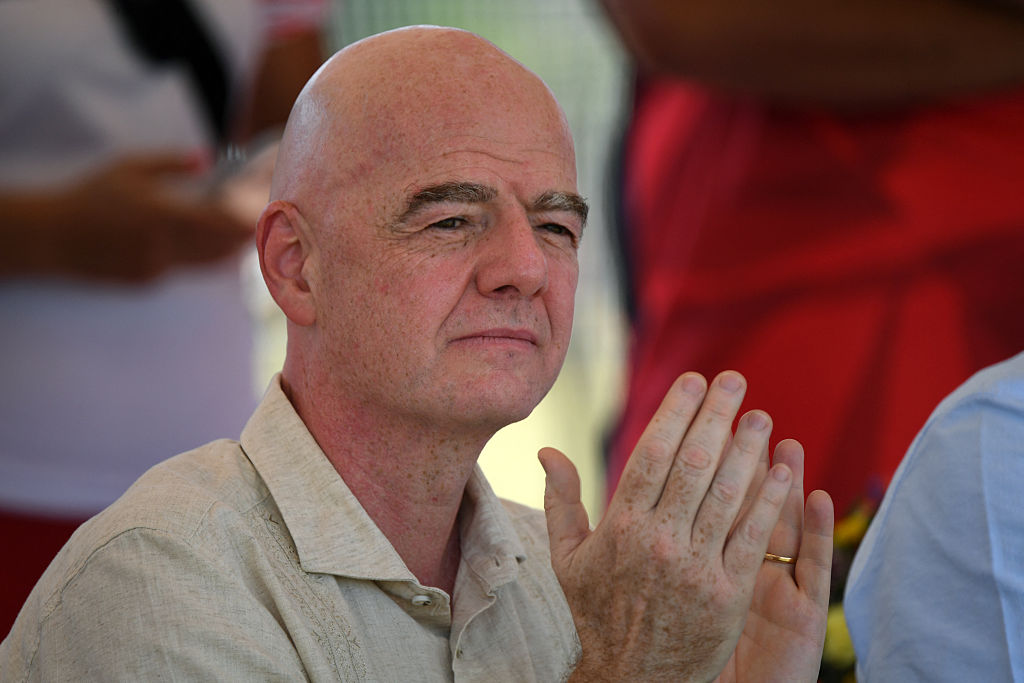
FIFA President Gianni Infantino applauds during a visit to a sports complex in Cali, Colombia, on August 7, 2026.

While football clubs are relatively high-risk assets, the willingness of fans to support their local teams will persist in spite of economic uncertainty. Private equity firms want to exploit this loyalty, and they’ve been investing heavily in the sport. (Jaime Saldarriaga / AFP)


Les Girondins de Bordeaux is one of France’s most historic and decorated football clubs, with a record of winning six League 1 titles and nurturing star players from Zinedine Zidane to Jules Koundé and Aurélien Tchouaméni. Yet at the start of the 2025–26 season, the club found itself on the verge of collapse, struggling to survive in the fourth tier of French football, after years of financial mismanagement, debt, and administrative sanctions.

The fate of Bordeaux exemplifies a broader trend across professional football where financially fragile teams have been pushed to insolvency, accelerated by the pandemic. However, Bordeaux still possesses one of the most respected youth academies in France, an underused stadium that seats 42,000, and a loyal local fan base (including my own family). Earlier this month, Sparta Capital, a British-based investment firm, bought the club for one symbolic euro (after raising €10 million to buy its debt).

This “phoenix strategy,” a financial-speak term for the practice of private equity firms buying up struggling organizations to turn them around, has become an increasingly important phenomenon in the economy of the world’s most popular sport. It has attracted much less attention than Gianni Infantino’s abortive scheme to sell off rights to the World Cup that is still convulsing the world of football.

A New Class of Owners

Over the past three decades, football increasingly has moved from local ownership to a new set of proprietors: billionaires, Gulf sovereign wealth funds, and Chinese state-backed capital. Some, like Bordeaux’s Gérard López, mismanaged clubs and ran them into the ground.

Others — notably the owner of Paris Saint-Germain (PSG), Qatar Sports Investment — poured in so much money that it inflated costs across the sport, notably for the transfers or salaries of players. It became difficult or impossible for competitors to keep up without risking financial ruin. Having increasingly dominated the French league in the fifteen years since its ownership change, PSG became only the second team to retain the European Cup since 1990 after defeating Arsenal in this year’s final.

Over the last decade, there has been a new trend, with private equity firms, primarily American, buying football institutions. These actors have invested over €10 billion in European football since 2016, and financial firms now own 36 percent of all clubs across Europe’s top five leagues (England, Spain, Germany, Italy, and France). While Europe is the sport’s most “mature market,” this dynamic has expanded across the world, from US Major League Soccer to the leagues of Mexico, Brazil, Saudi Arabia, and other countries.

According to economist Luc Arrondel, this trend can assume several different forms. Investment firms can acquire a majority stake — RedBird for Toulouse and AC Milan, Apollo Global Management for Atlético Madrid — or buy a minority portion, as Silver Lake did with Manchester City. Investors can even purchase commercial rights for entire leagues, as CVC Capital did for Spain’s La Lisa in 2021, or the right to operational functions: Sixth Street now has the right to participate in running Real Madrid’s Santiago Bernabéu stadium over the next twenty years.

Monetizing Football

This market is made up of traditional private equity firms, firms that specialize in sports investment, and other financial institutions such as hedge funds or venture capital companies. Private equity does not acquire clubs as personal trophies or a long-term asset. Instead, they invest other people’s money with the objective of generating a return, which often means reselling at a profit.

Elias Scott, a private equity professional, describes the contrasting logics at work:

Yes, individual owners may care about profits, but aside from soft power or fiscal interests, they usually buy clubs for “passion capital.” This means the biggest difference [in the ownership models] is time. Private equity firms are short-termists, their maximum horizon is ten years, and they are entirely focused on rentability. Individual owners can afford to be patient and have the deep pockets to reinvest, while private equity firms are beholden to their internal rate of return.

As a result, they usually look for ways to expand commercial revenues, monetize “assets” (such as stadiums, youth academies, fan bases, or legacies), and restructure the club’s management and finances to resemble those of a private company. As Scott puts it: “Since they won’t be there long, they are hyperfocused on things like quickly trading players or accumulating titles. This is a totally different approach to the sport.”

In addition to higher ticket prices and streaming games on pay-television platforms instead of free-to-air television, another concern for fans is the multiclub-ownership model (MCO). Half of England’s Premier League is now in some form of MCO structure. The model allows an owner to treat several clubs as parts of the same portfolio, moving players, coaches, and money between them.

For example, BlueCo, the investment group owned by Todd Boehly and Clearlake Capital, bought Chelsea and then Strasbourg. The firm uses the French club to develop young players and then “sells” them to Chelsea — a transaction between two parts of the same organization. This year, Strasbourg’s manager, Liam Rosenoir, also left the club midseason to take over at Chelsea.

Scott points to the harmful implications of the MCO model: “In multiclub ownership, the satellite teams essentially become subsidiaries of the flagship clubs. This goes against the culture of football, where every team has its own identity, and serves the interests of its fans.”

Balancing across assets is a familiar practice in the financial sector, but it raises fundamental questions about what happens to the sport when a club is turned into an investment product.

Infantino’s Plan

FIFA President Gianni Infantino was widely condemned for making the 2026 World Cup a consumer capitalist spectacle. This involved a host of tactics, from hiking ticket prices to astronomical levels and installing a dynamic pricing system to the addition of mandatory hydration breaks that doubled the ad revenue time for corporate sponsors.

In spite of international outrage, from his perspective, Infantino’s plan largely worked. Viewership broke historic records, and demand for tickets exceeded supply. This testifies both to the unmatched passion for football in comparison with any other sport and to the willingness of the wealthy to hijack this passion, without any qualms about what this could do to the game they claim to love.

In the weeks following the end of the World Cup, Infantino once again came under fire for a controversial proposal to spin off FIFA’s commercial interests into an investable vehicle called the FIFA Forward Enterprise (FFE). He believed that FIFA was still “undermonetized” when compared to the Union of European Football Associations (UEFA) or the Premier League and saw US sports leagues, notably the National Football League, as examples to follow.

Infantino drew up this plan in spite of the fact that FIFA is a nonprofit organization with no concerns about financial precarity (in fact, it has billions of dollars in reserves to hand). FIFA has since abandoned the proposal after international outrage and outright opposition from the European, North and Central American, and Asian member confederations, with threats of a World Cup boycott.

This abortive scheme did not take shape in isolation. It was the most visible manifestation to date of trends that have been unfolding at almost every other level of professional football.

Too Important to Sell

The increase in private equity investment comes at a time of excess liquidity in the sector. While football institutions are relatively high-risk assets, ones that take a long time to yield returns when compared to traditional private equity investments, the entertainment industry offers a uniquely “reliable” home for surplus capital amid growing financial and social uncertainty about artificial intelligence.

There will likely be much change and upheaval in the economy in the coming years, but the willingness of fans to support their local football team and go to games will persist. Private equity sees this as something to exploit.

Last month, when all fifty-five UEFA members announced a boycott of FIFA events as long as the proposal to privatize part of the organization remained alive, they explicitly rejected the capture of the sport by private investors or its treatment as an investment product:

Some things are simply too important to sell. The FIFA World Cup belongs to football. It always will. And so long as Europe has a voice, it will never be for sale.

This opposition was critical and commendable. But we should not only be concerned with these high-profile flash points. If we want to protect the right for everyone to participate in the beautiful game, we also need to pay attention to the less prominent but equally dangerous processes of financialization that are reshaping the people’s sport.