The Cuban Revolution Was a Revolution in Art and Culture
The Cuban Revolution was not just a transformation of the county’s political-economic order. It was a revolution in culture as well, bringing literacy to the masses and inspiring diverse artistic and intellectual ferment.
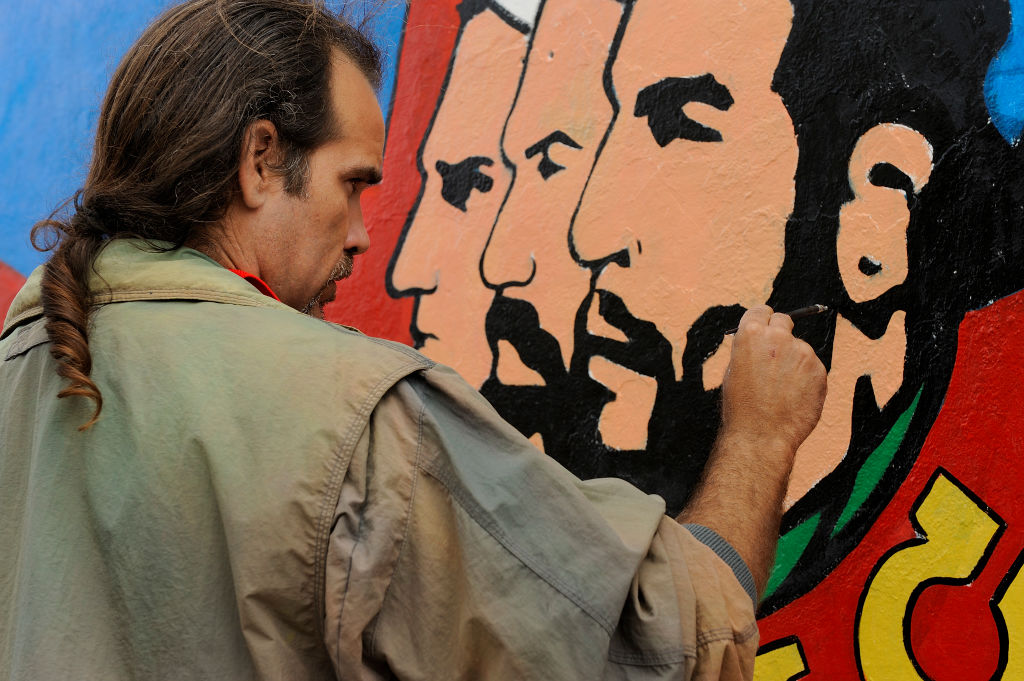
A painter works on a fresco on a Havana wall, February 17, 2010. (François Goudier / Gamma-Rapho via Getty Images)
As part of the Rumbo a Cuba, a Cuba solidarity mission — in which, for the first time, a civil society vessel crossed the Atlantic Ocean carrying solar energy equipment for a pediatric hospital in Havana — Jacobin contributor Simón Vázquez visited Abel Prieto at Casa de las Américas. A writer and essayist, former minister of culture of Cuba, and today president of this institution founded by Cuban revolutionary Haydée Santamaría, Prieto has been one of the central figures of the Cuban Revolution’s cultural policy for more than three decades. He chaired the National Union of Writers and Artists of Cuba (UNEAC), twice headed the Ministry of Culture, and served as an adviser to both Fidel and Raúl Castro.
In this discussion with Jacobin, Prieto takes stock of the cultural legacy of the Cuban Revolution, its errors — from the Padilla affair to the anti-gay repression of the Military Units to Aid Production (UMAP) — and the challenges of Cuba’s present: the blackouts, emigration, social media, and the battle over meaning.
Simón Vázquez
Let’s start at the beginning. How would you characterize the Cuba you came of age in, prerevolutionary Cuba?
Abel Prieto